



Plentiful Earth | Spiritual Store
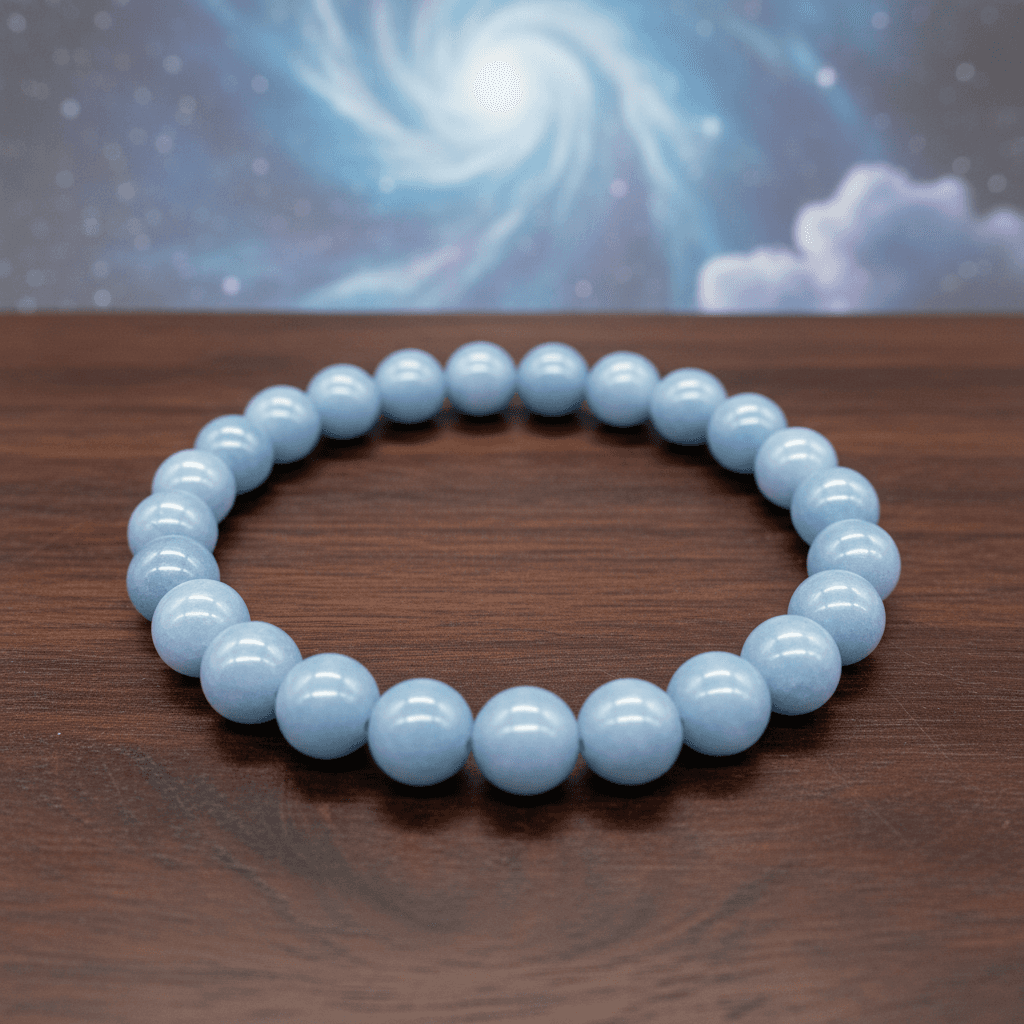
Angelite Bead Bracelet, 8mm
Angelite Bead Bracelet, 8mm- Primary Spiritual Use: Connection
- Secondary Spiritual Use: Peace
- Element: Water
- Planet: Moon
- Zodiac: Aquarius
- Chakra: Throat
- Ruling Day: Monday
- Tradition: Wiccan/eclectic
- Intent: Connection, Peace
Couldn't load pickup availability
Before anything else, the thing this listing has to tell you: angelite must never be put in water. It is blue anhydrite, a calcium sulfate, and water converts it back toward gypsum. A soak will not cleanse an angelite bead bracelet, it will quietly destroy it, and that is a fact the stone's soft, chalky pale blue does nothing to advertise.
With that said, it is a lovely material. These are 8mm rounds in the soft cornflower to dove blue the stone is known for, often with faint white veining or a patch of paler matrix running through a bead.
Key Features of the Angelite Bead Bracelet
A soft, matte blue. Angelite takes a gentle luster rather than a glassy shine, which is exactly why people like it. The color is closer to chalk or sky than to a polished gem.
Genuinely soft stone. Anhydrite sits around 3.5 on the Mohs scale, roughly the hardness of a copper coin. It marks more easily than most bracelet stones, so it wants gentler handling.
Visible natural variation. White veining, faint banding, and patches of lighter matrix are normal and are part of how you tell it apart from the dyed or reconstituted lookalikes.
Product Details
- Bead size: 8mm rounds
- Material: angelite, the trade name for blue anhydrite, a calcium sulfate
- Construction: strung on elastic cord, one size fits most
- Never immerse in water, and never make an elixir with it. Water chemically alters anhydrite and will pit, cloud, and eventually ruin the beads.
- Cleanse by dry methods only: smoke, sound, moonlight, dry salt, or a selenite plate.
- Soft at roughly 3.5 Mohs. Store it separately from harder stones, which will scratch it in a shared pouch.
- Remove before showering, swimming, washing up, and exercise. Sweat and humidity both count.
The Spiritual Significance
Angelite is a modern stone, and it is worth being clear about that. Blue anhydrite was only identified as a distinct decorative material in the twentieth century, and the name angelite is a trade name coined for the metaphysical market. There is no folk tradition behind it, no entry in Cunningham, and no inherited body of practice.
What there is, is a well established contemporary use. Modern practitioners work angelite as a stone of calm and of communication, most often associated with the throat, and it appears widely in meditative and devotional practice where a quieting influence is wanted. That is a real practice with real practitioners in it; it is simply a recent one.
We would rather tell you the correspondences are twentieth century than dress them up as ancient. Recent does not mean unreal, and a great many people work with this stone to good effect.
How To Use the Angelite Bead Bracelet
- Cleanse it dry before first wear. Pass it through incense smoke, rest it on selenite, sound a bell over it, or leave it out overnight under the moon. Never water.
- Wear it during quiet work rather than active work. Angelite suits meditation, journaling, and devotional practice more than it suits high-energy ritual.
- If your practice uses it for communication work, many practitioners hold the beads at the throat while speaking a petition aloud.
- Take it off before any contact with water at all, including washing your hands if you can remember. This is the single thing that determines how long it lasts.
- Store it in its own pouch, away from harder stones. At 3.5 Mohs almost everything else in your collection will scratch it.
Pairs Well With
- Angelite Wire Wrapped Pendants, Set of 5: the same stone in a pendant form, from the same material family.
- White Selenite Heart: a dry cleansing partner, and a stone with the same absolute no-water rule.
- Hematite Bead Bracelet, 4mm: a dark, dense counterweight in a stack, though store the two apart.
- Amazonite Wire Wrapped Point, Set of 5: another pale blue-green in the same quiet register.
- Black Brass Cone Incense Burner: for the smoke cleansing this bracelet actually requires.
Frequently Asked Questions
Can I cleanse it in water or salt water?
No, and this is the most important thing on the page. Angelite is anhydrite, and water converts it toward gypsum. Even a short soak will dull and pit the beads, and a long one destroys them. Use smoke, sound, moonlight, dry salt, or selenite instead.
Can I make a crystal elixir with it?
No. Beyond ruining the stone, calcium sulfate is not something to be steeping in water you intend to use. If you want the association in liquid form, use an indirect method where the stone never touches the water at all.
Why does mine have white streaks in it?
Those are natural. Angelite commonly shows white veining, faint banding, or patches of paler matrix, and that variation is one of the signs you are looking at real anhydrite rather than a dyed or reconstituted substitute. Uniform, flawless blue is the thing to question.
Is it really connected to angels?
The name is a trade name, coined in the twentieth century for the metaphysical market rather than inherited from any tradition. Plenty of practitioners do work it that way today and find it useful. We just would not tell you the association is ancient, because it isn't.
Why does it scratch so easily?
Because it is genuinely soft, around 3.5 on the Mohs scale, which is softer than a steel blade and far softer than quartz. Keys, other bracelets, and most stones in a shared pouch will all mark it. Store it on its own.


Spend $50 & enjoy guilt-free shopping with our free shipping on all orders. Get your favorite items delivered right to your door at no extra cost.