



Plentiful Earth | Spiritual Store
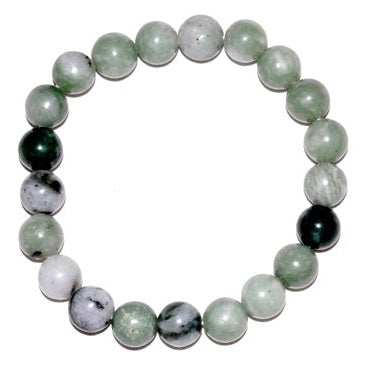
Green Jade Bracelet, 8mm | Heart Chakra & Good Fortune
Green Jade Bracelet, 8mm | Heart Chakra & Good Fortune- Primary Spiritual Use: Protection
- Secondary Spiritual Use: Intention
- Element: Spirit
- Planet: Sun
- Zodiac: Leo
- Chakra: Crown
- Ruling Day: Sunday
- Tradition: Wiccan/eclectic
- Intent: Protection, Intention
Couldn't load pickup availability
Jade has been revered for longer than almost any other stone in the archaeological record: carved, traded, and ceremonially significant in China, Mesoamerica, and the Pacific cultures of New Zealand and Hawaii for thousands of years before most other stones entered the spiritual vocabulary. In China, where jade's place in material and spiritual culture is most thoroughly documented, it was understood as the most perfect material substance: the embodiment of the five Confucian virtues (benevolence, wisdom, courage, justice, and purity), the nourisher of life, and the material most closely allied with the energy of the earth. The Emperor's most sacred objects were jade. The most honored dead were buried with jade. To give jade was to give the most meaningful of material gifts.
This 8mm bead bracelet brings green jade to the wrist in its most wearable format: round, polished beads strung on elastic cord, comfortable for all-day wear. The 8mm bead size is substantial enough to feel present on the wrist without being heavy. Green jade's color corresponds to the heart chakra and the wood element in Chinese cosmology: growth, vitality, the renewal of living things, and the harmony that comes from being in right relationship with the life force.
Key Features
8mm jade beads for substantial, comfortable daily wear. The 8mm bead size provides a visually clear and physically substantial bracelet without the weight or bulk of larger formats. Round, polished beads minimize sharp edges that might catch on clothing.
Heart chakra and wood element correspondence. Green jade's color connects it to the heart chakra in Western crystal practice and to the wood element in Chinese Five Element theory: both systems associate this green with growth, vitality, emotional warmth, and the kind of balanced flourishing that comes from being in healthy relationship with one's own life force and with others.
One of the most cross-culturally validated lucky and protective stones. No other stone approaches jade's breadth of documented protective and luck-drawing use across Asian, Mesoamerican, and Pacific cultures. This cross-cultural consistency reflects genuine qualities in the stone that multiple independent traditions recognized independently.
Product Details
- Stone: Green jade
- Bead size: 8mm
- Stringing: Elastic cord
- Fit: Standard elastic chip/bead bracelet sizing
- Color: Green (natural variation in shade)
- Note: Jade occurs in two mineral species — nephrite and jadeite — and in a range of green tones; individual bead color will vary within the green range
The Spiritual Significance
In Chinese tradition, jade is not a metaphor for virtue: it is virtue in material form. The philosopher Confucius described jade's qualities as corresponding directly to the gentlemanly virtues: its warmth to benevolence, its translucence to knowledge, its unyielding quality to courage, its sharpness when broken to justice, and its purity to virtue itself. Wearing jade was not decoration but aspiration: the material presence of the qualities you are working to embody.
This understanding persists in contemporary Chinese cultural practice, where jade bangles and bracelets are given at significant life events (birth, coming of age, marriage) as objects meant to be worn through a lifetime, absorbing the wearer's life history and providing continuous protective and beneficial energy. A jade bangle that breaks is understood to have absorbed a harm that would otherwise have reached the wearer: the stone sacrificed itself for its bearer.
In Wiccan and contemporary crystal practice, green jade's correspondences center on the heart chakra: emotional healing, the cultivation of love and compassion, protection against negativity that operates through emotional channels, and the quality of peaceful confidence that comes from feeling genuinely supported by the natural world. In Mesoamerican tradition (Olmec, Maya, Aztec), jade was more sacred than gold: the material of rain, of life force, of the divine green of growing things.
How To Use
- Wear consistently for long-term benefit. In Chinese tradition, jade improves with wear: the oils from the skin polish it, and the stone becomes more beautiful and more closely attuned to its wearer over time. Daily wear is not just appropriate; it is part of how jade is meant to be used.
- Set your intention at the wrist. Before putting the bracelet on each morning, take a moment to hold it, name the quality you want to carry into the day (peace, good fortune, emotional balance, protection), and then put it on with that awareness.
- Heart chakra meditation. Hold the bracelet or wear it during heart chakra meditations: visualize green light emanating from the stone and filling your chest, expanding outward with each breath. Jade's green color makes it a natural visual anchor for this practice.
- Cleanse gently. Jade can be cleansed with a brief rinse in cool water, a rest in moonlight, or smoke from sage or sandalwood incense. The elastic stringing means prolonged soaking should be avoided; brief rinse and thorough drying is appropriate.
- Do not share. In Chinese tradition, personal jade bracelets are closely attuned to their wearer and should not be shared or worn by others. Whether you approach this as literal or as a sensible energetic hygiene practice, keeping your jade bracelet personal is consistent with how the stone is traditionally understood.
Pairs Well With
- Shungite Tumbled Pendant — Shungite's absorptive grounding at the chest pairs with jade's heart-warming protective energy at the wrist for a complementary daily wear combination.
- Bloodstone Chip Bracelet — Bloodstone's root chakra courage and jade's heart chakra peace and protection make a deeply grounded, courageous, emotionally balanced combination for daily wear.
- Amethyst Chip Bracelet, 3 1/8" — Layer jade (green, heart chakra) with amethyst (purple, crown chakra) for a full-chakra-range wrist combination that grounds spiritual awareness into emotional warmth.
- Metaphysical Bracelets Collection — Browse PE's full bracelet collection to build out a complementary wrist stack around this jade bracelet.
- Love & Attraction Collection — Jade's heart chakra energy and associations with love, peace, and harmonious relationships pair naturally with PE's love and attraction ritual tools.
History & Occult Background
Jade as a material encompasses two distinct minerals that were historically treated as a single substance and only distinguished mineralogically in the 19th century: nephrite (a calcium magnesium silicate) and jadeite (a sodium aluminum silicate). Nephrite is the traditional jade of China, New Zealand (where Māori call it pounamu and regard it as a treasure), and many Pacific cultures. Jadeite is the more prized variety in East Asia and was the principal jade of Mesoamerica. Both are dense, hard, and work-resistant, which contributed to their high value in cultures that lacked metal tools for carving.
Archaeological evidence of jade use in China dates to approximately 7000 BCE; by the Neolithic period, jade was already the most important material in Chinese ceremonial life. The nephrite deposits of Hetian (Khotan) in present-day Xinjiang were among the most significant jade sources for Chinese civilization; the Silk Road carried both raw jade and carved jade objects across Central Asia. In Mesoamerica, jadeite deposits in Guatemala were mined by Olmec civilization as early as 1000 BCE and traded throughout the Maya, Zapotec, and Aztec worlds as a material more sacred and more valuable than gold.
In New Zealand, pounamu (greenstone/jade) is a taonga (treasure) with deep cultural and spiritual significance for Māori: carved into pendants (hei-tiki), weapons, and tools, it was accumulated as a form of wealth and given as a mark of deep relationship and esteem. The giving of pounamu creates a lasting connection between giver and receiver.
The consistency of jade's sacred status across three entirely independent civilizations — China, Mesoamerica, and the Pacific — argues for something in the material itself that multiple cultures recognized independently: its density, its warmth when held, its resistance to breaking, and its range of green colors that so directly evoke the color of living things.
Frequently Asked Questions
Is this nephrite or jadeite? Please confirm with Plentiful Earth. Both are genuine jade; jadeite tends toward more vivid greens and is the rarer and more expensive of the two. Nephrite is the traditional Chinese jade with the longer ceremonial history. Both are appropriate for crystal work.
How do I know this is genuine jade and not serpentine or aventurine? Genuine jade (both nephrite and jadeite) is significantly harder (6 to 7 on the Mohs scale) and denser than serpentine (3 to 4) or green aventurine (quartz, 7 but lighter). Jade feels heavy for its size and warm to the touch. If provenance is important to you, purchase from suppliers who can confirm the stone's identity. Plentiful Earth can confirm the specific stone material if needed.
What shade of green is this bracelet? Natural jade occurs in a range of green tones from pale celadon to deep forest green; the specific hue depends on the mineral composition and origin of the stone. Individual beads will vary somewhat within the green range. The listing confirms green; for exact color matching, contact PE.
Is jade appropriate as a gift? Jade is one of the most traditional gift stones in Chinese culture, where it has been given at births, weddings, and significant life events for millennia. Its associations with longevity, protection, and good fortune make it a meaningful gift for anyone.
Can I wear jade in water? Brief water contact is fine and will not damage jade. Prolonged soaking of the elastic-strung bracelet is not recommended, as it degrades the elastic over time. Remove before swimming, and rinse and dry thoroughly after any water contact.
Spend $50 & enjoy guilt-free shopping with our free shipping on all orders. Get your favorite items delivered right to your door at no extra cost.