



Plentiful Earth | Spiritual Store
Moldavite Untumbled Stone, 25.3 g
Moldavite Untumbled Stone, 25.3 g- Primary Spiritual Use: Enlightenment
- Secondary Spiritual Use: Connection
- Element: Water
- Planet: Moon
- Zodiac: Scorpio
- Chakra: Heart
- Ruling Day: Monday
- Tradition: Modern crystal practice
- Intent: Transformation, Unblocking
Couldn't load pickup availability
Moldavite is not a crystal, and it is not a meteorite. It is a tektite: natural glass, formed about fifteen million years ago when an asteroid struck what is now southern Germany hard enough to melt the ground and throw it into the sky. The molten rock cooled in flight and fell across Bohemia and Moravia, in the modern Czech Republic. It takes its name from the Vltava, the Moldau, where the first pieces were found.
This is a raw, untumbled piece of 25.3 grams: the smaller of the two loose pieces we carry, for practitioners who want genuine material without committing to a fifty gram stone.
Key Features
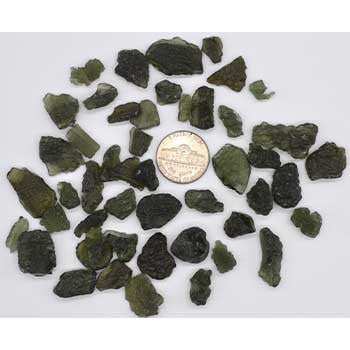
A raw 25.3 gram piece. Untumbled, with the natural etched surface intact. Every piece is unique, and yours will not be identical to the photograph.
Genuinely finite. One impact, one strewn field, no resupply. Czech mining is restricted and the accessible deposits are working out. The price follows from real scarcity, not from fashion.
Not a mineral. Moldavite is amorphous glass with no crystal lattice. The trade calls it a crystal from habit; it is not one, and we would rather be accurate.
Product Details
- Weight: 25.3 grams
- Form: Raw, untumbled
- Material: Tektite, natural silica glass
- Origin: Bohemia and Moravia, Czech Republic
- Sourcing: Sold to us as moldavite by our supplier. Individual pieces are not independently tested. The FAQ below explains how to check a piece yourself.
- SKU: GUMOL25
The Spiritual Significance
Moldavite carries no folk tradition. It has no entry in Cunningham, no planetary or elemental attribution in the older sources, and no lineage of practice behind it. Its reputation is a product of the late twentieth century, when it entered the crystal trade and rapidly acquired a name as the most intense stone on the shelf.
What practitioners describe is disruption rather than comfort: acceleration, abrupt change, the collapse of arrangements that were not working, and the hard clarity that comes after. It is not spoken of as a soothing stone by anyone. The lore of the moldavite flush, a heat or pressure some report on first handling, is lore, and we pass it on as something people say rather than something we promise.
The tradition's own advice is to pair it with a grounding stone and not to sleep beside it. That caution comes from enough directions to be worth keeping even if you hold the rest loosely.
How To Use
- Begin with short contact. Brief handling rather than sustained wear, especially at first.
- Ground alongside it. Black tourmaline or hematite within reach. Anchor before you accelerate.
- Altar, not bedside. The standard counsel is not to sleep with it.
- Treat it as glass. It is brittle and it chips. Keep it away from harder stones in storage.
- Cleanse it dry. Smoke, sound, or moonlight. No water, no salt; salt abrades the etched surface that gives the piece its character.
Pairs Well With
- Moldavite Untumbled Stone, 50 g. The larger raw piece, for collectors and for altar work at scale.
- Moldavite Pendant. The wearable form, for carrying the material rather than keeping it in one place.
- Moldavite Adjustable Ring. Set for daily wear and adjustable to fit.
- Black Tourmaline Tumbled Stones, 1 lb. The grounding counterweight the tradition asks for whenever moldavite is on the table.
- Moldavite Incense Sticks by HEM. Named for the stone and containing none of it, for setting a tone around the work.
History and Background
The Ries impact struck what is now Bavaria roughly fifteen million years ago. The crater survives, about fifteen miles wide, with the town of Nordlingen sitting inside it. The strike vaporized and melted the surface rock, and part of that melt was flung hundreds of kilometers east, cooling into glass on the way.
Bohemian farmers turned the pieces up in their fields for centuries, and worked moldavite appears in Stone Age sites as amulets, which makes it one of Europe's older human curiosities even though its spiritual reputation is only decades old. It was formally described in 1786 and named moldavite in 1900.
Frequently Asked Questions
How can I tell if a piece of moldavite is genuine? Specific gravity is the strongest home test: real moldavite runs about 2.32 to 2.40, while common green bottle glass sits closer to 2.5, and a kitchen scale with water displacement will get you close enough to catch a fake. Then look at the surface, which should be hackly, wrinkled, and deeply etched rather than smooth, and should show no mold seams. Under magnification, genuine material shows elongated wormlike silica threads and irregular bubbles; glass fakes show perfectly round ones. Finally, price: moldavite is expensive because it is finite, and anything far below market is telling you something.
Is moldavite a meteorite? No. This is the most common misconception about it. The material is terrestrial rock, melted by an impact and thrown clear. What came from space was the energy, not the substance.
Is it a crystal? No. It is amorphous glass with no lattice.
Why is it expensive? One impact, one field, no resupply. Restricted mining and depleting deposits. The scarcity is real.
How does this compare to the 50 gram piece? Same material, roughly half the mass. The choice is about how much stone you want, not about quality.
Spend $50 & enjoy guilt-free shopping with our free shipping on all orders. Get your favorite items delivered right to your door at no extra cost.