



Buddhism Oracle by Sofan Chan, 36 Cards
Buddhism Oracle by Sofan Chan, 36 Cards- Primary Spiritual Use: Wisdom
- Secondary Spiritual Use: Peace
- Element: Water
- Planet: Moon
- Zodiac: Cancer, Pisces
- Chakra: Third Eye
- Ruling Day: Monday
- Tradition: Eastern devotional
- Intent: Wisdom, Peace, Divination
Couldn't load pickup availability
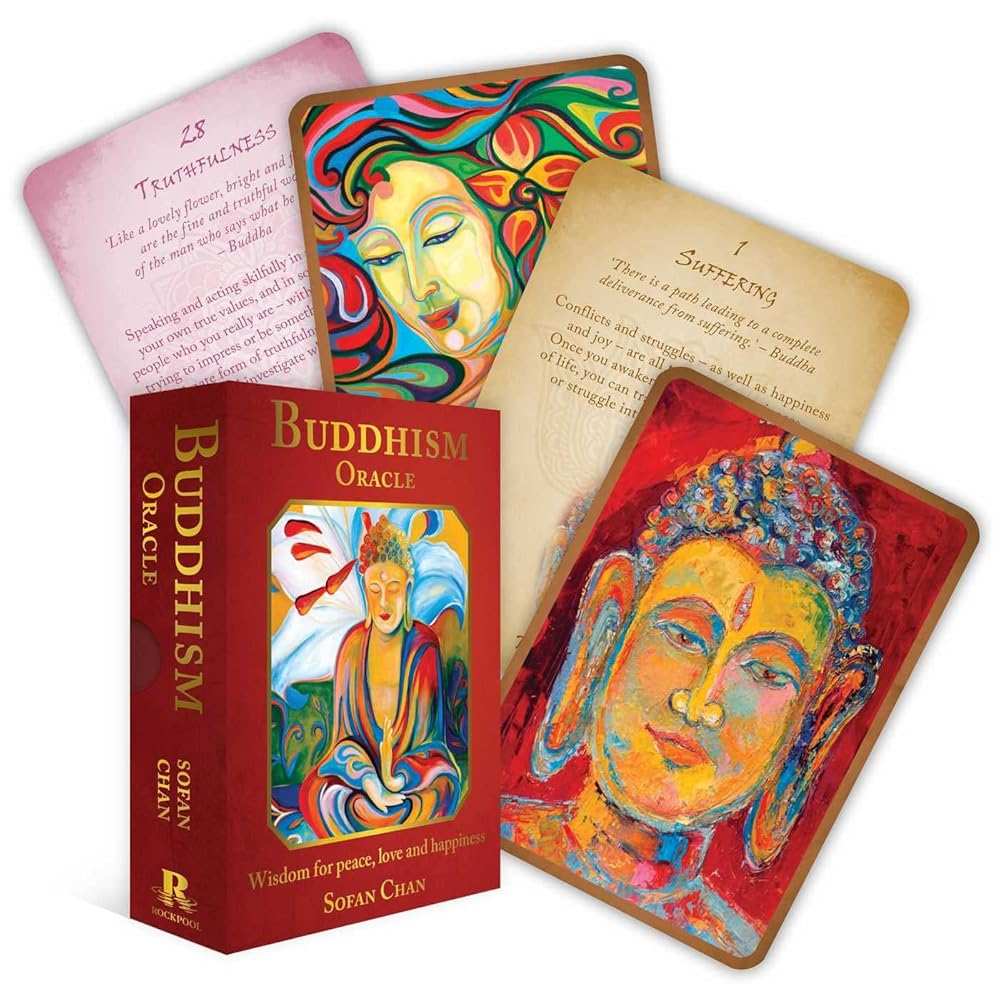
A single card, a single Buddhist principle, and a few quiet minutes: that is the whole practice this deck asks of you. The Buddhism Oracle by Sofan Chan is a 36-card oracle deck that distills core teachings of Buddhism into approachable daily prompts, grouped into four sections: Truth, Purity, Contemplation, and Cultivation. Each card carries a serene Buddha image and a principle to sit with, so a morning draw becomes a small act of contemplation rather than a prediction.
You do not need to be Buddhist to use it, and if you are, it makes a gentle companion to practice. Draw the card you feel pulled toward, read it aloud, and let the day take its shape around it.
Key Features of the Buddhism Oracle
36 cards in four sections. The Buddhism Oracle sorts its prompts into Truth, Purity, Contemplation, and Cultivation, so you can draw from the whole deck or work one section at a time as a focused practice.
Plain, usable prompts. Each card states one core principle in everyday language, which makes it an easy introduction to Buddhist teaching and a quick daily reflection for readers who already know the ground.
Compact and travel-friendly. The deck is small enough for a desk drawer or a coat pocket, so a one-card draw can happen on a train, at lunch, or before a hard conversation.
Product Details
- Card count: 36
- Sections: Truth, Purity, Contemplation, Cultivation
- Creator: Sofan Chan
- Publisher: Rockpool Publishing
- Published: 2024
- Guidebook: 112 pages (per catalog data)
- ISBN: 9781922785763
- Weight: about 12.8 oz
The Spiritual Significance
The Buddhism Oracle is used for daily contemplation and mindful decision-making in contemporary oracle practice, with its prompts drawn from Buddhist teaching. You draw a card, read the principle, and ask how it applies to the situation in front of you. The answer comes from your own reflection, which is very much in the spirit of the teachings the cards borrow from.
Buddhism itself is a living religion roughly 2,500 years old, founded on the teachings of Siddhartha Gautama, the Buddha, and centered on the Four Noble Truths and the Eightfold Path. Oracle cards are not part of traditional Buddhist practice; they are a modern contemplative tool that uses Buddhist vocabulary as a doorway. Sofan Chan's deck is honest about that, presenting itself as an introduction rather than a teaching lineage.
If the cards open something in you, the deeper path is best learned from practitioners within the tradition: a sangha, a teacher, a temple near you. In the meantime, the deck offers what it promises, a principle a day and a quiet minute to hold it.
How To Use the Buddhism Oracle
- Sit somewhere quiet with the Buddhism Oracle and take three slow breaths before you touch the cards; the pause is part of the practice.
- Shuffle gently and set a soft intention, something like "show me what to carry today," rather than a yes-or-no question.
- Draw the card you feel pulled toward and read its principle aloud. Saying the words gives them a little more weight than reading silently.
- Ask how the principle applies to today: a conversation you are dreading, a choice you keep postponing, a habit you want to notice.
- Choose one small, compassionate action that follows from the card, and let that be the reading's conclusion.
There is no wrong way to draw. If a card keeps returning, or if you want to work through one section slowly over a month, follow that pull; the deck is patient.
Pairs Well With
- Buddha Statue Blue Gold, 4.5 Inches: A small altar figure gives your daily draw a place to happen and a face to return to.
- Om Pewter Pocket Stone: Carry the day's principle in your pocket alongside a stone stamped with the sacred syllable.
- Meditation for Beginners by Stephanie Clement: If the Contemplation cards make you want a sitting practice, this is a friendly place to start.
- Buddhist Temple Perfume Oil by Escential Essences, 0.5 oz: A temple-scented oil on the wrists before the draw marks the minute as set apart.
- Buddha and Tree of Life Leather Journal with Latch: A journal to record each card's principle and the small action you chose.
Frequently Asked Questions
How many cards are in the Buddhism Oracle?
The Buddhism Oracle has 36 cards, divided into four sections: Truth, Purity, Contemplation, and Cultivation. Unlike tarot, which is fixed at 78 cards, oracle decks vary in size and structure by design, and 36 is a comfortable number for a deck meant to be drawn from daily rather than laid out in complex spreads.
How do I cleanse an oracle deck?
Cleanse an oracle deck the same way you would a tarot deck: pass it through incense smoke, rest it on a selenite wand overnight, or hold it and breathe slowly over the cards with the intention of clearing them. Cleanse the Buddhism Oracle when it is new, after lending it, or whenever your draws feel scattered.
How do I shuffle the Buddhism Oracle?
Shuffle the Buddhism Oracle with a gentle overhand shuffle, dropping small sections from one hand into the other, or spread the cards face down and swirl them before gathering the deck. Both methods protect the card edges. With 36 cards the deck is easy to handle, so shuffle until it feels settled and then draw.
How do I use oracle cards if I am not Buddhist?
You can use the Buddhism Oracle without being Buddhist; the deck was designed as an accessible introduction to core teachings. Draw one card, read the principle, and reflect on how it fits your day. If the ideas draw you further in, the fuller path is best learned from practitioners within the tradition.
What is the difference between an oracle deck and a tarot deck?
An oracle deck follows its creator's own structure, while a tarot deck always has 78 cards in Major and Minor Arcana. The Buddhism Oracle uses 36 cards in four themed sections, each with a single principle, so it reads more like a daily prompt than a predictive spread. Many readers keep both and use them together.
Is this deck respectful to Buddhist practitioners?
The Buddhism Oracle presents Buddhist principles as prompts for reflection rather than claiming to be a Buddhist practice, and it does not imitate ritual or liturgy. Practicing Buddhists often enjoy it as a light daily reminder, while newcomers use it as a doorway. Either way, hold the teachings with the care a living religion deserves.

Spend $50 & enjoy guilt-free shopping with our free shipping on all orders. Get your favorite items delivered right to your door at no extra cost.