



Plentiful Earth | Spiritual Store
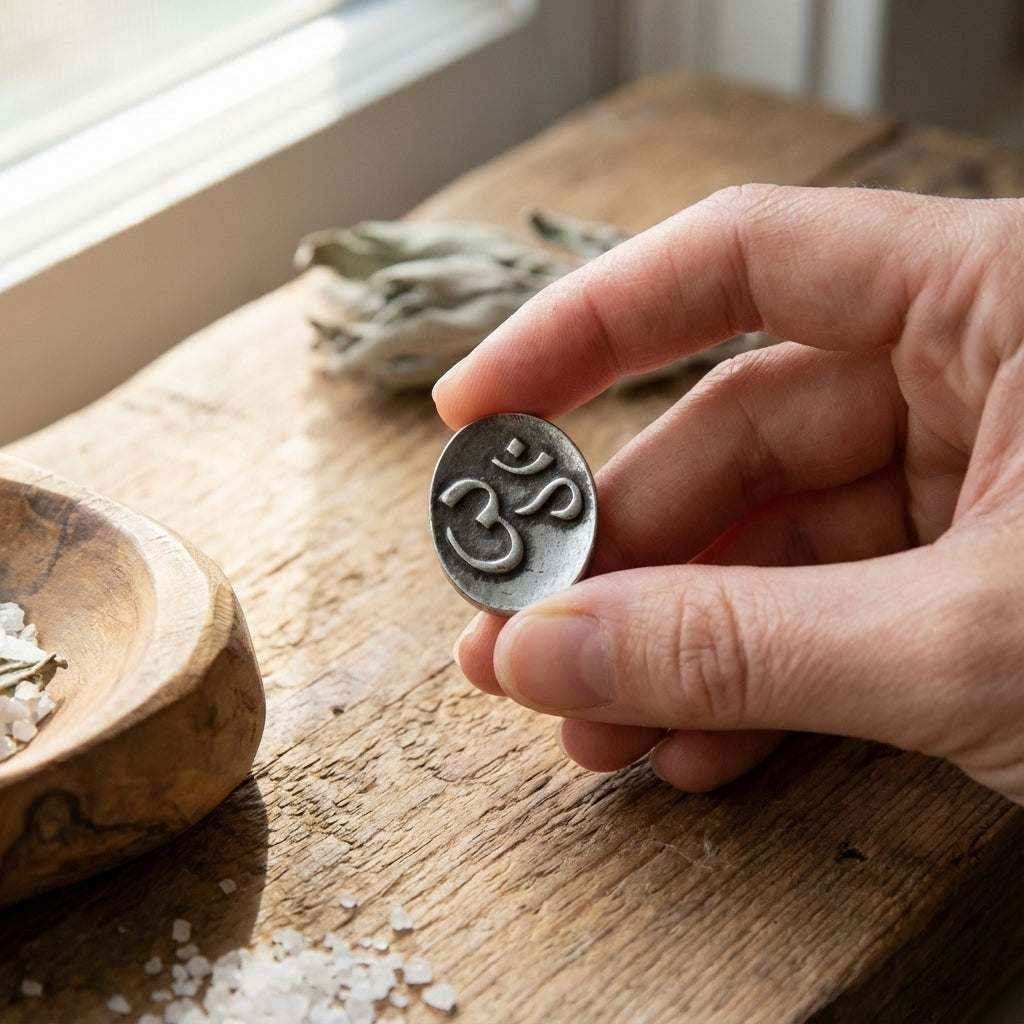
Om Pewter Pocket Stone, Sacred Syllable Token
Om Pewter Pocket Stone, Sacred Syllable Token- Primary Spiritual Use: Connection
- Secondary Spiritual Use: Peace
- Element: Spirit
- Planet: Sun
- Zodiac: Leo
- Chakra: Crown
- Ruling Day: Sunday
- Tradition: Eastern devotional
- Intent: Connection, Peace
Couldn't load pickup availability
Om is the oldest sound in the room. In the Hindu and yogic traditions it is the primordial syllable, the vibration the universe is said to have unfolded from and the sound chanted at the open and close of countless meditations and mantras. This pewter pocket stone carries that single syllable in a form you can hold: about an inch across, cast with the Om symbol, smooth on every edge, sized for a pocket, a palm, or a corner of the altar.
Carry it as a quiet companion through the day, and let your thumb find the sound your voice does not always have time to make.
Key Features
- Pewter cast with the Om symbol at the face, smooth on every edge for daily handling.
- 1" x 5/8", the working size for pocket, palm, or altar carry.
- Lead-free pewter, made in the USA.
- A tactile anchor for meditation, mantra practice, and daily centering.
- Sits comfortably alongside Hindu and yogic mantra tradition, modern meditation practice, and eclectic altar work.
Product Details
This pocket stone is cast from lead-free pewter in the United States. The face shows the Om (Aum) symbol cut into the metal, so it reads by touch as well as by sight. The reverse is plain. Dimensions are about 1 inch by 5/8 inch, light enough to forget in a pocket and heavy enough to find again. Like all pewter, it develops a soft patina over years of handling, which most carriers consider part of its character.
Spiritual Significance
Om, also written Aum, is the most sacred sound in the Hindu tradition and one of the most widely used in the world. It appears in the Upanishads as the syllable that holds the whole of reality, past, present, and future, and it opens and closes mantras, prayers, and meditation sessions across Hinduism, Buddhism, Jainism, and Sikhism. The three sounds of A-U-M are often read as the cycle of creation, preservation, and dissolution, with the silence that follows standing for the absolute beyond all three.
Chanting or contemplating Om is, at heart, a practice of returning: the sound gives the breath and the attention one steady thing to rest on. To carry the symbol in pewter is to carry that pointer through the day, a reminder of the sound even when the room is not right for making it aloud. If you come to Om from a yoga practice, a meditation habit, or an eclectic path rather than from a Hindu lineage, the respectful approach is the same as with any borrowed sacred symbol: carry it with knowledge of where it comes from, and use it as a focus rather than a claim.
The pocket-stone form is a modern continuation of a very old habit: a small, smooth, reachable object that keeps a sacred thing close to the hand.
How To Use
There is no single right way to carry an Om stone. A few practices that map to real tradition:
For meditation, hold the stone in your palm as you settle, and let it be the cue to take the first slow breath. Some practitioners sound a single Om aloud while holding it, letting the metal rest against the vibration in the chest.
For mantra practice, keep it beside your mala or in the same pocket, a tactile bookend to the recitation.
For daily centering, slip it in your pocket on the way out the door and find it again at a stoplight, in line at the grocery, in the long minutes before a difficult conversation. The thumb finds the symbol, the breath settles a notch, and you continue.
Cleanse it however your practice favors. Pewter is non-porous, so smoke, moonlight, sound, or a brief pass under running water all suit it. Many practitioners simply hold the stone and re-sound their intention.
Pairs Well With
- Buddha Coin Pewter Pocket Stone: a sibling pocket stone for mindfulness and the middle way, a natural companion for meditation carry.
- 7 Chakra Tumbled Stones, Set of 7: the full chakra spectrum for layered meditation and energy work alongside the stone.
- Positive Energy Reiki Charged Pillar Candle: a flame to light for a longer sitting while the stone rests in the palm.
- Calming Gemstone Set, 5 Stones: a settling pouch for the days the meditation is mostly about coming down.
- Black Velveteen Bag: a soft place to keep the stone with your mala and meditation tools.
Frequently Asked Questions
What does the Om symbol mean?
Om (Aum) is the primordial sound of the Hindu tradition, treated as the vibration underlying all of reality and used to open and close mantras and meditations across Hinduism, Buddhism, Jainism, and Sikhism. The three sounds A-U-M are often read as creation, preservation, and dissolution, with the silence after standing for the absolute.
Is it appropriate to carry Om if I am not Hindu?
Om is widely used in yoga and meditation worldwide. The respectful approach is the same as with any sacred symbol from a living tradition: carry it knowing where it comes from, treat it with care, and use it as a genuine focus for practice rather than decoration.
Why is it called a pocket stone if it is metal?
"Pocket stone" describes the form, not the material. Like worry stones and prayer beads, this pewter piece is meant to be touched, held, and carried. The name is a category for small, reachable, handheld objects.
What is the difference between this and the other pewter pocket stones?
They share one form, 1 by 5/8 inch lead-free pewter, with a different symbol on each face. The Buddha reads as mindfulness, the Pentagram as witchcraft protection, the Hamsa as evil-eye protection. The Om is the one that anchors to mantra, meditation, and the Hindu and yogic traditions of sacred sound.
Will the pewter tarnish?
Pewter develops a soft patina with handling, which many carriers welcome as a sign of a stone that has been worked with. To brighten it, polish gently with a soft cloth; avoid harsh silver polishes, which are too aggressive for pewter.


Spend $50 & enjoy guilt-free shopping with our free shipping on all orders. Get your favorite items delivered right to your door at no extra cost.