


Plentiful Earth | Spiritual Store
Copper Dowsing Rods (L-Rods), Set of 2, 12 Inch
Copper Dowsing Rods (L-Rods), Set of 2, 12 InchYour cart is $12.05 away from free U.S. shipping.Other rates are calculated at checkout.
- Primary Spiritual Use: Psychic
- Secondary Spiritual Use: Intuition
- Size: 12 in
- Material: Copper
- Element: Water
- Planet: Venus
- Zodiac: Taurus, Libra
- Chakra: Third Eye
- Ruling Day: Friday
- Tradition: European folk magic
- Intent: Divination, Intuition, Psychic
Couldn't load pickup availability
Works Well With


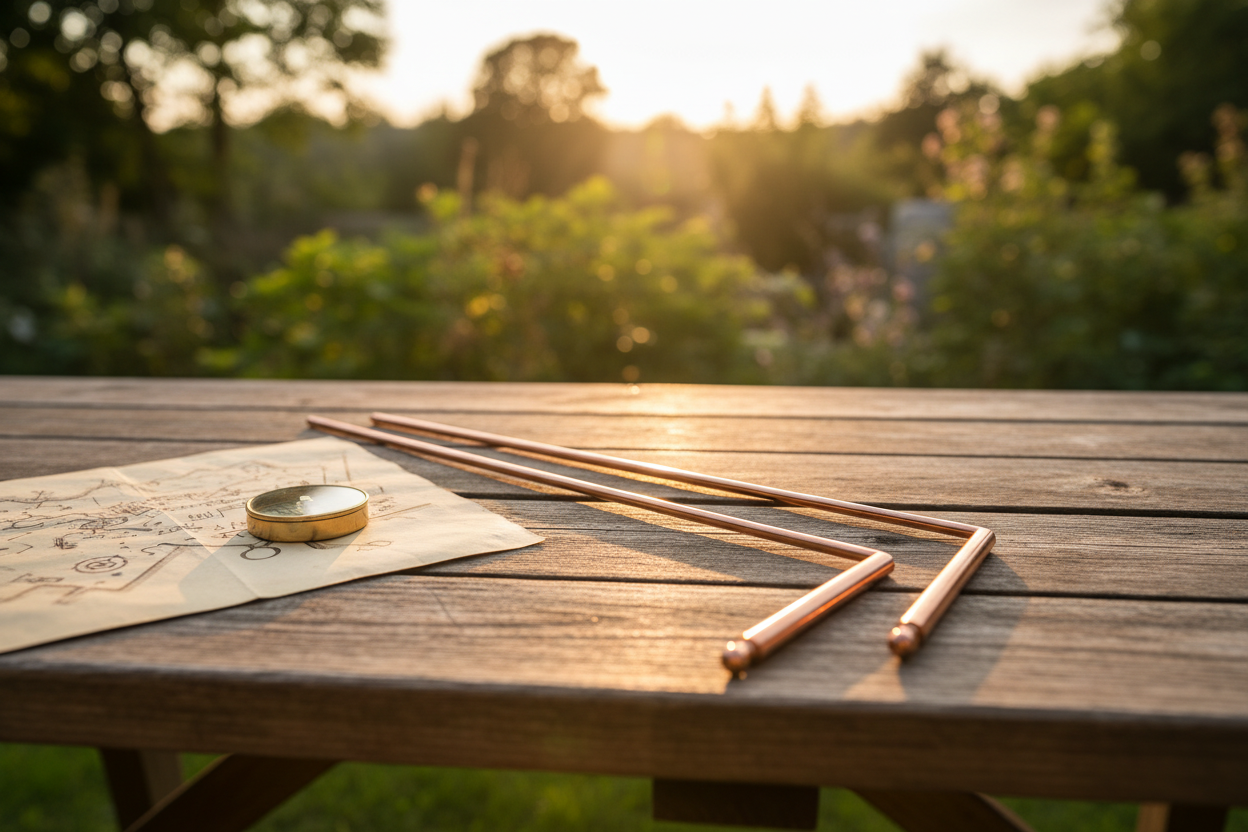
Dowsing rods are held loosely and read by how they move. This set of two copper dowsing rods, 12 inches each with 4 3/4-inch handles, is the L-rod style: one rod in each hand, held with the long arm pointing forward, ready to swing inward, outward, or cross when the practitioner walks over the target. The rods come with a storage bag so the long arms stay straight between sessions. Copper is a popular modern choice for L-rods, and a relaxed grip and clear intention matter more than the material.


At a glance
Key Features of These Copper Dowsing Rods
L-rod design, classic dowsing format. Two L-shaped rods, one for each hand. The 12-inch long arm points forward; the 4 3/4-inch handle leg rests in your closed fist with the rod free to swing. L-shaped rods are a twentieth-century form. The earliest description found so far is a 1933 letter from New South Wales, printed in the Journal of the British Society of Dowsers in March 1934.
Solid copper construction. Copper is a popular modern choice for L-rods, and the 1933 letter names iron, steel, or copper wire for making them. The polished copper finish reads warm in candle and lamp light and tarnishes over time into a deeper patina.
Storage bag included. Each pair ships with a fabric bag that protects the rods between sessions and keeps the long arms straight. L-rod accuracy depends on the long arm staying perpendicular to the handle leg; bent arms swing irregularly. Store flat or hanging when not in use.
The particulars
Product Details
- Set of 2 L-rod dowsing rods
- Long arm: 12 inches
- Handle leg: 4 3/4 inches
- Material: copper
- Finish: polished copper, will develop a darker patina with age and handling
- Includes: fabric storage bag
The Spiritual Significance
Nobody recorded when dowsing began. The earliest records found so far are German charms from the 1400s that ask a rod to point to treasure, ore, and a mineral spring (Dillinger, "Charms and the Divining Rod," 2017). The first detailed printed description is in Georgius Agricola's De Re Metallica (1556), where miners walk with a forked hazel twig that turns over a vein of ore (Hoover translation, 1912). Agricola writes that miners were already arguing over the twig, so the practice is older than its first record. These dates show when dowsing was written down, not when it was first practiced. The practice reached North America with settlers from England and Germany (U.S. Geological Survey, "Water Dowsing"), and in rural parts of the United States, dowsers are still hired to choose well sites (USGS Water Science School).
Dowsers also pass down an older beginning in China. Since at least the 1930s, dowsing writers have pointed to a carved relief of Yu the Great, a legendary early ruler, holding a forked tool beside an inscription said to praise his knowledge of springs (Thurston, "The Divining Rod and Its Implications," 1934). No written record found so far confirms dowsing in ancient China, so a Chinese origin is a possibility and not a documented one.
Other cultures have their own old ways of divining with sticks and of finding water. Herodotus describes Scythian diviners laying out bundles of willow wands (Histories 4.67). A sixth-century Indian text, Varahamihira's Brihat Samhita, finds groundwater by reading trees, anthills, and soil (chapter 54). These are different practices from walking the ground with a rod.
Modern uses go well beyond water and minerals. L-rods are used in earth-mysteries work to trace ley lines, in energy work for scanning auras and detecting geopathic stress, in space-clearing to find energetic stagnation in a room, in yes-or-no divination similar to pendulum work, and in psychic development as a feedback loop for intuitive impressions. Alfred Watkins proposed leys in the 1920s as old straight tracks between landmarks, and since the 1960s the earth-mysteries movement has described them as lines of earth energy (Wikipedia, Ley line).
The mainstream scientific explanation for rod movement is the ideomotor effect, where subconscious muscle micro-movements translate into visible rod swing. Whether you read that as the working mechanism or as a description of how spirit communicates through the body, the practice rewards patience, a relaxed grip, and clear intention.
Step by step
How To Use These Copper Dowsing Rods
- Calibrate yes and no first. Hold one rod loosely in each hand, with elbows bent and the long arms pointing forward parallel to the ground. Ask the rods to show you a "yes" response. Note whether they cross, open, or swing right or left. Ask for a "no" and note the difference. Calibration becomes your personal code.
- Form a clear question. The more specific the intention, the more useful the response. "Is there underground water in this yard" is workable; "tell me about water" is too vague to give clean feedback.
- Walk slowly, breath steady. Subtle movement is the data. Dowsers describe the rods as responding to a state of relaxed alert attention, not concentration. Hold the rods loosely enough that they can swing freely on their handles.
- Cross-check. If the rods give you a "yes," step back, reset, and ask the same question from a different angle. Consistent responses across multiple approaches build confidence; inconsistent responses suggest your question needs refinement or you need to settle further before asking.
- Care for the rods. Polish copper occasionally with a soft dry cloth or copper polish if you want to preserve the shine; otherwise let the patina develop naturally. Store flat or hanging so the long arms don't bend. Avoid harsh chemical cleaners, which pit the surface and dull the response.
Good company
Pairs Well With
- Clear Crystal Gazing Ball with Pentacle Stand, 80mm A different scrying tool for the same divinatory practice; many practitioners alternate between handheld ideomotor work (rods) and contemplative scrying (ball) depending on what the question calls for.
- Pentagram Pendulum Mat, 8" x 12" A working surface with directional indicators that doubles as a calibration mat for rods; useful when you want a fixed reference for yes/no/maybe responses.
- Black Tourmaline Pendulum, 6-Sided The closest sister-tool to dowsing rods; both work via ideomotor response, and most practitioners cross-train between rods (for area scanning) and pendulum (for seated yes/no work).
- How to Use a Pendulum by Richard Webster A practical introduction to the closest sister-tool; the pendulum principles transfer cleanly to dowsing rod work.
- Black Obsidian Scrying Mirror, 10cm with Stand An adjacent divination practice; rods scan space, the mirror invites images, and many serious practitioners eventually keep both methods alive.
Before you buy
Frequently Asked Questions
What's the difference between L-rods (these) and Y-rods?
L-rods are held one in each hand with the long arm pointing forward; they cross, open, or swing to indicate. Y-rods are forked sticks held with both hands that dip downward over a target. L-rods are more popular for indoor energy work and yes-or-no divination; Y-rods are the traditional water-finding tool used in old-school rural dowsing.
Do I have to believe in dowsing for it to work?
Practitioners are split. Some hold that dowsing accesses real subtle energies; others read it through the ideomotor effect as a way to externalize subconscious knowing. Either framing supports practice; many dowsers report results without strong metaphysical commitments. The technique rewards a relaxed grip, clear questions, and consistent calibration.
Can I use these to find water or lost objects?
Practitioners in rural water-witching traditions use them for well-siting; modern dowsers also use them to find lost objects, pet wandering paths, and buried utilities. Scientific testing has not shown dowsing to outperform chance for these tasks. Use the rods as part of practice, not in place of professional surveys or utility locators.
What is the ideomotor effect?
The ideomotor effect is the phenomenon where subconscious or unconscious muscle micro-movements translate into visible motion of a held object. It's the explanation mainstream science offers for Ouija planchettes, pendulums, and dowsing rods. Whether you take that as deflation or as a description of how spirit and body talk, the practice still rewards consistent intention.
How do I cleanse the rods between sessions?
A soft dry cloth wipe is the practical care. For an energetic cleanse, pass them through smoke (rosemary, sage, palo santo) or rest them on a selenite plate. Avoid water and harsh chemicals; copper tarnishes attractively, but pitting from cleaners is harder to undo.
Are these beginner-friendly?
Yes. L-rods are the most common entry point into dowsing because the movement is easy to see and the calibration step is simple. Most beginners get usable responses within a few practice sessions. The harder skill is asking precise questions and trusting the rods consistently.
Spend $50 & enjoy guilt-free shopping with our free shipping on all orders. Get your favorite items delivered right to your door at no extra cost.