



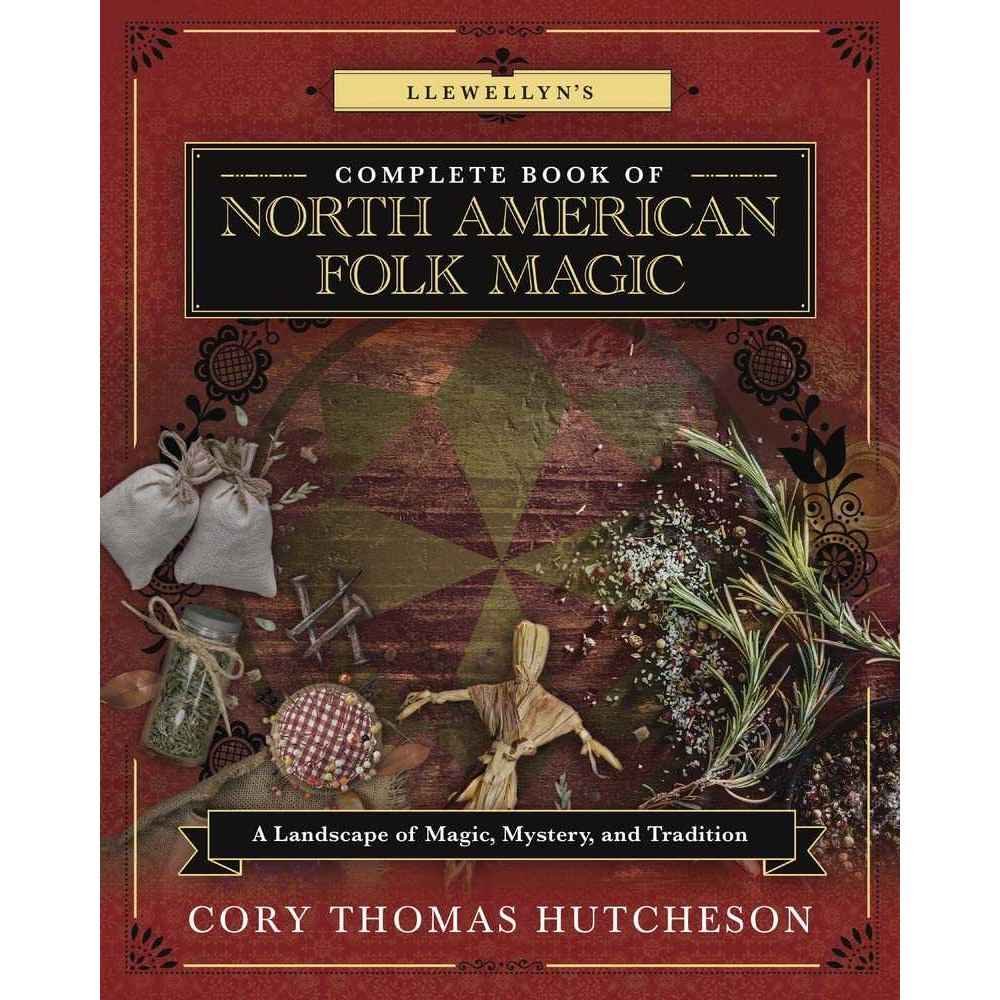
Llewellyn's Complete Book of North American Folk Magic: A Landscape of Magic, Mystery, and Tradition (Llewellyn's Complete Book Series, 16) by Cory Thomas Hutcheson, Brandon Weston, Melissa A. Ivanco-Murray, Starr Casas, Stephanie Rose Bird, H. Byron
Llewellyn's Complete Book of North American Folk Magic: A Landscape of Magic, Mystery, and Tradition (Llewellyn's Complete Book Series, 16) by Cory Thomas Hutcheson, Brandon Weston, Melissa A. Ivanco-Murray, Starr Casas, Stephanie Rose Bird, H. Byron- Primary Spiritual Use: Wisdom
- Secondary Spiritual Use: Protection
- Element: Air
- Planet: Mercury
- Zodiac: Gemini, Virgo
- Chakra: Third Eye
- Ruling Day: Wednesday
- Tradition: Folk magic
- Intent: Wisdom, Intention, Power
Couldn't load pickup availability
Llewellyn's Complete Book of North American Folk Magic gathers twenty-four practitioners writing about the traditions they actually belong to, region by region across Mexico, the United States, and Canada. It is the rare survey book where the people describing a practice are the people who do it.
That is the whole argument for it, and it is a strong one.
Key Features of the Complete Book of North American Folk Magic
Twenty-four practitioner-contributors. Each tradition is written from the inside rather than surveyed from outside, which is unusual and worth a great deal.
More than twenty traditions. Appalachian mountain magic, Brujeria, Curanderismo, Detroit Hoodoo, Florida swamp magic, Irish and Italian American folk magic, Melungeon practice, New England cunning craft, New Orleans Voodoo, Ozark folk magic, Pennsylvania Powwow and Braucherei, Slavic American folk magic, Southern conjure, and more.
Organized by region. A tour of the continent's magical landscape rather than an alphabetical catalogue.
Product Details
- Editor: Cory Thomas Hutcheson, with twenty-four contributing practitioners
- Publisher: Llewellyn Publications, Complete Book Series
- Contributors include Starr Casas, Stephanie Rose Bird, H. Byron Ballard, Lilith Dorsey, Jake Richards, Benebell Wen, and Alexander Cummins
- SKU: BCOMBOOFM
The Spiritual Significance
Most books on folk magic are written by one person about many traditions, which means a great deal is inevitably lost or flattened in translation. This one takes the opposite approach: each tradition is described by someone who practices it. That matters especially for the living traditions in these pages, several of which are closed or partly closed, and several of which have been badly served by outsiders writing about them for a century.
Hoodoo, Curanderismo, Brujeria, New Orleans Voodoo, and Powwow are living practices belonging to living communities, and this book is one of the more responsible ways to begin learning what they actually are. Read it as an introduction to what exists rather than a manual for taking it up. Where a tradition asks for initiation or community, the book will say so, and that is a feature rather than a limitation.
How To Use the Complete Book of North American Folk Magic
- Read the whole thing rather than only the chapter you were curious about.
- Notice which traditions the contributors describe as open and which they do not.
- Follow the contributors. Many have written full books on their own tradition.
- Take it as an introduction to a landscape rather than a manual for practicing all of it.
- Keep it as a reference; it is the sort of book you come back to.
Pairs Well With
- Living Wicca by Scott Cunningham: for the solitary Wiccan end of the shelf.
- Llewellyn's Complete Book of Correspondences: the reference in the same series.
- High John the Conqueror Root, 1 oz: the great root of the conjure tradition.
- Lodestone Food, 4 oz: the magnetic sand for feeding a lodestone.
- Aged Leather Journal with Latch: for the notes this book tends to generate.
Frequently Asked Questions
What traditions does it cover?
More than twenty, including Appalachian mountain magic, Brujeria, Curanderismo, Detroit Hoodoo, New Orleans Voodoo, Ozark folk magic, Pennsylvania Powwow and Braucherei, Southern conjure, and Irish, Italian, and Slavic American folk magic.
Who wrote it?
Twenty-four practitioners, each writing about their own tradition, edited by Cory Thomas Hutcheson.
Can I practice everything in it?
No, and the book is honest about that. Several of these traditions are closed or require initiation and community. Read it as an introduction to what exists, and follow the contributors into their own work if a tradition calls you.
Is it a spellbook?
Not primarily. It covers history, tools, and beliefs, and it is a survey rather than a grimoire.
Is it good for beginners?
Yes, and it is unusually good at giving a beginner an accurate map of a landscape most books distort.

Spend $50 & enjoy guilt-free shopping with our free shipping on all orders. Get your favorite items delivered right to your door at no extra cost.