



Plentiful Earth | Spiritual Store
Interfaith Minister's Stole, Blue & White
Interfaith Minister's Stole, Blue & WhiteThis item ships free in the U.S.Other rates are calculated at checkout.
Couldn't load pickup availability
- Primary Spiritual Use: Intention
- Secondary Spiritual Use: Wisdom
- Material: Cotton
- Element: Spirit
- Planet: Sun
- Zodiac: Leo
- Chakra: Crown
- Ruling Day: Sunday
- Tradition: Modern eclectic
- Intent: Intention, Wisdom
There is something that happens when you put on a stole. The weight of it, however slight, settles something in you. It marks a threshold: here I am not just myself, but something in service of something larger. That's the ancient function of sacred vestments, and it belongs to no single tradition. Every path that has asked its leaders to stand at the center of a gathered community has found its own version of this garment.
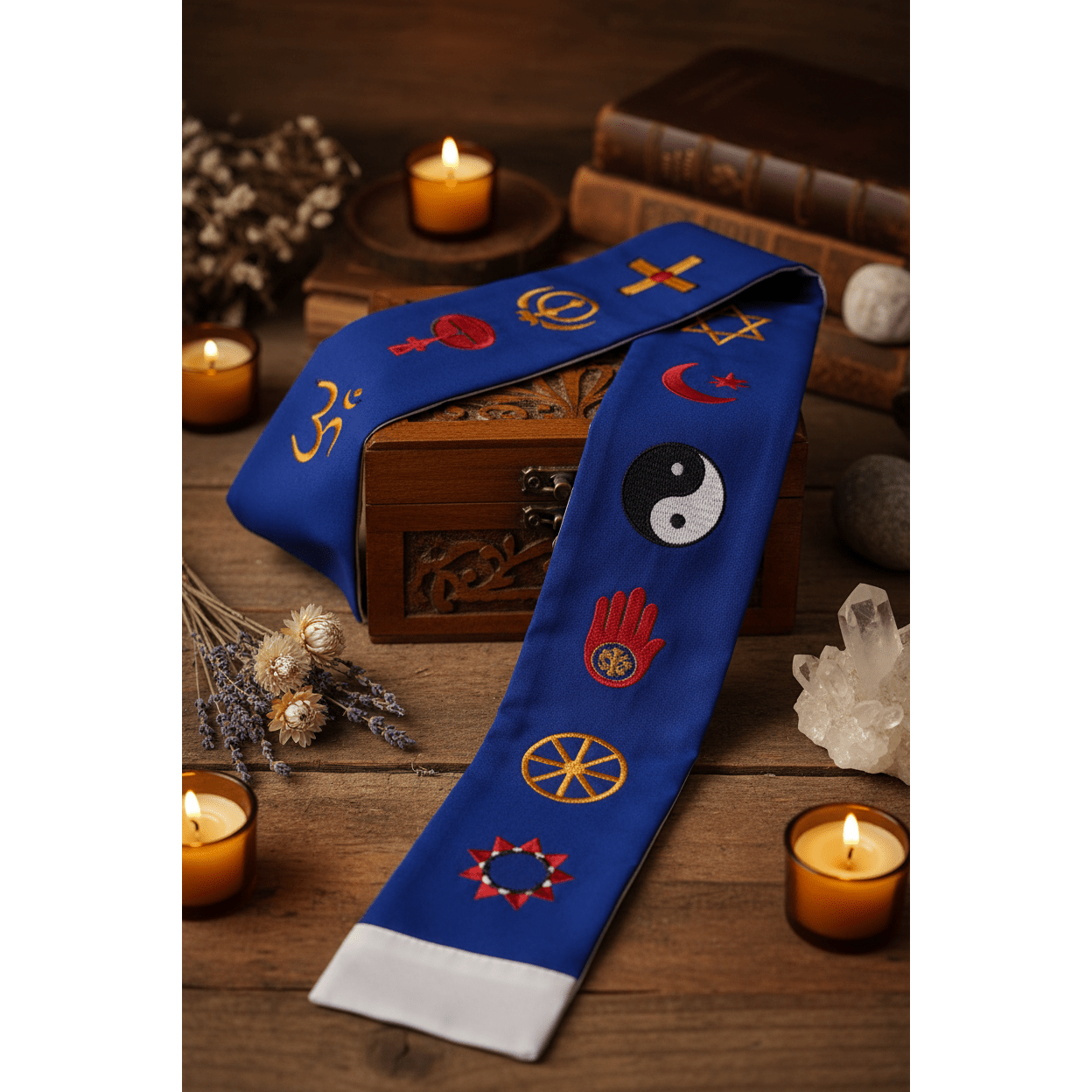
This blue and white cotton Interfaith Minister's Stole is made for those who hold space at the intersection of many paths. Whether you lead weddings, funerals, circles, rites of passage, healing ceremonies, or simply your own personal devotional practice, this stole carries twelve symbols from the world's major spiritual traditions, making visible what interfaith ministry is at its core: the recognition that the sacred is not the property of any one lineage.
At four inches wide and six feet long, it drapes with presence. The blue and white palette carries associations across traditions; clarity, truth, spirit, and the liminal space between sky and earth. If you have been ordained, trained as a chaplain, called into ministerial service from an eclectic path, or simply feel the weight of a pastoral calling, this stole is a worthy companion for that work.
Key Features
Twelve world religion symbols, woven into a single garment. The stole's design acknowledges the breadth of human spiritual expression without collapsing it into a single narrative. For interfaith practitioners, this is the garment's most important quality: it communicates openness and respect to those you serve, regardless of their tradition.
Cotton construction with liner, built for actual ceremony use. This is a working vestment, not a display piece. The lightweight cotton with liner is comfortable to wear through long ceremonies, holds its shape when draped over the shoulders, and is practical enough for repeated use across diverse settings: handfastings, memorial services, naming ceremonies, hospital chaplaincy, or circle work.
Includes a description sheet for context and intention-setting. The included sheet supports mindful use, offering guidance on the symbols and how to approach wearing this garment with intention. This is a meaningful detail for practitioners who may be new to vestment traditions or who work across multiple faith contexts.
Product Details
- Material: Cotton with liner
- Dimensions: 4 inches wide by 6 feet long
- Color: Blue and white
- Design: 12 symbols of world religions
- Includes: Description sheet
The Spiritual Significance
For interfaith ministers, chaplains, and multi-path practitioners, the stole functions as a visual covenant with those you serve. When you put it on before a ceremony, you can use that moment as a conscious act of preparation: hold the fabric for a moment, breathe, and name your intention aloud or silently. You are not just dressing; you are marking the shift from ordinary time into sacred time. The stole becomes a signal to yourself and to others that what follows is held with care.
For practitioners who work within earth-based, Pagan, or eclectic spiritual traditions, the stole can also function as a ceremonial anchor during ritual. Draping it over the shoulders when opening circle, leading a sabbat celebration, or officiating a handfasting signals to the gathered community that you have stepped into your role as ritual leader. Blue, widely associated across traditions with clarity, spirit, and truth, and white, carrying associations with purification and new beginnings, make this colorway particularly fitting for rites of passage, blessing ceremonies, and threshold work of all kinds.
How To Use
Before ceremony: Before wearing the stole for the first time, consider cleansing it according to your practice. Smoke cleansing with frankincense, sandalwood, or an herb that resonates with your tradition is a straightforward approach; you might also leave it in moonlight overnight or hold it in your hands and breathe a blessing into it.
Wearing it: Drape the stole around the back of your neck with the two ends hanging evenly down the front. This is the traditional wearing style for most ordained ministers across Christian, Unitarian Universalist, and interfaith contexts, and it reads clearly to ceremony participants as a sign of ministerial presence.
During ceremony: Let the stole's presence remind you of your role. When nerves arise before a difficult ceremony, a gentle hand placed on the fabric can serve as a grounding gesture, a return to intention.
After ceremony: Fold and store the stole with care. Many ministers develop their own closing ritual around putting it away: a word of gratitude, a brief moment of stillness, an acknowledgment that the work is complete. This kind of bookending helps you transition back to ordinary life after the heightened attention of ceremony.
Ongoing care: Launder gently and store folded or rolled, not crumpled. Cotton responds well to light pressing. Because vestments accumulate the energetic residue of ceremony over time, some practitioners periodically reclean theirs under the full moon or with fresh smoke.
Pairs Well With
Frankincense Incense Sticks — Frankincense is one of the few sacred resins recognized across Christianity, Judaism, Islam, and Pagan practice alike; burning it before donning your stole creates a cross-traditional consecration that aligns naturally with the stole's interfaith design.
Frankincense Perfume Oil — Anoint your wrists or the fabric of your stole lightly with this oil before ceremony for a grounded, consecrated presence that honors the sacred across traditions.
Meditation Tools Collection — A singing bowl or meditation tool used to open and close ceremony pairs naturally with the stole; sound marks the threshold just as the vestment does, signaling that sacred time has begun and ended.
God & Goddess Deity Statues — For ministers who work within specific devotional frameworks alongside their interfaith practice, a deity statue on the altar creates a grounded focal point that complements the stole's broader symbolic embrace.
Altar Tiles & Pentacle Plates — An altar tile placed at the center of your ceremony space while you wear the stole extends the visual and energetic language of sacred space into the physical environment around you.
History & Occult Background
The stole's history begins not in any temple but in the practical world of Roman civic life. Its predecessor, the orarium, was a simple scarf-like cloth used by Roman officials as a symbol of rank and function. By the fourth century CE, early Christian communities had begun adopting it as a vestment, and by the sixth century, church councils were formalizing its use as a marker of clerical authority. The transformation from functional cloth to sacred vestment is itself a microcosm of how the early Church consistently drew on Roman civic symbols and reframed them as sacred ones.
In Christian tradition, the stole came to represent the "yoke" of ordained service: the weight and responsibility of ministry, worn visibly on the body. In the Roman Catholic Church it carries the symbolism of immortality, conferred at ordination as a visible sign of holy orders. In Eastern Orthodox practice the symbolism extends to the anointing that accompanies ordination, the oil flowing downward as the stole does. Different Christian denominations adopted different wearing styles: a deacon's stole crosses the body diagonally like a servant's sash, marking readiness for active service; a priest's hangs straight from the neck.
By the mid-twentieth century, the stole had moved well beyond its origins in Catholic and Anglican practice. Unitarian Universalist clergy, in particular, embraced the stole in the late 1960s and 1970s as interfaith and theologically liberal ministry grew, partly through the influence of the Congregation of Abraxas and partly through the increasing number of women entering UU ministry who found the stole a more accessible vestment than traditional clerical robes. Today, interfaith-ordained ministers across virtually every non-creedal and multi-path tradition wear stoles as a marker of ministerial presence, carrying the form into entirely new spiritual territory while honoring its long history as the visible sign of a calling.
The blue and white colorway of this particular stole carries its own symbolic weight. Blue appears as a sacred color in traditions spanning Judaism (the tekhelet thread woven into prayer shawls), Christianity (associated with the Virgin Mary and with truth), Islam (blue tiles adorning mosques from Morocco to Persia), and broadly across Pagan and earth-based traditions where it signifies sky, spirit, and clarity. White carries associations with purification, new beginnings, and the liminal in virtually every tradition that uses it.
Frequently Asked Questions
Do I need to be formally ordained to wear this stole? That depends on your tradition and context. In many interfaith and earth-based spiritual communities, ministerial garments are worn by anyone who has stepped into a leadership role within ceremony, whether or not they hold formal ordination credentials. In more formally structured settings such as hospital chaplaincy or legally officiated weddings, ordination through a recognized body is generally required. The stole itself carries no legal or denominational requirement; it is a garment of intention.
What are the 12 symbols on this stole? The product description notes twelve symbols of the world's major religions representing harmony and universal unity. Common symbols on interfaith stoles in this style typically include the Christian cross, the Star of David (Judaism), the crescent and star (Islam), the Om symbol (Hinduism), the Dharma wheel (Buddhism), the Bahá'í star, the Yin-Yang (Taoism), the Sikh Khanda, and others. The included description sheet will identify the specific symbols on your stole.
Can I wear this stole for Pagan, Wiccan, or earth-based ceremonies? Absolutely. The stole has no denominational ownership, and its use in Pagan and eclectic ceremonial contexts is well-established. Many Pagan clergy, Wiccan High Priests and Priestesses, and independent spiritual leaders wear stoles as a visible marker of their ceremonial role, adapting the form to their own tradition.
How do I cleanse and consecrate this stole before first use? Choose a method that aligns with your practice. Smoke cleansing with frankincense, cedar, or an herb meaningful to your path is common. Some ministers hold the stole and breathe a prayer or intention into it; others leave it overnight on their altar or under moonlight. There is no single correct method; what matters is that the act is conscious and intentional.
Is this stole appropriate for legally officiated ceremonies such as weddings or funerals? The stole is appropriate for any ceremony; it is the legal standing of the officiant that matters for civil rites, not the garment. If you are officiating a legally binding ceremony, ensure you hold proper ordination or ministerial credentials recognized in your jurisdiction.
How should I care for this stole between ceremonies? Launder gently on a cool cycle or by hand, press lightly, and store folded or rolled in a clean cloth or bag. Many ministers treat their stoles as sacred objects and store them apart from everyday clothing, handling them deliberately. Periodic energetic cleansing is a matter of personal practice.
Can this stole be gifted at an ordination? Yes, and it makes a particularly meaningful ordination gift for anyone stepping into interfaith or multi-path ministry. The tradition of gifting a stole at ordination is well-established across Christian denominations and has been adopted widely in interfaith and Pagan ministerial communities as well.


Spend $50 & enjoy guilt-free shopping with our free shipping on all orders. Get your favorite items delivered right to your door at no extra cost.