



Plentiful Earth | Spiritual Store
Talking Board, A Spirit Board Set
Talking Board, A Spirit Board Set- Primary Spiritual Use: Psychic
- Secondary Spiritual Use: Attraction
- Element: Water
- Planet: Moon
- Zodiac: Cancer, Pisces
- Chakra: Third Eye
- Ruling Day: Monday
- Tradition: Spiritualism
- Intent: Divination, Psychic, Connection
Couldn't load pickup availability
Some tools arrive in your practice quietly, slipping into the work without announcement. A spirit board is not one of those. It asks to be taken seriously, approached with intention, and used with the kind of deliberate respect you would offer any means of crossing a threshold. That threshold is the central premise of the talking board: a surface that holds the alphabet, numbers, and the words yes, no, and goodbye, paired with a planchette that participants rest their fingers on and allow to move. The question the board poses is not whether it works. The question is what kind of attention you bring to it.
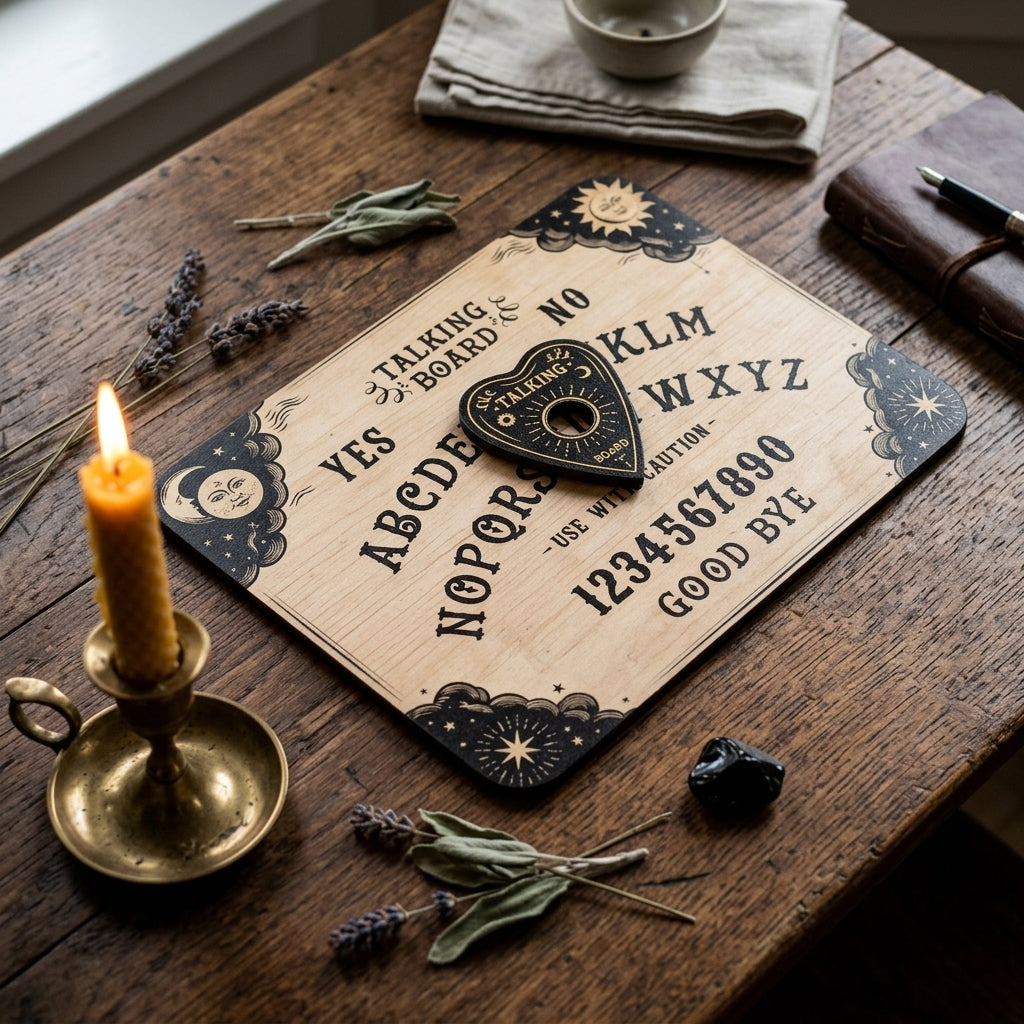
This spirit board set measures 12¼" × 15¼" and carries the classic vintage aesthetic that has defined talking boards since the late 19th century. It comes with a planchette included, ready to use from the moment you sit down with it. The format is immediately recognizable; the letters arc across the upper portion of the board, numbers run beneath them, and the essential yes and no anchor the two upper corners while goodbye waits at the base, the word that closes every session properly and with good manners. The design draws on the visual tradition that has made this format one of the most enduring objects in the history of Western divination.
A spirit board used thoughtfully, with clear intent, proper opening and closing protocols, and a working knowledge of the tradition you are engaging, is a genuine divination instrument. It is also, like all tools that invite response from the unseen, a practice that benefits from care, grounding, and honest self-examination about what you are hoping to contact and why.
Key Features
Classic format, complete set: everything you need to begin. The board includes a planchette, so there is no hunting for a compatible pointer or improvising one from another tool. The 12¼" × 15¼" dimensions provide a substantial working surface, large enough for two people to sit comfortably across from each other with their fingertips on the planchette, which is the traditional working configuration for partner spirit board sessions.
Vintage aesthetic: working within a visual tradition that carries its own history. The classic talking board design is not merely decorative. The lettering, layout, and overall visual language of this board connect it to a lineage of divination objects whose forms have been refined through more than 130 years of use. Working with a board that holds that traditional aesthetic is different from working with a novelty item; it grounds your session in the full weight of that history.
A versatile entry point into spirit communication and automatic movement practices. The spirit board is accessible to beginners in a way that more technically demanding divination tools are not. It requires no memorized card meanings, no complex casting systems, no extensive study before first use. What it requires is the right mental state, a clear question or intention, and a working partner you trust. The low barrier to entry makes it one of the most democratic divination tools available.
Product Details
- Set includes: Spirit board and planchette
- Board dimensions: 12¼" × 15¼"
- Material:
- Design: Classic vintage-style talking board with alphabet, numbers 0–9, YES/NO, and GOODBYE
The Spiritual Significance
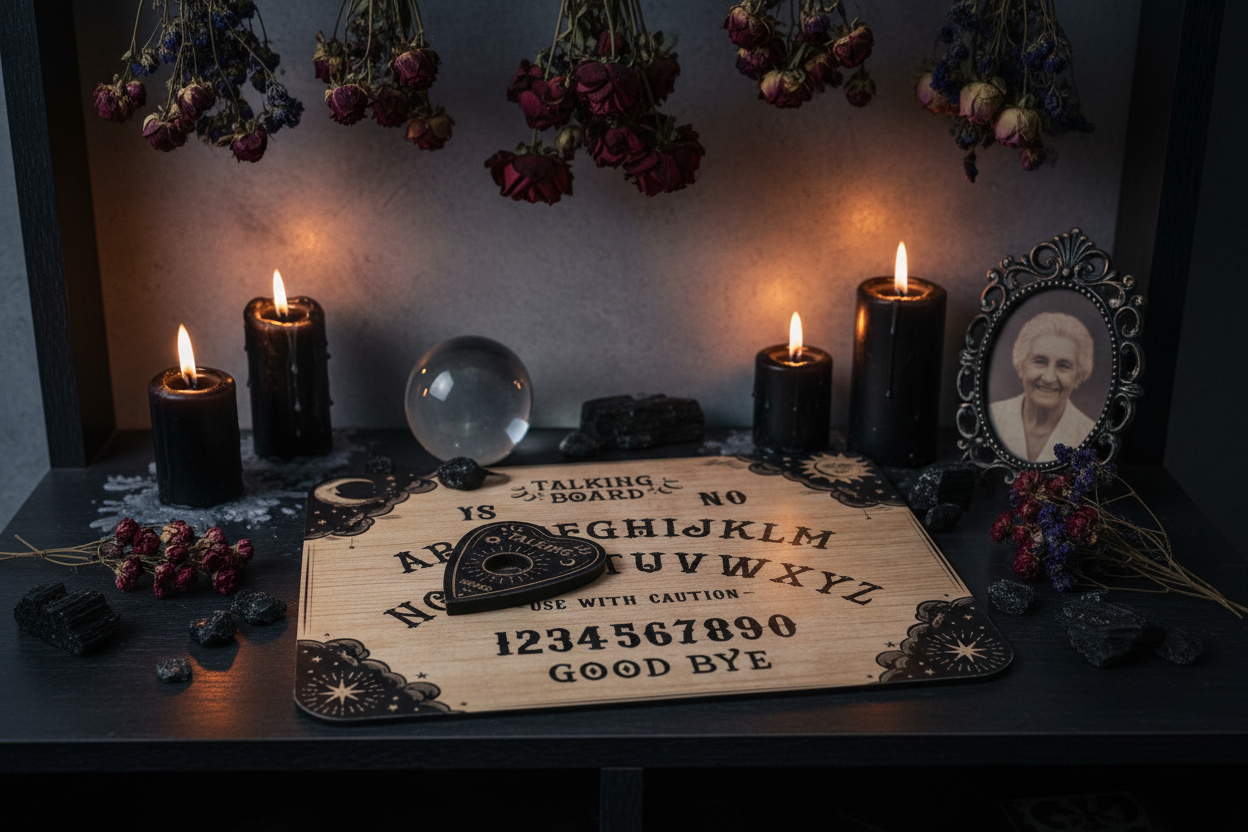
In the eclectic Pagan and Wiccan traditions that incorporate spirit communication work, a spirit board can be used as a focused tool for ancestral communication during ritually prepared space. You can use this board to reach out to specific ancestors by casting a protective circle beforehand, calling in your spirit guides or patron deities, and stating clearly and aloud who you wish to contact and why. This protocol, rather than open-ended contact with any available presence, reflects the approach recommended by many experienced practitioners in the modern Pagan community. The board becomes one spoke of a broader ancestral practice, used alongside offerings, photographs, ancestor altars, and other tools of the tradition.
You can also use this board for deep inner divination, drawing on the interpretation in some modern eclectic and New Age practice that the planchette's movement represents unconscious knowledge rather than external spirit contact. In this framework, the board functions as a means of bypassing the analytical mind and accessing information your deeper self already holds, making it a tool for self-inquiry, shadow work, or exploring questions you have been unwilling or unable to consciously articulate. Whichever interpretive framework resonates with your practice, the protocol remains the same: enter the session with clear intent, close it properly, and document what arises.
How To Use
Prepare your space before beginning. Cleanse the room with smoke, Florida Water, or sound before a session. Set your intent clearly: are you seeking contact with a named ancestor, a spirit guide, or using the board as an inner divination tool? Light a candle if you work with one. Many practitioners also place a protective circle or call quarters before sitting down. This preparation is not optional formality; it shapes the quality and safety of the session.
Work with a trusted partner. The traditional and most widely recommended format is two people seated facing each other, both resting two or three fingertips lightly on the planchette without gripping. The lighter the touch, the more clearly the planchette can move. Neither person should try to direct or influence the planchette's movement; the receptive, non-effortful state is the one that produces meaningful sessions.
State your intention and ask clear questions. Vague, open-ended invitations for "any spirit" to come forward are generally considered poor practice in traditions that take spirit communication seriously. Name who you are hoping to speak with, or state what type of guidance you are seeking. Ask questions that can be responded to intelligibly through spelling; yes/no questions are a good starting point.
Always close the session by saying goodbye. Move the planchette to GOODBYE and say the word aloud before removing your hands from the board. This is the most consistently emphasized protocol across traditions: opening a session without closing it properly is considered by many practitioners to leave unwanted energies active. Do not skip this step.
Store the board respectfully. Keep it separate from other divination tools, wrapped in a cloth, in its own space. Many practitioners treat the board as a charged object that benefits from periodic cleansing with smoke or moonlight between sessions.
Trust your instincts throughout. If a session feels uncomfortable, disturbing, or out of control, close it immediately and ground yourself. The board is a tool; you are always in a position to end the working.
Pairs Well With
Florida Water Cologne, 7.5 oz. — Sprinkle or spray Florida Water around the working space before a spirit board session; its deep roots in American folk magic and Hoodoo tradition as a cleanser and spirit-calming agent make it one of the most historically appropriate pre-session tools for this kind of work.
White Sage Kit Smudge — Smudge the board, the planchette, and the room before and after sessions to clear residual energies and reset the space; smoke cleansing is among the most widely practiced pre-divination purification methods across traditions.
Rainbow Moonstone Pendulum — Keep a pendulum alongside the spirit board as a complementary spirit communication tool; many practitioners use the pendulum for confirmation of board messages or for shorter single-question sessions when a full board setup is not warranted.
Black Tourmaline Crystals Collection — Place a piece of black tourmaline at each corner of the board or on your altar space during sessions; black tourmaline's strong protective and grounding properties are widely used in eclectic practice to maintain energetic boundaries during spirit communication work.
Divination & Psychic Abilities Collection — Explore the full range of divination tools at Plentiful Earth; the spirit board works well as part of a broader divination practice that includes tarot, runes, pendulums, and scrying tools, each offering a different mode of receptive inquiry.
History & Occult Background
The talking board as a commercial object was patented on February 10, 1891, by Elijah Bond, a Baltimore businessman, but the practice it formalized had roots in the American Spiritualist movement of the mid-19th century. Spiritualism, which emerged in the United States in the late 1840s following the Fox Sisters' reported spirit communications in Hydesville, New York, generated intense popular and cultural interest in methods of communicating with the dead. By 1886, news reports were documenting talking board use at Spiritualist camps in Ohio. The board Bond patented was named "Ouija" — a word reportedly spelled out by the board itself when medium Helen Peters Nosworthy asked it what it wanted to be called and then asked what the word meant, receiving the answer "Good Luck." Bond passed the business to his employee William Fuld in 1901, and the Ouija name became so culturally embedded that it remains a trademark of Hasbro today, though "spirit board" and "talking board" are the generic terms for the tool.
For the first decades of its existence, the Ouija board was sold as a parlor game and novelty item, its spiritual dimensions taken seriously within Spiritualist circles but not emphasized in its marketing. That changed during World War I, when American medium Pearl Curran popularized its use as a channeling tool and produced thousands of pages of writing she attributed to a spirit named Patience Worth. The board became associated with the occult in popular culture through a combination of genuine Spiritualist use, cultural anxiety, and eventually horror cinema — most consequentially the 1973 film The Exorcist, which depicted a child's use of a Ouija board as a point of demonic entry. This cultural moment hardened the board's sinister popular reputation in a way that persists in mainstream culture to this day, entirely separate from its actual history as a Spiritualist communication tool.
The scientific community has consistently explained talking board phenomena through the ideomotor effect, first described by Michael Faraday in 1853 while investigating table-turning and applied to planchette movement by researchers in the late 19th and 20th centuries. In this explanation, unconscious micro-movements of the participants' hands, below the threshold of conscious awareness, produce the planchette's movement and spelling. A 2012 study found that Ouija use produced more accurate yes/no responses than conscious guessing, suggesting it may draw on implicit or unconscious knowledge rather than external contact. In eclectic and modern Pagan practice, both the spirit-contact interpretation and the inner-knowledge interpretation are in active use, and many practitioners hold both simultaneously as complementary framings.
Frequently Asked Questions
Is a spirit board safe to use? This depends considerably on how you use it, and what tradition's framework you are operating within. In eclectic Pagan and Spiritualist-influenced practice, the most widely recommended protocols are: prepare and protect your space beforehand, work with a trusted partner rather than alone, ask for named or known presences rather than issuing open invitations, and always close the session properly by moving the planchette to GOODBYE. Practitioners who take spirit boards seriously generally emphasize that careless, unprepared, or fear-driven use produces the worst outcomes, while intentional, grounded, well-prepared use is a legitimate and manageable form of spirit communication work.
Should I use this board alone or with a partner? The strong majority consensus across traditions that use spirit boards is that two people working together is the standard and preferred format. The planchette responds to the combined subtle movement of both participants, and having a partner makes it easier to observe the session with some objectivity. Solo use is practiced by some experienced practitioners, but is generally not recommended for beginners.
How do I cleanse and store this board between sessions? Pass it through incense smoke or sage smoke after each session. Many practitioners keep it wrapped in a dark cloth and stored away from their other tools. Some store it with a piece of black tourmaline or obsidian to maintain protective energy around it between uses. Avoid leaving it out as general decor if you use it for active spirit work.
What is the difference between this spirit board and a pendulum for spirit communication? Both are tools used to make unconscious or subtle signals visible. The pendulum uses a single rotating or swinging object to give yes/no responses, while the spirit board uses the planchette's movement across an alphabet to spell out full messages. The board is more time-consuming but potentially yields more detailed responses; the pendulum is faster and more portable. Many practitioners use both, choosing between them based on the nature of the question and how much time they have.
Is using a spirit board compatible with Wicca or other Pagan paths? The talking board is not specifically a Wiccan tool; it originated in the American Spiritualist movement and has been adopted across eclectic practice. Many Wiccans and Pagans do use spirit boards as part of their ancestral communication and spirit work practice, typically within a cast circle and with appropriate protective protocols in place. Whether it fits your specific path is a question for your own discernment and any relevant elders or teachers in your tradition.
Can beginners use this board? Yes, though doing your preparation work first is important regardless of experience level. Read about protective protocols, understand how to close a session properly, and approach your first session with a specific and respectful intention rather than an open-ended invitation. A beginner who is well-prepared and grounded will have a better experience than an experienced person who is dismissive or careless.



Spend $50 & enjoy guilt-free shopping with our free shipping on all orders. Get your favorite items delivered right to your door at no extra cost.