
Plentiful Earth | Spiritual Store
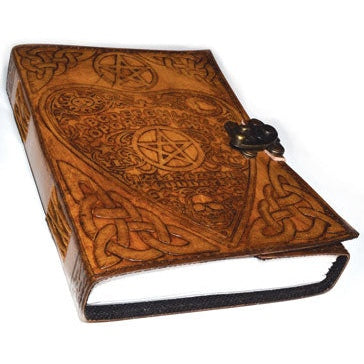
Ouija Board Planchette Leather Journal with Latch, 6" × 8"
Ouija Board Planchette Leather Journal with Latch, 6" × 8"
Couldn't load pickup availability
-
Ships In 1-2 Days
-
180 Day Returns
-
Trusted By 1,000+ Spiritualists
Every serious divination practice eventually demands a record. The messages that come through a spirit board session, the impressions that surface during a pendulum working, the dreams that arrive after a night of open receptivity: these things fade quickly without documentation, and the patterns that become visible only over weeks and months of accumulated sessions are invisible if there is no record to look back through. A dedicated divination journal is not a luxury. It is the infrastructure of a practice that deepens over time rather than perpetually starting over.
This leather-bound journal was designed for exactly that work. Its cover carries the image of the planchette, the heart-shaped pointer that glides across a spirit board to spell out what moves through the session. On the back, Celtic knotwork continues the theme: interlacing patterns that have carried spiritual meaning in British and Irish folk tradition for centuries, speaking to the weaving of the visible and invisible, the way that what seems separate turns out to be one continuous line. The 6" × 8" format sits comfortably in the hand or beside your working space, and the leather latch keeps your records private and protected between sessions.
The 240 unlined pages inside give you complete freedom in how you record: narrative accounts, sketched diagrams of where the planchette moved, quick notes on atmosphere and participants, longer reflective entries about what you felt in a session's aftermath. Unlined pages are particularly appropriate for this kind of work because divination recording rarely fits neatly into horizontal rows. You might want to draw a rough board layout with notations, or spiral your thoughts outward from a central image, or simply write in whatever direction feels right on a given night. The blank page holds all of that.
Key Features
Planchette cover design: the journal announces its purpose. The image of the planchette on the cover identifies this journal immediately as a divination record, a spirit communication log, a Book of Shadows organized around the practice of reading subtle responses. That specificity matters. Having a dedicated journal for this work rather than a general notebook signals to yourself, each time you open it, that the practice is worthy of its own space.
240 unlined pages: enough for a substantial body of work. At 240 pages, this journal holds a meaningful period of practice. If you record every spirit board or pendulum session in detail, you will have months of material before you need a new volume. If you use it more sparingly for significant sessions only, it will serve years. The unlined format means you record sessions your way, in whatever structure serves the work rather than fighting a grid that wasn't designed for it.
Leather with latch closure: durable and discreet. The leather cover will age and soften with use, developing the kind of patina that only comes from something handled regularly and with care. The latch keeps the journal securely closed between sessions, protecting its contents from casual eyes. Many practitioners consider their divination records genuinely private, and a journal that closes and latches respects that privacy in a way a simple bookmark cannot.
Product Details
- Dimensions: 6" × 8"
- Pages: 240, unlined
- Cover material: Leather with embossed planchette design
- Back: Celtic knotwork design
- Closure: Leather latch
- Paper: Unlined / blank
- Use: Divination journal, spirit communication log, Book of Shadows
The Spiritual Significance
In the tradition of the Book of Shadows, the personal magical record that Wiccan and eclectic Pagan practitioners have kept since Gerald Gardner formalized the concept in the mid-20th century, a dedicated journal for spirit work occupies a specific and important role. You can use this journal as your working Book of Shadows for spirit communication practice: record the date, lunar phase, who was present, and the specific conditions of each session before it begins, then document the session's events and your immediate impressions afterward. Over time, patterns emerge from this kind of consistent record-keeping that are simply invisible in the moment: the conditions under which your sessions are most clear, the questions that produce reliable responses versus those that produce ambiguity, the times of month or year when the veil seems thinnest for you specifically.
You can also use this journal as a companion to pendulum work and other yes/no divination practices that extend beyond the spirit board. The planchette on the cover is a symbol of the divination act itself: the movement of something between your hands and the unknown, the physical tracking of subtle response. Before any pendulum session, you might write your question here and return to record the response; over sessions, the journal builds into a personal oracle record that shows how your own intuitive accuracy develops and shifts, which questions you return to repeatedly, and what you learn when you follow a thread of inquiry across multiple sittings.
How To Use
As a pre-session preparation log: Before opening your spirit board or beginning any divination practice, write the date, time, lunar phase, and your intention for the session. This grounding act focuses the mind and creates a consistent record structure that makes later review meaningful. Note who is present, the atmospheric conditions if they feel relevant, and any unusual sense of presence or energy in the space before you begin.
As a real-time session record: Keep this journal open beside your working space during sessions if possible, or at least within immediate reach. Note key messages, movements, letters that the planchette lingered on, responses that surprised you, and anything in the session that felt particularly charged. Write quickly and without self-editing during this stage; accuracy matters more than elegance, and impressions fade fast.
As a post-session reflection space: Return to the journal within a short time after closing the session, before the experience diffuses entirely into ordinary consciousness. Write your honest assessment: what felt clear, what felt uncertain, how your body felt during the session, and any immediate intuitions about what the session's content might mean. This reflective layer is often where the most useful insights emerge.
As a Book of Shadows for divination practice: Use the blank pages to develop your own shorthand, diagrammatic methods, and recurring symbols that have meaning in your personal practice. The unlined format invites this kind of creative record-keeping. Over time the journal becomes a document of your evolving language with the unseen, specific to you in ways no printed guidebook could be.
For dream and synchronicity recording: The planchette journal need not be limited to formal sessions. Many practitioners find that the nights following active spirit board or pendulum work are rich with significant dreams, or that the following days bring synchronicities that speak to the session's themes. Keeping those observations in the same journal creates a fuller picture of the communication thread.
Let your practice determine what belongs here. The journal holds whatever you bring to it with intention.
Pairs Well With
Spirit Board Set, 12¼" × 15¼" — Use this journal as the dedicated record-keeping companion to the spirit board; open the journal before each session and return to it after closing, building a complete and searchable archive of your spirit communication work over time.
Rainbow Moonstone Pendulum — Pair this journal with the moonstone pendulum for yes/no divination sessions: write your question before the reading and the response and impressions after, using the journal to track the accuracy and themes of your pendulum practice across sessions.
Florida Water Cologne, 7.5 oz. — Lightly mist your hands and working space with Florida Water before a spirit board or divination session; its traditional cleansing properties prepare the practitioner and space, and spritzing the journal's cover has become a grounding ritual for many divination practitioners.
Divination & Psychic Abilities Collection — Explore the full range of divination tools at Plentiful Earth; this journal works in concert with tarot decks, rune sets, crystal balls, and other divination instruments as a unified record of the complete breadth of your intuitive practice.
Journals Collection — Browse the full journals selection at Plentiful Earth to find additional volumes as your practice deepens; many practitioners keep multiple journals with different focuses, using this planchette journal specifically for spirit communication while keeping separate records for other aspects of their craft.
History & Occult Background
The practice of keeping written records of magical and divinatory work has roots as old as the craft itself. The grimoire tradition of European ceremonial magic produced manuscript books of spells, invocations, and spirit names from at least the medieval period, and the practice of recording magical experiments was formalized in the Renaissance period by practitioners like Heinrich Cornelius Agrippa, who in his Three Books of Occult Philosophy (1531) wrote extensively about the importance of systematic documentation in magical work. The Hermetic and alchemical traditions both emphasized meticulous record-keeping as essential to the practitioner's development.
The modern Book of Shadows, the personal magical journal associated with Wicca, was developed and popularized by Gerald Gardner in the 1950s as part of his systematization of modern Wiccan practice. Gardner's original Book of Shadows was a ritual text containing circle-casting procedures, invocations, and initiatory material; over time, as Wicca spread and evolved, the concept expanded to include personal practice records, spell workings, divination sessions, and reflective observations. Today, a practitioner's Book of Shadows is as individual as the practice it records, and the spirit communication journal represents one specialized form of this broader tradition of magical record-keeping.
The spirit board planchette, whose image graces this journal's cover, carries its own layered history. The planchette (from the French planchette, "little plank") was a small heart-shaped board on castors developed in the mid-19th century by Spiritualist practitioners as an aid to automatic writing; participants placed their fingers on it and allowed it to move over paper to produce written messages. The subsequent development of the talking board placed the planchette over a lettered surface rather than blank paper, allowing for more legible and direct communication. The planchette's distinctive heart-with-pointer shape has become one of the most immediately recognizable symbols of spirit communication in Western folk practice, making it an apt emblem for a journal dedicated to the careful documentation of what moves through such sessions.
Celtic knotwork, which appears on the back of this journal, has roots in the decorative art of Iron Age and early medieval Celtic cultures, found most famously in illuminated manuscripts like the Book of Kells (ca. 800 CE) and in metalwork, stonework, and jewelry across Britain, Ireland, and continental Celtic regions. The interlacing patterns, which have no beginning or end, came to carry symbolic associations with eternity, the interconnection of all things, and the cyclical nature of life and death. In modern Celtic-influenced and neo-Pagan practice, knotwork imagery is widely used as a visual language for these themes.
Frequently Asked Questions
Is this journal pre-lined with any kind of spirit board layout or divination template? No. All 240 pages are completely blank and unlined, giving you full freedom to create whatever recording format works best for your practice. Some practitioners draw a rough spirit board outline and annotate it to document planchette movement; others write in narrative form, in columns, or in a free-form style. The blank format accommodates any approach.
How do I spiritually cleanse or consecrate this journal before first use? One approach is to pass it through incense smoke, opening each page section briefly to allow the smoke to move through it. You might also leave it on your altar under the full moon for a night, or sprinkle a small amount of salt on the cover and brush it clean as a symbolic act of purification. A simple verbal dedication, stating aloud that this journal is dedicated to your honest record of your spirit communication work, is a meaningful way to mark its beginning.
Is this appropriate for a Book of Shadows, or only for spirit communication? While the planchette imagery makes it a natural fit for spirit communication records specifically, any journal is appropriate for whatever you bring to it with intention. You might use it for a full personal Book of Shadows, for tarot or oracle card journaling, for dream records, or as a general spiritual practice log alongside or independent of spirit board work. The imagery is evocative rather than prescriptive.
Will the leather cover hold up to regular use? Leather is among the most durable cover materials available for books. With regular use it will develop a natural patina and soften over time; this aging is considered desirable by many practitioners who see it as the journal developing its own character through sustained engagement. If you want to maintain the leather's condition, a small amount of leather conditioner applied occasionally will keep it supple. Avoid prolonged exposure to direct moisture.
Can I use this journal for working alongside both a spirit board and a pendulum? Absolutely. The planchette is a symbol of the divination act broadly, not exclusively of spirit board use. Many practitioners use the same journal to record both spirit board sessions and pendulum work, keeping both types of divination practice in the same volume to observe how they relate and inform each other over time.
Share
Free Shipping On U.S. Orders Over $100!
Spend $100 & enjoy guilt-free shopping with our free shipping on all orders. Get your favorite items delivered right to your door at no extra cost.