



Plentiful Earth | Spiritual Store
Abalone Shell Incense Burner, 4"
Abalone Shell Incense Burner, 4"Couldn't load pickup availability
-
Ships In 1-2 Days
-
180 Day Returns
-
Trusted By 1,000+ Spiritualists
Smoke has always known where it needs to go. It rises, it drifts, it carries — and for thousands of years, the vessels that held the flame and caught the ash have mattered just as much as what burned inside them. The abalone shell is one of the oldest of those vessels. Before altar tables, before incense holders cast in brass or clay, people were cupping the sea's own gift in their hands and letting sacred smoke rise from it.
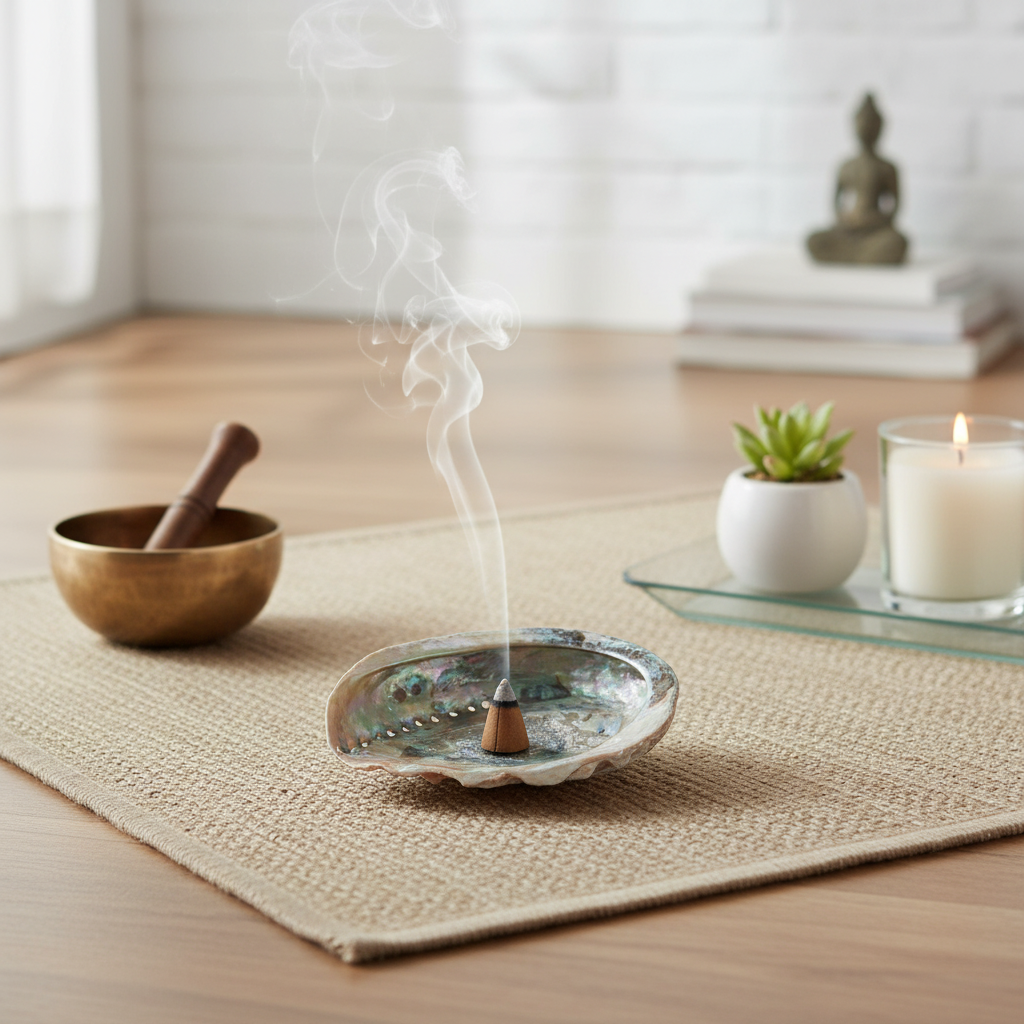
This 4-inch abalone shell incense burner is a genuine shell — not cast resin, not a lookalike — with the shimmering, opalescent interior that makes abalone unmistakable. In witchcraft and earth-based traditions, the shell represents the Water element, one of the four classical elements used to consecrate and activate sacred space. When you burn incense inside it, you're not just containing ash. You're holding all four elements at once: Earth in the herbs and resins, Air in the smoke itself, Fire in the flame, and Water in the shell beneath. It's a quiet kind of wholeness that sits on your altar and works whether you consciously call on it or not.
At four inches, this shell is sized to sit comfortably at the center of your practice — spacious enough for incense cones and small amounts of loose resin, compact enough to tuck into a travel altar or a windowsill ritual. The natural variation in each shell means yours will be unlike anyone else's, with its own particular swirl of pink, green, blue, and silver.
The Spiritual Significance
In many eclectic Wiccan and contemporary witchcraft traditions, you can use this abalone shell as the Water elemental anchor on your altar, placed in the West to honor that direction's correspondences of emotion, intuition, and psychic awareness. When you set it in the West quarter before casting a circle, you're calling in the tides — the ebb and flow of feeling, the deep knowing that lives beneath rational thought. Burn a water-associated incense such as myrrh, lotus, or jasmine inside it during your circle casting, and you give the element something tangible to inhabit.
You can also use this shell as the central vessel for smoke cleansing rituals drawn from the practice of smudging, which has roots in various Indigenous North American traditions and has been widely adopted across contemporary earth-based spirituality. Hold the lit smudge bundle over the shell as you move through a space, letting the shell catch any falling embers or ash. The shell's natural heat resistance and its long association with protective energy in coastal Indigenous traditions make it a fitting companion for this kind of clearing work — grounding the smoke in something that came from the living world.
History & Occult Background
Abalone shells have been used as vessels for burning herbs, pigments, and offerings for thousands of years. Archaeological evidence of abalone use in ritual contexts goes back at least 75,000 years in parts of Africa, where the shells were used to hold ochre mixtures at Blombos Cave — among the earliest evidence of symbolic human behavior. In North America, abalone from the Pacific Coast was traded extensively among Indigenous nations across the continent, appearing in ceremonial contexts far inland, which speaks to how widely the shell was valued as a sacred material.
In many contemporary Native American and First Nations ceremonial practices, abalone shells serve as the traditional vessel for smudging with sacred herbs including white sage, cedar, and sweetgrass. It's worth noting that the specific ceremonial practices belonging to particular Indigenous nations are protected cultural expressions — the use of the shell in contemporary witchcraft draws on the broader cross-cultural recognition of abalone as a spiritually significant material, but practitioners should approach any direct adoption of specific ceremonial protocols with respect and awareness of that context.
In Western occultism and modern Wicca, the abalone shell's classification as a Water element tool derives from its origin in the ocean. The classical element associations central to ceremonial and Wiccan practice — Earth, Air, Fire, and Water, each governing a cardinal direction and a set of correspondences — place Water in the West, governing emotion, intuition, the subconscious, and psychic work. The shell, as something the sea made and discarded, carries that elemental current naturally. Gerald Gardner and Doreen Valiente's early formulation of Wiccan ritual practice established elemental tools as foundational to circle work, and the abalone shell has become one of the most widely recognized Water element tools in eclectic and Wiccan-influenced practice.
The iridescence of abalone — its nacre, the same material that forms pearls — comes from microscopic layers of calcium carbonate that diffract light like a prism. Across many cultural traditions, this quality of seeming to contain multiple colors at once has linked abalone to the liminal, the magical, and the in-between. Something that shows you one color and then another depending on how you hold it is, in the most intuitive sense, a fitting tool for work that asks you to see more than one thing at once.
Key Features
A genuine Water element altar tool. This is a real abalone shell, not a manufactured replica, which means the iridescent nacre interior is naturally present and functional — both as a heat-resistant surface for burning and as an authentic elemental correspondence for Water in your ritual work. In traditions that place value on working with materials that carry inherent elemental signatures, this matters.
Sized for versatile ritual use. At 4 inches in diameter, this shell is the most practical size for everyday altar work — large enough to hold an incense cone securely or to catch ash from a smudge bundle, small enough to fit naturally on an altar of any size, in a travel kit, or in a sacred space that doesn't have much room to spare. It burns incense cones and can be used with loose resin placed on a small piece of charcoal.
Natural variation makes each shell unique. No two abalone shells are identical. The specific pattern of iridescent blues, greens, pinks, and silvers in the nacre of your shell will be singular — a small reminder that the item on your altar came from a living creature and carries the particular signature of its own existence. For practitioners who believe that the individual character of natural materials matters to magical work, this is a feature, not a variance.
Product Details
- Diameter: approximately 4 inches
- Material: genuine abalone shell (Haliotidae family)
- Finish: natural iridescent nacre interior; natural exterior
- Compatible with: incense cones, loose resin incense on charcoal discs, small smudge bundles
- UPC: not available — natural product; dimensions and appearance vary slightly per shell
- Note: as a natural material, each shell may vary slightly in shape, color, and size
How To Use
Working with an abalone shell in ritual is less about technique and more about intention — the shell is a receiver, not a complex instrument. Here are several ways to bring it into your practice.
For smoke cleansing: Light your smudge bundle or incense cone and set it inside the shell. Move through your space with the shell in one hand, directing the smoke with your other hand or a feather. The shell catches falling embers and ash, keeping your practice safe and contained. When you're finished, rest the bundle in the shell to let it extinguish naturally.
As a Water element altar anchor: Place the shell in the West position of your altar or ritual circle to represent the Water element. You might fill it with a small amount of water if you're not burning incense during a particular ritual, or simply let its presence and elemental signature do the work.
For elemental balance work: If you work with the four elements consciously — whether in a Wiccan circle casting, a ceremonial working, or simply as a framework for understanding energy — you might use this shell as the point of completion. Set it last, acknowledge the Water element and its domain (emotion, intuition, the unconscious, the deep knowing), and feel the circle or working settle into balance.
For meditation: Place a lit incense cone in the shell and let the smoke anchor your attention. Watch it rise. Let your thoughts drift with it. The combination of scent and movement is one of the oldest forms of contemplative focus.
A note on care: Abalone shells are heat-resistant but not indestructible. Avoid placing very large amounts of resin directly on the shell without a charcoal disc or small layer of sand — the heat concentration can damage the nacre over time. A thin layer of sand in the bottom of the shell is the traditional and practical solution. Trust what works for your practice, and let the tool teach you.
Pairs Well With
White Sage Kit Smudge — This complete smudging kit pairs directly with the abalone shell: the 3-inch white sage bundle rests in the shell for burning, and the kit gives you everything else you need to build a complete cleansing ritual from scratch.
4" Sage & Frankincense Smudge Stick — Mountain sage combined with frankincense resin creates a smoke that is both cleansing and consecrating; burning this bundle in your abalone shell deepens the ritual into not just clearing but actively sanctifying a space.
Palo Santo Essential Essences Incense Sticks 16-Pack — Palo Santo's sweet, grounding aroma complements the Water element energy of the abalone shell beautifully; use these sticks when you want a lighter, more uplifting smoke for meditation or beginning a ritual.
Brass Cone Incense Burner 2¼" — A brass burner alongside your abalone shell gives you a Fire element companion for the altar — one vessel for the watery, receptive work and one for focused, directive burning, covering two elemental bases in your practice.
White Sage Kit Smudge — (see above — recommended for practitioners building their first complete smudging altar kit)
Frequently Asked Questions
Can I burn loose resin incense like frankincense or myrrh directly in the abalone shell? You can, but with a small precaution: place a thin layer of sand in the bottom of the shell first, then set a charcoal disc on top of the sand before adding your resin. The sand acts as insulation between the heat of the charcoal and the shell's nacre, which can be damaged over time by sustained direct heat. Many practitioners keep a small bag of sand with their shell specifically for this purpose.
Is the abalone shell ethically sourced? Abalone shells used in spiritual tools are typically harvested shells from the seafood industry — the shell is a byproduct of abalone that was already harvested for food. This is the most common and most sustainable sourcing method. If the origin of your specific shell matters to your practice, we recommend reaching out to us directly for sourcing information on current inventory.
Do I need to cleanse or consecrate the shell before using it on my altar? Many practitioners choose to cleanse any new tool before bringing it into ritual use, and an abalone shell is no exception. One fitting approach: hold the shell under running water (it's already a creature of the sea — water is a natural cleanser for it), then set it in sunlight or moonlight to dry and charge. You might speak an intention over it as you do. That said, the shell comes from a living world and already carries its own energy — if you feel it's ready to work the moment it arrives, trust that.
What types of incense work best in an abalone shell? Incense cones fit the shape of a shell naturally and are the most common choice. Small smudge bundles — white sage, cedar, rosemary, or similar — also work well, resting in the curve of the shell while they burn. Loose resin incense (frankincense, copal, myrrh, dragons blood) works beautifully with a charcoal disc and sand layer as described above. Standard incense sticks are better suited to a stick holder, as the shell doesn't have a channel to hold them upright.
Is working with an abalone shell appropriate if I'm not Wiccan? Absolutely. The abalone shell predates Wicca by thousands of years, and its use as a sacred vessel spans cultures across the Pacific, the Americas, and beyond. In contemporary spiritual practice — whether you identify as a witch, an animist, a hedge practitioner, or simply someone drawn to working with natural materials — the shell is a tool with deep cross-cultural resonance. You don't need to adopt any particular framework to find meaning in it. Work with it in the way that feels true to your path.
How do I care for the shell so the iridescence doesn't fade? The nacre of abalone is durable but can be dulled over time by excess heat, harsh chemicals, or abrasive cleaning. Wipe it clean with a soft, dry or slightly damp cloth after use. Avoid submerging it in soapy water frequently, and keep it away from prolonged direct sunlight when not in use (brief sunlight for cleansing is fine). Treat it as you'd treat any beautiful natural object you want to keep for years — with a little care and a lot of respect.


Spend $100 & enjoy guilt-free shopping with our free shipping on all orders. Get your favorite items delivered right to your door at no extra cost.