



Plentiful Earth | Spiritual Store
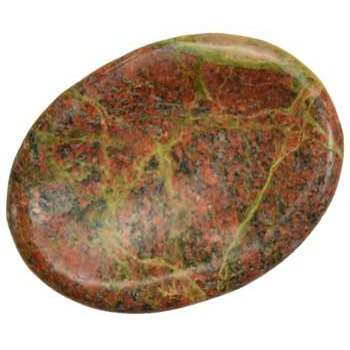
Unakite Worry Stone, 1.25" x 1"
Unakite Worry Stone, 1.25" x 1"- Primary Spiritual Use: Balance
- Secondary Spiritual Use: Optimism
- Element: Water
- Planet: Moon
- Zodiac: Cancer
- Chakra: Third Eye
- Ruling Day: Monday
- Tradition: Wiccan/eclectic
- Intent: Balance, Optimism
Couldn't load pickup availability
Unakite is the only worry stone in the line with a dated American origin story. The stone was named in 1874 by F.H. Bradley of the Tennessee Geological Survey, after the Unaka Mountains where he first identified it in what is now western North Carolina and eastern Tennessee. Geologically, unakite is an altered granite: pink orthoclase feldspar interlocked with green epidote and quartz, the pink-and-green coloration that gives the stone its character. This worry stone is the polished pocket version of that distinctive American mineral. Approximately 1.25 by 1 inches, smooth on every face, sized for thumb work and pocket carry.
Key Features
- Polished natural unakite, smooth on every face for sustained thumb work
- Approximately 1.25 by 1 inches, with a slight oblong profile (sizes and pink-to-green ratios vary, as with all natural stone)
- A gemstone alternative to symbolic pewter worry stones, carrying the lore of this distinctive American pink-and-green combination
- Tactile anchor for heart-chakra meditation, integration work, and quiet handling through the day
- The stone of the Appalachian highlands, named in 1874 by an American geologist for the Cherokee mountain range where he first identified it
Product Details
This worry stone is cut and polished from natural unakite, an altered granite composed of pink orthoclase feldspar, green epidote, and clear or smoky quartz. Approximately 1.25 by 1 inches with a slight oblong profile and a thickness of about three-eighths of an inch; exact dimensions and color proportions vary, since every piece carries a different ratio of pink to green. Major commercial sources are the Appalachian Mountains of the United States (especially North Carolina, Tennessee, and Virginia), South Africa, China, Brazil, and Sierra Leone. Unakite is moderately hard (Mohs 6 to 7 across the constituent minerals), water-safe, salt-tolerant in brief exposure, and sun-safe; it is a durable stone for pocket carry.
Spiritual Significance
Unakite has the unusual distinction, for a worry-stone gemstone, of being a stone whose modern name and identification can be dated precisely. F.H. Bradley of the Tennessee Geological Survey identified it in 1874 during fieldwork in the Unaka Mountains, the range that gave the stone its name. The Unaka Mountains run through what is now western North Carolina and eastern Tennessee, in the southern Appalachians; the name comes from the Cherokee word for "white," referring to the mountains' often fog-covered ridges. The Cherokee people are the traditional inhabitants of this region, and the mountains and rivers throughout this part of the Appalachians still carry Cherokee names.
This makes unakite a distinctly American stone, in the sense that its modern mineralogical identity belongs to the American geological tradition rather than the European or Asian lapidary lineages that named most older stones.
In modern crystal-healing tradition (the post-1970s Western metaphysical movement), unakite is associated primarily with the heart chakra, on the strength of its pink-and-green coloration — the same pairing that gives watermelon tourmaline and other dual-colored stones their heart-chakra associations. In Hindu and Tantric tradition, the heart chakra (anahata) is traditionally green; the addition of pink as a heart-chakra color is a 20th-century Theosophical and New Age contribution. Both layers exist in contemporary practice; many crystal practitioners pair unakite with rose quartz, green aventurine, and emerald for heart-centered workings.
A common framing in modern crystal lore positions unakite as a stone of integration: the pink and the green together representing the integration of opposite or complementary energies, the two halves of the heart's spectrum locked into the same stone. Practitioners often work with unakite during periods of personal change, when integrating new circumstances, relationships, or identities into a settled inner life. Like all modern crystal correspondences, this framework is recent rather than ancient, but it is genuinely the framework most contemporary practitioners use.
The worry-stone form itself has roots that predate all of this. Smooth palm-held stones turn up in ancient Greek practice, in Irish folk magic where they were called fairy stones, and across many cultures' folk centering traditions. This unakite stone is the modern-American gemstone version of that very old practice.
How To Use
There is no single right way to carry a worry stone. A few practices that map to real traditions:
For heart-chakra meditation, hold the stone over the center of your chest while you breathe. The pink-and-green coloration is often visualized as the two halves of the heart's spectrum, the pink for the receptive and compassionate aspect, the green for the active and generative aspect, held together in one stone.
For integration work, hold the stone in your dominant hand during periods of transition or change. Many practitioners use it as the anchor for a daily morning practice during a longer transition: a new home, a new relationship, a new role, a new chapter. The stone becomes the steady thing in the hand while everything else moves.
For altar work, set it on a dish at the center of the altar for heart-themed workings, or pair it with rose quartz and green aventurine for a heart-chakra trio.
For grounding through the day, slip the stone in your pocket on the way out the door and find it again at a stoplight, in line at the grocery, in the long minutes before a difficult conversation. The thumb finds the smooth face, the breath settles a notch, and you continue.
Cleanse unakite as suits the practice. Because unakite is a durable composite stone, it tolerates most common cleansing methods: smoke (sage, mugwort, copal, palo santo), moonlight, sound (a bell or singing bowl), or a brief rinse under running water. Avoid prolonged soaking in salt water, since some of the feldspar component can be sensitive to extended brine contact. Otherwise this is a low-maintenance stone for daily carry.
Pairs Well With
- Pink Calcite Worry Stone, sibling gemstone worry stone for heart-chakra and self-love work in a single-color pink stone
- Selenite Worry Stone, sibling gemstone worry stone for crown-chakra and lunar work where unakite carries the heart
- Moss Agate Worry Stone, sibling gemstone worry stone for root-chakra and earth-energy grounding where unakite carries integration
Frequently Asked Questions
What is unakite, exactly?
Unakite is a type of altered granite, made of three interlocked minerals: pink orthoclase feldspar (the pink), green epidote (the green), and clear or smoky quartz. It was named in 1874 by F.H. Bradley of the Tennessee Geological Survey, after the Unaka Mountains in what is now western North Carolina and eastern Tennessee, where he first identified it. Most of the world's commercially polished unakite still comes from the Appalachian region, though it is also mined in South Africa, China, Brazil, and Sierra Leone.
Why is unakite associated with the heart chakra?
In modern Western crystal-healing tradition, the pink-and-green color combination is the visual signature of heart-chakra work, parallel to watermelon tourmaline and other dual-colored pink-green stones. The pink is read as the receptive, compassionate aspect of the heart; the green as the active, generative aspect. The combination in one stone is often framed as integration of those two aspects. As with all modern crystal-chakra correspondences, this framework comes from 20th-century Theosophical and New Age writers rather than from the original Hindu and Tantric tradition, where the heart chakra (anahata) is traditionally green and pink does not figure in the original color schema.
Where does the name "unakite" come from?
From the Unaka Mountains in the southern Appalachians, where the stone was first identified by geologist F.H. Bradley in 1874. The mountains' name comes from the Cherokee word for "white" (sometimes anglicized as "Unicoi" elsewhere in the region), referring to the often fog-covered ridges of the range. The Cherokee people are the traditional inhabitants of this part of the Appalachians, and the regional toponymy throughout still carries Cherokee names.
How do I cleanse it safely?
Unakite is durable (Mohs hardness 6 to 7) and tolerates most cleansing methods: smoke (sage, mugwort, copal, palo santo), moonlight, sound, or a brief rinse under running water. Avoid prolonged soaking in salt water, since the feldspar component can be sensitive to extended brine. Otherwise this is a low-maintenance stone for daily carry.
Will it scratch or break?
Unakite is hard enough to handle daily pocket carry alongside keys and change. The pink-and-green pattern is structural rather than surface, so scratches will not disrupt the appearance. It can chip if dropped on tile or concrete, since granite has a grainy fracture, but it is one of the more durable worry stones in the line.
What's the difference between this and the other gemstone worry stones?
All four are gemstone worry stones in the same family of working object, each carrying a different lore stack. Pink Calcite carries heart-chakra and self-love associations. Selenite carries crown-chakra and lunar associations. Moss Agate carries earth-energy and gardener's-stone associations. Unakite carries heart-chakra integration and the distinctively American Appalachian regional lore. Many practitioners keep multiple, choosing which to carry based on the day's intention.
Spend $50 & enjoy guilt-free shopping with our free shipping on all orders. Get your favorite items delivered right to your door at no extra cost.