



Plentiful Earth | Spiritual Store
Selenite Worry Stone, 1.5"
Selenite Worry Stone, 1.5"- Primary Spiritual Use: Cleansing
- Secondary Spiritual Use: Connection
- Element: Water
- Planet: Moon
- Zodiac: Taurus
- Chakra: Crown
- Ruling Day: Monday
- Tradition: Wiccan/eclectic
- Intent: Cleansing, Peace, Purification
Couldn't load pickup availability
The selenite worry stone is two old practices in one small object. The worry stone form, polished and palm-sized, goes back at least as far as ancient Greece. And selenite, named after Selene, the Greek goddess of the moon, has been carried, ground, and used in lapidary work since antiquity for its pearly shimmer and translucent light. This stone marries both traditions: roughly an inch and a half across, polished smooth, sized for thumb work and pocket carry, with the lunar lore that gives the stone its name.
Key Features
- Polished natural selenite, smooth on every face for sustained thumb work
- Approximately 1.5" (sizes and translucence vary slightly, as with all natural stone)
- A gemstone alternative to symbolic pewter worry stones, carrying the lunar-named crystal's specific lore
- Tactile anchor for crown-chakra meditation, lunar work, and crystal cleansing rituals
- Sits comfortably alongside modern crystal-healing tradition, witchcraft moon work, and the broader ancient worry-stone practice
Product Details
This worry stone is cut and polished from natural selenite, the crystalline form of gypsum (calcium sulfate dihydrate). Approximately 1.5 inches across, polished smooth, with the soft pearly translucence that gives selenite its character; exact dimensions and luminescence vary by piece. Major commercial sources are Mexico, Morocco, and the United States; the most famous selenite formation in the world is the Cave of the Crystals in Naica, Chihuahua, which contains the largest natural crystals ever documented. Selenite is soft (Mohs hardness 2) and water-sensitive: keep it away from water, salt, and harder stones, since both moisture and friction will damage the surface.
Spiritual Significance
Selenite takes its name from Selene, the Greek goddess of the moon. The lunar association is not modern crystal-healing invention; the name comes from antiquity, after the stone's pearly, moonlight-like translucence. The mineral was used in classical Greek and Roman lapidary work and was known to Pliny the Elder, who wrote about it in his Natural History around 77 CE.
In modern crystal-healing tradition (the post-1970s Western metaphysical movement that codified specific crystal-to-intention correspondences), selenite occupies a distinctive role: it is the stone most often paired with the crown chakra (sahasrara, the seventh chakra in the original Hindu and Tantric framework), and it is uniquely associated with the function of cleansing other crystals. Many crystal practitioners keep a selenite slab or wand specifically as a charging plate for other stones, on the principle that selenite itself does not need to be cleansed.
That cleansing-other-stones tradition is recent rather than ancient. Like most modern crystal correspondences, it emerged through 20th-century Theosophical and New Age writers and was popularized in crystal-healing manuals from the 1980s onward. The deeper lore of the crown chakra in classical Tantric tradition, where sahasrara is described as the thousand-petaled lotus at the top of the head and the seat of pure consciousness, predates the stone correspondences by many centuries.
Within modern witchcraft, selenite is most often worked with in moon rituals (esbats, full-moon work, lunar phase magic), in crown-chakra meditation, and in space-clearing practice. Many practitioners keep a selenite stick or wand on the altar specifically for clearing the energy of a workspace before ritual.
The worry-stone form itself has roots that predate any of this crystal lore. Smooth palm-held stones turn up in ancient Greek practice, in Irish folk magic where they were called fairy stones, and across many cultures' folk centering traditions long before any modern label existed for what they were doing. This selenite stone is the lunar-named gemstone version of that very old form.
How To Use
There is no single right way to carry a worry stone. A few practices that map to real traditions:
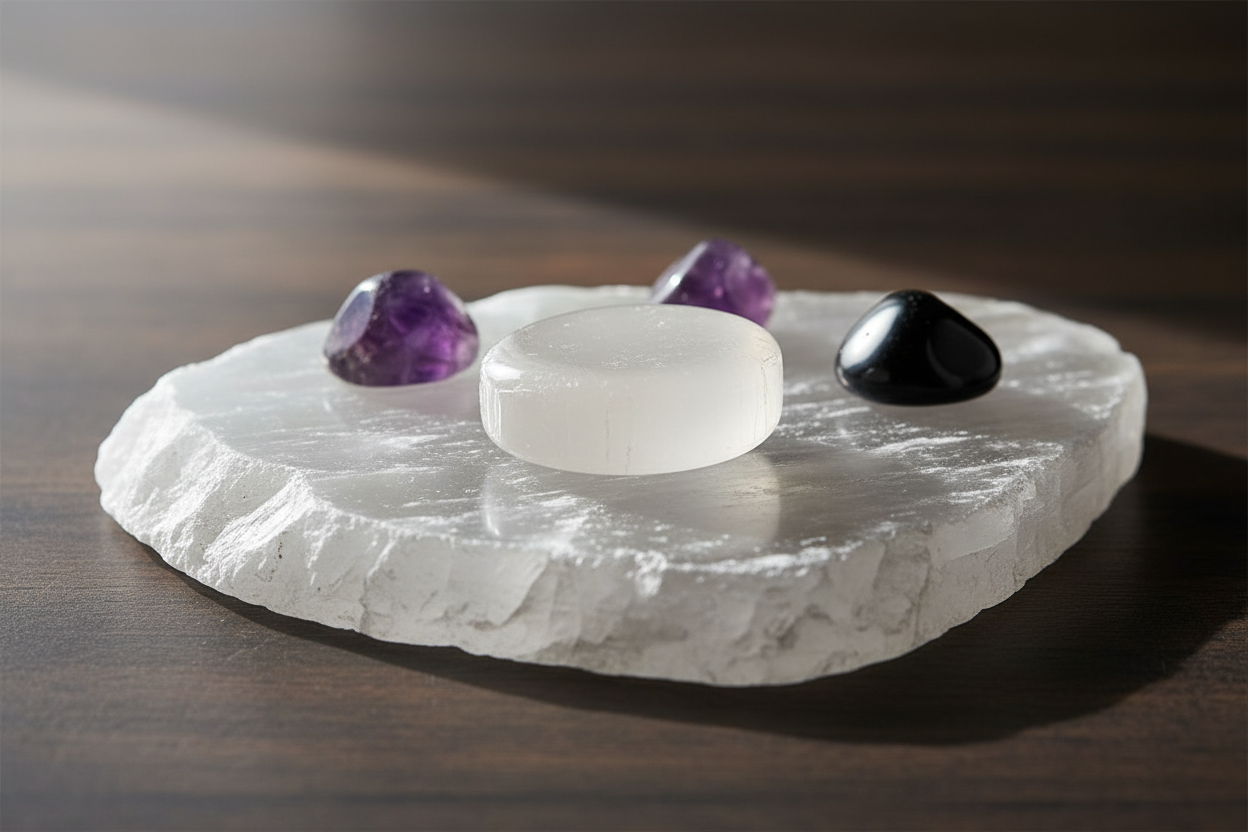
For crown-chakra meditation, hold the stone briefly over the crown of your head before placing it on your altar or beside your seat. Many practitioners use a selenite stone alongside an amethyst or clear quartz to layer the crown- and third-eye-chakra work.
For full-moon and lunar phase work, set the stone outside or on a windowsill during the night of a full moon to charge it under the lunar light. Some practitioners also do this with the new moon for releasing work and with the waxing moon for drawing work.
For cleansing other crystals, set your other stones on or beside the selenite worry stone for several hours or overnight. The tradition holds that selenite cleanses neighboring stones without itself needing to be cleansed; whether you take this as literal energetic mechanics or as a working ritual framework, it is one of the most common modern crystal practices.
For grounding through the day, slip the stone in your pocket on the way out the door and find it again at a stoplight, in line at the grocery, in the long minutes before a difficult conversation. The thumb finds the smooth face, the breath settles a notch, and you continue.
Cleanse selenite carefully. Selenite is water-sensitive and salt-sensitive: do not submerge it in water or bury it in salt; both can dissolve the surface or pit the polish. Safe cleansing methods are smoke (sage, mugwort, copal, palo santo), moonlight overnight on the windowsill, or sound (a bell or singing bowl held near it). The tradition holds that selenite is largely self-cleansing, so many practitioners simply rest it in moonlight occasionally as a devotional rhythm rather than from any sense that it has gathered residue.
Pairs Well With
- Pink Calcite Worry Stone, the sibling gemstone worry stone for heart-chakra work where selenite carries the crown
- Black Obsidian Worry Stone, a contrasting worry stone with grounding and protective lore where selenite carries cleansing and elevation
- Selenite Heart with Flower of Life, a selenite-family altar piece in heart form for sustained cleansing and meditative work
Frequently Asked Questions
What is selenite for?
The worry stone form has been used across cultures for centuries as a tactile aid for centering and contemplation. Selenite is a beloved variant of the form for its pearly translucence, its lunar etymology (named after the Greek moon goddess Selene), and its association in modern crystal tradition with the crown chakra and the function of cleansing other crystals. It is a small, steady, traditional object meant for the hand to find, and for whatever centering, lunar, or cleansing work you bring to it.
Why is selenite associated with the moon?
The name comes from antiquity. The Greek lapidary tradition called the stone selenites lithos (literally "moonstone") for its pearly, moonlight-like translucence; the word predates the modern "moonstone" mineral (which is actually a different stone, a variety of feldspar). The connection runs through the Greek goddess Selene, the personification of the moon in classical mythology, daughter of Hyperion and sister of Helios.
Does selenite really cleanse other crystals?
This is a modern crystal-tradition belief that emerged in the post-1970s Western metaphysical movement and was popularized in crystal-healing manuals from the 1980s onward. Many practitioners use it as a working framework: a selenite slab, wand, or worry stone as a charging plate for other stones. Whether you take the cleansing function literally or as a ritual structure for setting and refreshing intention, it is one of the most common modern crystal practices.
How do I cleanse it safely?
Selenite is water-sensitive and salt-sensitive. Do not submerge it in water or bury it in salt; both will dissolve or pit the surface. Safe cleansing methods are smoke (sage, mugwort, copal, palo santo), moonlight overnight on the windowsill, or sound (a bell or singing bowl). The tradition holds that selenite is largely self-cleansing.
Will it scratch or break?
Selenite is very soft (Mohs hardness 2), softer than a fingernail in some pieces. Keep it in a separate pouch from harder stones, keys, or sand. It also has a single cleavage plane that can split if dropped on a hard surface. If your stone picks up scratches, small chips, or a softened polish over time, that is the nature of the material rather than damage you need to fix.
What's the difference between this and the Pink Calcite Worry Stone?
Both are gemstone worry stones in the same family of working object. Pink Calcite carries heart-chakra and self-love associations; selenite carries crown-chakra and lunar associations. Many practitioners keep both, one for the heart and one for the crown, sometimes paired during a single meditation to span the upper-chakra spectrum.


Spend $50 & enjoy guilt-free shopping with our free shipping on all orders. Get your favorite items delivered right to your door at no extra cost.