



Plentiful Earth | Spiritual Store
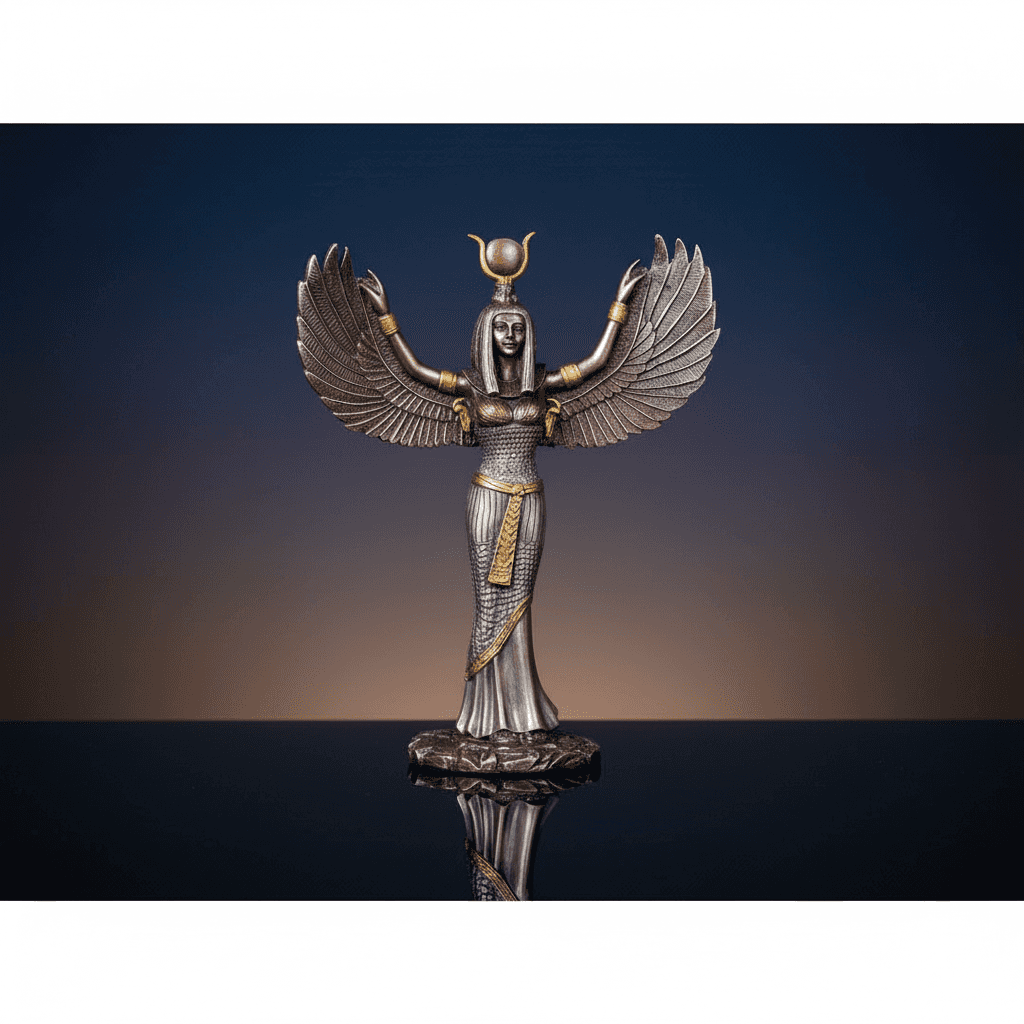
Silver Winged Isis Statue, 12 Inches
Silver Winged Isis Statue, 12 Inches- Primary Spiritual Use: Protection
- Secondary Spiritual Use: Rebirth
- Element: Water
- Planet: Moon
- Zodiac: Cancer
- Chakra: Crown
- Ruling Day: Monday
- Tradition: Egyptian revival
- Intent: Protection, Rebirth
Couldn't load pickup availability
When you build an altar for Isis, you tap into one of the longest continuous religious lineages in human history. Worship of Aset, known to the Greeks as Isis, dates back more than four thousand years, and her cult outlived the pharaohs to spread across the Mediterranean before reawakening in modern Kemetic and goddess-centered practice. This statue gives her a place to land: a hand-painted winged Isis on a silvery base with gold and copper-red highlights, her wings spread wide in the protective gesture known from tomb art.
Use her as the focal point of a working, the silent presence at a daily ritual, or the figure you keep nearby through a season of transformation.
Key Features
Winged in the gesture of protection. Isis with her wings spread wide, the iconography of shelter seen across Egyptian temple and tomb art.
Hand-painted silver, gold, and copper-red. A silvery base lifted with gold and copper-red detailing, a cooler palette than the classic black-and-gold winged Isis.
A devotional focal point, not an archaeological reproduction. A contemporary work that draws on Egyptian iconography rather than reproducing a specific historical piece.
Product Details
- Height: about 12 inches (approximately 9 3/4 x 3 1/2 x 11 7/8 inches)
- Material: hand-painted resin
- Finish: silvery base with gold and copper-red highlights
- Form: winged Isis, standing with wings outspread
- Use: deity statue, altar focal point, protection and rebirth work
- SKU: SI581
- Sold by Plentiful Earth
The Spiritual Significance
Isis is one of the most important goddesses of ancient Egypt and one of the most widely worshipped deities of the ancient Mediterranean. In myth she is the wife of Osiris and the mother of Horus, the great magician, weret-hekau or Great of Magic, who reassembled Osiris after his murder and revived him long enough to conceive their son. From this comes her association with rebirth, magic, protection, and motherhood, and her wings appear again and again in Egyptian art as a gesture of shelter wrapping the living and the dead.
On a modern altar, Isis is honored for protection, magic, healing of the spirit, and renewal through hard transitions. Devotion to her comes through many lineages: Kemetic reconstruction, the Fellowship of Isis, goddess-centered Paganism, ceremonial magic, and simple personal practice. You do not need formal initiation to work with her; many practitioners keep her presence on the altar and speak to her directly, as Egyptians did for thousands of years.
How To Use
- Place her where the altar lives, giving the wings a little clearance on each side so they read as outstretched rather than crowded.
- Make the introduction: clean her with a soft cloth, hold her, and say what you hope for from the relationship; a first offering of water, bread, or a candle is a traditional welcome.
- Use her as a focal point for protection or rebirth work, bringing her forward and lighting a candle when a working calls for her specifically.
- Keep offerings simple: fresh water in a small dish, a flower, a stick of incense such as frankincense or kyphi.
- Cleanse and refresh as needed, wiping the resin with a dry or barely damp cloth so the painted detail is not disturbed.
Pairs Well With
- Egyptian Goddess Isis Statue, 13 Inch the black-and-gold winged Isis, a warmer-toned companion.
- Egyptian Winged Isis Statue, 12 Inch another winged Isis in black and gold.
- Hathor Egyptian Goddess Statue, 11 Inches Isis and Hathor were syncretized in later Egyptian religion.
- Solid Brass Ankh, 3.5" x 6.5" the Egyptian symbol of life for the altar.
- Ancient Egyptian Magic by Eleanor L. Harris a practical guide to Egyptian devotion and ritual.
History & Occult Background
Worship of Isis is attested from the Old Kingdom and grew until she became one of the supreme deities of Egypt, absorbing attributes of other goddesses including Hathor. By the Greco-Roman period her cult had spread across the Mediterranean as one of the great mystery religions, with temples from Rome to Britain. Her worship was only gradually displaced as Christianity rose, and her imagery as the divine mother with her child influenced later religious art. Modern devotion comes through Kemetic reconstruction, the Fellowship of Isis founded in 1976, goddess spirituality, and ceremonial magic, where the veiled Isis is a central esoteric image.
Frequently Asked Questions
How is this different from the other Isis statues?
This is the silver-toned winged Isis, hand-painted on a silvery base with gold and copper-red highlights, a cooler palette than the black-and-gold winged Isis statues. All depict the same goddess; the choice is one of finish.
Who is Isis?
She is the ancient Egyptian goddess of magic, protection, motherhood, and rebirth, wife of Osiris and mother of Horus, and the great magician who restored her murdered husband. She became one of the most widely worshipped deities of the ancient world.
Is this an archaeological reproduction?
No. It is a modern devotional sculpture drawing on Egyptian iconography, not a museum replica. Treat it as contemporary devotional art pointing back to her tradition.
What offerings traditionally go to Isis?
Fresh water, milk, bread, flowers such as lotus or roses, honey, and incense like frankincense, myrrh, or kyphi. Freshness and intention matter more than abundance; refresh perishable offerings regularly.
How do I care for the statue?
Dust with a soft dry cloth or barely damp microfiber, keep it out of prolonged direct sunlight so the paint does not fade, and avoid soaking the resin.

Spend $50 & enjoy guilt-free shopping with our free shipping on all orders. Get your favorite items delivered right to your door at no extra cost.