



Plentiful Earth | Spiritual Store
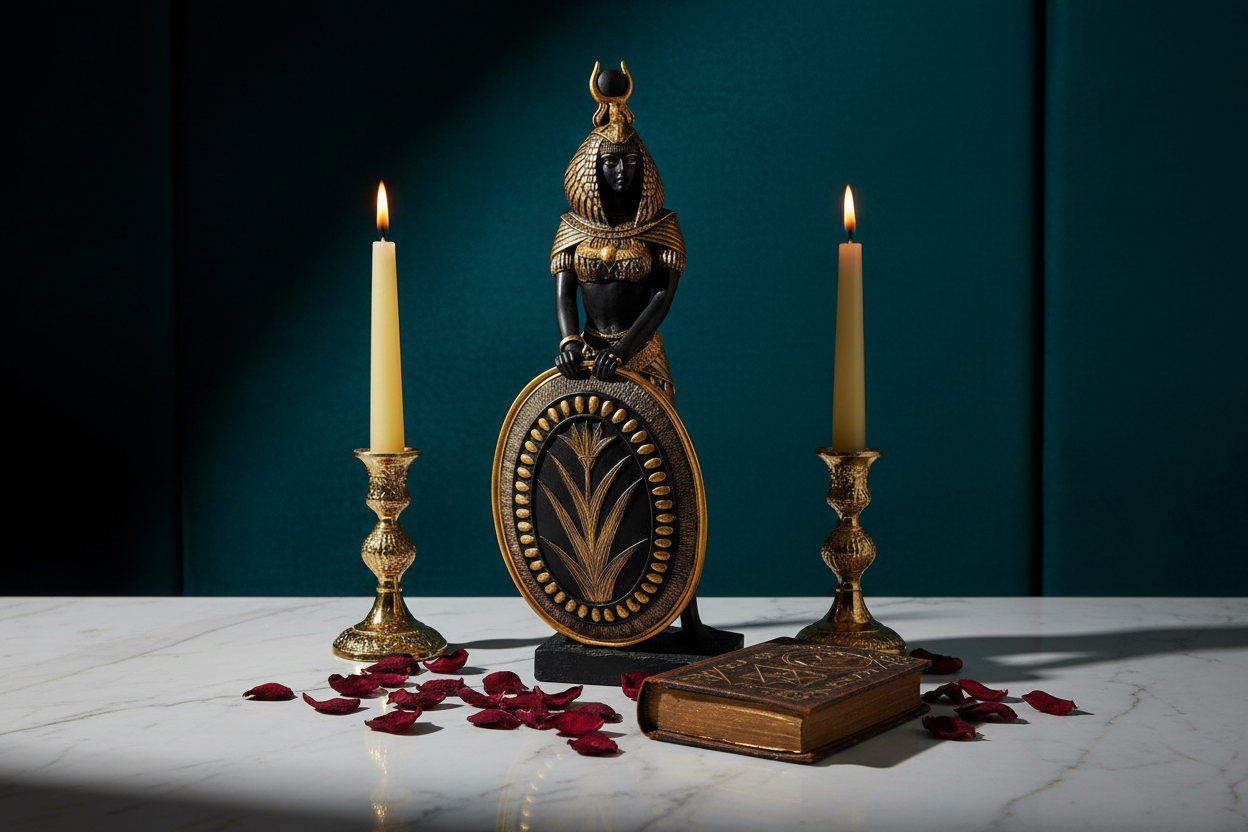
Egyptian Goddess Isis Statue, Black and Gold, 13 Inch
Egyptian Goddess Isis Statue, Black and Gold, 13 InchThis item ships free in the U.S.Other rates are calculated at checkout.
Couldn't load pickup availability
- Primary Spiritual Use: Protection
- Secondary Spiritual Use: Rebirth
- Size: 13 in
- Material: Cold-cast resin
- Element: Water
- Planet: Moon
- Zodiac: Cancer
- Chakra: Crown
- Ruling Day: Monday
- Tradition: Egyptian revival
- Intent: Protection, Rebirth
When you build an altar for the goddess Isis, you're tapping into one of the longest continuous religious lineages in human history. Worship of Aset (Isis in her Greek-period name) dates to the Old Kingdom around 2400 BCE, and her cult outlived the pharaohs themselves, spreading across the Mediterranean as the Greco-Roman Isiac mysteries before reawakening in modern Kemetic and goddess-centered practice. This Isis statue gives her a place to land on your altar: 13 inches of cold-cast resin painted black and gold, wings spread wide in the protective gesture you'd recognize from tomb art, a shield in her hand bearing a symbol associated with Nile rebirth. Use her as the focal point of a working, the silent presence at your morning ritual, or the figure you keep nearby when you're moving through a season of transformation.
Key Features of This Isis Statue
Winged in the gesture of protection. Egyptian art repeatedly depicts Isis with outstretched wings shielding the dead or the living she chooses to protect. This statue carries that iconography forward, wings spread wide, recognizable to anyone familiar with sarcophagus art or temple reliefs.
Cold-cast resin, hand-painted in black and gold. The matte black base with gold highlight detailing reads dramatically in candlelight without being so polished it feels stage-set. Cold-cast resin holds detail well; the wings, shield, and headdress all keep their crispness even up close.
A devotional focal point, not an archaeological reproduction. The design draws on Egyptian iconography (wings, headdress, shield) without claiming to be a museum-grade replica. Read it the way you'd read modern Kemetic devotional art: a contemporary work that points back to a tradition rather than reproducing it.
Product Details
- Height: approximately 13 inches (13 3/8 inches per manufacturer)
- Width: approximately 9 7/8 inches
- Depth: approximately 4 1/8 inches
- Material: cold-cast resin
- Finish: hand-painted black with gold detailing
- Base: felt-bottomed for safe placement on wood or stone surfaces
- Manufacturer style sold as the "Shielded Isis" form
The Spiritual Significance
Isis is one of the most important goddesses in ancient Egyptian religion and one of the most-worshipped deities of the ancient Mediterranean world. In Egyptian myth she's the wife of Osiris and the mother of Horus; the great magician (weret-hekau, "great of magic") who reassembled Osiris after his death and resurrected him long enough to conceive Horus. From this comes her association with rebirth, magic, protection, and motherhood. Her wings appear repeatedly in Egyptian art as a gesture of shelter, often wrapping the dead in tomb iconography or the living in devotional reliefs.
By the Greco-Roman period her cult had spread across the Mediterranean as one of the major mystery religions; the Isiac mysteries were practiced from Rome to Britain. Modern devotion comes through multiple lineages: Kemetic Orthodoxy and other reconstructionist Egyptian traditions, the Fellowship of Isis, goddess-centered eclectic paganism, Hermetic and ceremonial magical orders that engage Isis-Veiled imagery, and personal devotional practice outside any formal tradition.
You don't need lineage to work with her. Many practitioners simply keep her presence on the altar and speak to her directly, the way Egyptians did three thousand years before.
How To Use This Isis Statue
- Place her where the altar lives. A central altar position works for active devotional practice; a quieter shelf or windowsill works if she's part of a household altar that doesn't get formal worship but holds a daily presence. The wings need a little clearance on either side so they read as outstretched rather than crowded.
- Make the introduction. If this is your first Isis statue, take a few minutes when she arrives to clean her with a soft dry cloth, hold her, and say (silently or aloud) what you're hoping for from the relationship. Practitioners coming from Kemetic traditions often offer water, bread, or a candle as a first welcome.
- Use her as a focal point for protection or rebirth work. When the working calls for her specifically (a protective ritual, a transformation working, a Heka or magic-focused spell), bring the statue forward, light a candle in front of her, and let her be the center of the working. When the working is for something else, she can stay on the altar without being activated; her presence does not demand constant attention.
- Keep offerings simple at first. Fresh water in a small dish, a flower, a piece of bread, a stick of incense. Egyptian devotional practice does not require elaborate offerings, especially in modern home contexts.
- Cleanse and refresh as needed. Wipe the resin with a dry or barely damp cloth (the gold leaf detail can lift if scrubbed). If you're moving the altar, smoke the statue lightly with frankincense or kyphi (the classical Egyptian incense blend) before resettling her.
Pairs Well With
- Hathor Statue, 11": The other major Egyptian goddess statue in the PE catalog; Isis and Hathor were syncretized in later Egyptian religion (Isis sometimes wears Hathor's cow-horn-and-sun-disc crown), and they pair naturally on an Egyptian devotional shelf.
- Solid Brass Ankh, 3.5" x 6.5": The ankh is the Egyptian symbol of life and one of the most common ritual objects placed on Isis altars; the brass version reads warm against the statue's gold detailing.
- Pentacle Frankincense Jar Candle, 90 Hours: Frankincense was central to Egyptian temple worship and remains a standard offering scent for Isis devotional practice; the long burn time supports extended altar work.
- Bronze Ankh Necklace, 2" x 3/4": A wearable companion for daily devotional practice when you want to carry the Egyptian symbol of life out of the altar room and into the day.
- Ancient Egyptian Magic by Eleanor L. Harris and Normandi Ellis: A practical introduction to Heka, devotional offerings, and ritual structure for practitioners building out a serious Egyptian magical practice.
Frequently Asked Questions
Is this statue archaeologically accurate?
It's a modern devotional sculpture in the Egyptian-revival decorative style, not a museum reproduction. The wings, headdress, and stance draw on ancient Egyptian iconography, but the shield and exact symbol on it are artistic interpretations rather than a specific historical hieroglyph. Treat the statue as a contemporary work pointing back to a tradition.
I'm new to working with Isis; where do I start?
Start with presence. Place the statue somewhere you'll see daily, learn one or two of her names (Aset, Isis, Weret-Hekau "Great of Magic"), and read a basic introduction to Egyptian religion. Most modern practitioners begin without formal initiation; the relationship is the practice, not the credentialing.
How do I care for the cold-cast resin?
Dust with a soft dry cloth or barely damp microfiber, never abrasive cleaner. Keep her out of direct prolonged sunlight (the gold paint will fade over years) and avoid temperature swings near heaters or freezers. The felt base on the bottom protects wood altar surfaces from scratches.
Can I work with this statue outside a Kemetic tradition?
Yes. Many practitioners engage Isis through eclectic paganism, Wicca, Hermetic and ceremonial magical orders, the Fellowship of Isis, or simple personal devotion. The statue is a focal point; the tradition framework is yours to choose. Treat her with the respect any devotional image deserves and the working takes shape from there.
What offerings traditionally go to Isis?
Fresh water in a small dish, milk, beer, bread, flowers (lotus or roses in modern practice), honey, and incense like frankincense, kyphi, or myrrh. Egyptian offerings did not require expense; freshness and intention mattered more than abundance. Refresh perishable offerings daily or compost them respectfully when they wilt.
What does the symbol on her shield mean?
The manufacturer describes the shield as bearing a symbol of Nile rebirth, drawing on the cluster of Egyptian motifs associated with annual flooding, fertility, and Osiris-Isis resurrection mythology (the Nile flood was thematically tied to Osiris's return). The specific design is a modern artistic interpretation rather than a hieroglyph you'd find in tomb art.


Spend $50 & enjoy guilt-free shopping with our free shipping on all orders. Get your favorite items delivered right to your door at no extra cost.