



Plentiful Earth | Spiritual Store
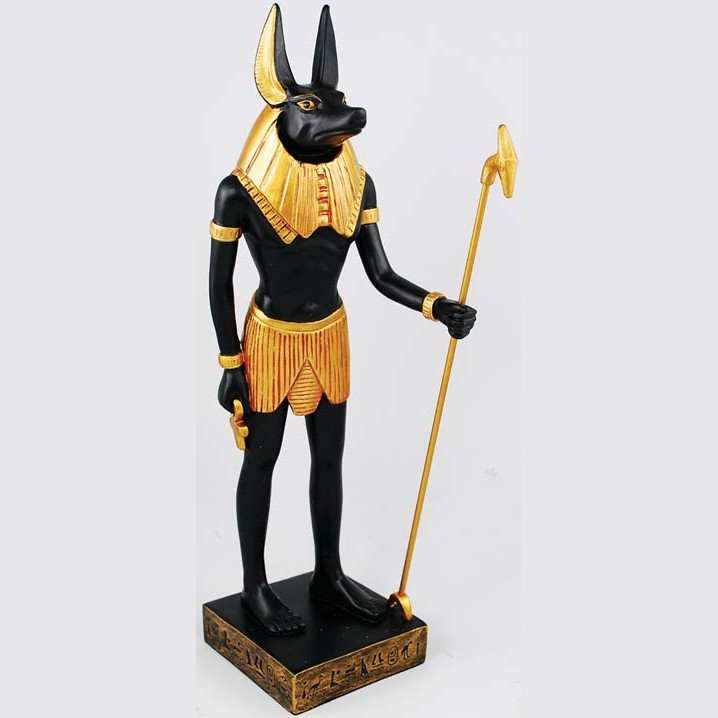
Anubis Egyptian God Statue, 12 Inches
Anubis Egyptian God Statue, 12 Inches- Primary Spiritual Use: Protection
- Secondary Spiritual Use: Transformation
- Element: Earth
- Planet: Mercury
- Zodiac: Gemini, Virgo
- Chakra: Root
- Ruling Day: Wednesday
- Tradition: Egyptian revival
- Intent: Protection, Transformation
Couldn't load pickup availability
Anubis is the jackal-headed god who stands at the threshold between life and what comes after. To the ancient Egyptians he was the guardian of the dead, the embalmer who prepared the body for eternity, and the guide who led souls through the underworld to judgment. Where there was a boundary to be watched or a passage to be made safe, Anubis was the one who kept it.
This 12-inch statue brings that watchful guardian presence to an altar or sacred space, a focal point for protection, for honoring the dead, and for any work that crosses a threshold from one state to another.
Key Features
The jackal-headed guardian. Depicted in Anubis's classic form, the upright jackal head that marks him as god of the dead and protector of thresholds.
Twelve inches with gold-toned detail. A substantial altar figure finished with gold-toned accents in the black-and-gold palette of Egyptian devotional art.
A devotional focal point. Made as a modern devotional sculpture for Kemetic, eclectic Pagan, or ancestor-honoring practice, not as a museum reproduction.
Product Details
- Height: about 12 inches
- Material: cold-cast resin
- Finish: dark with gold-toned accents
- Form: jackal-headed Anubis figure
- Use: deity statue, altar focal point, protection and ancestor work
- SKU: SA717
- Sold by Plentiful Earth
The Spiritual Significance
Anubis (Anpu in the Egyptian language) is one of the oldest gods of Egypt, attested from the earliest dynasties as lord of the necropolis and master of mummification. In the myth of Osiris it was Anubis who embalmed the murdered god and so performed the first mummification, and it was Anubis who weighed the heart of the dead against the feather of Ma'at to determine their fate. He is the protector of graves, the opener of the ways to the afterlife, and the steady guardian who makes the most frightening passage safe.
On a modern altar, Anubis is honored as a guardian and a guide. Practitioners call on him for protection, especially of boundaries and thresholds, for help in times of grief and death, for ancestor work and funerary rites, and for any transition that asks you to move from one state of being to another. His energy is steady, serious, and protective rather than fierce; he is the one who keeps watch so the work can be done.
How To Use
- Place the statue where you want a guardian presence, on an altar, by a doorway, or in a space dedicated to the dead and the ancestors.
- To welcome him, clean the statue, hold it, and speak his name and what you hope for from the relationship; a first offering of water, incense, or a candle is traditional.
- Call on him for protection or threshold work by lighting a candle before him and stating your request clearly and with respect.
- For ancestor and grief work, set his image near photographs or mementos of the dead and make simple offerings as you tend their memory.
- Keep the space clean and offerings fresh; dust the statue with a soft cloth and refresh water or perishable offerings rather than letting them sit.
Pairs Well With
- Egyptian Goddess Isis Statue, 13 Inch Isis and Anubis stand together in the Osiris myth, where Anubis embalms the god Isis restores.
- Horus Statue, 14 Inches the falcon sky god, to build out an Egyptian devotional altar.
- Solid Brass Ankh, 3.5" x 6.5" the Egyptian symbol of life for the altar.
- Frankincense Incense Sticks a sacred Egyptian offering scent to burn before him.
- Ancient Egyptian Magic by Eleanor L. Harris a practical guide to Egyptian devotion and ritual.
History & Occult Background
Anubis was among the most important funerary deities of ancient Egypt, his worship attested from the Old Kingdom, with priests who wore jackal masks while preparing the dead. The jackal became his animal because these creatures were seen prowling the desert edges of cemeteries; the Egyptians turned the scavenger of the necropolis into its divine protector. As Egyptian religion developed, some of his funerary roles were shared with Osiris, but Anubis remained the embalmer, the keeper of the scales of judgment, and the guide of souls. He entered the modern Western imagination through Egyptomania and now appears widely in Kemetic reconstructionist practice and eclectic Paganism as a protector and a god of the threshold.
Frequently Asked Questions
Who is Anubis?
He is the jackal-headed Egyptian god of the dead, of mummification, and of the passage to the afterlife. He embalmed Osiris in myth and weighs the heart of the dead at judgment, serving as both guardian of the tomb and guide of souls.
What do people work with Anubis for?
Protection, especially of boundaries and thresholds; grief, death, and funerary work; ancestor veneration; and life transitions. His steady, guardian energy suits any working that involves crossing safely from one state to another.
Is this an archaeological reproduction?
No. It is a modern devotional sculpture that draws on Egyptian iconography rather than reproducing a specific historical piece. Read it the way you would read contemporary Kemetic devotional art, a present-day work pointing back to an ancient tradition.
What offerings suit Anubis?
Water, incense (frankincense and myrrh are historically appropriate), candles, and bread are all traditional. Many devotees also honor him through care for the dead and the ancestors, keeping their memory and their resting places tended.
How do I care for the statue?
Dust it with a soft dry cloth and keep it out of prolonged direct sunlight so the gold-toned finish does not fade. Avoid soaking the resin; a barely damp cloth is enough if it needs more than dusting.


Spend $50 & enjoy guilt-free shopping with our free shipping on all orders. Get your favorite items delivered right to your door at no extra cost.