



Plentiful Earth | Spiritual Store
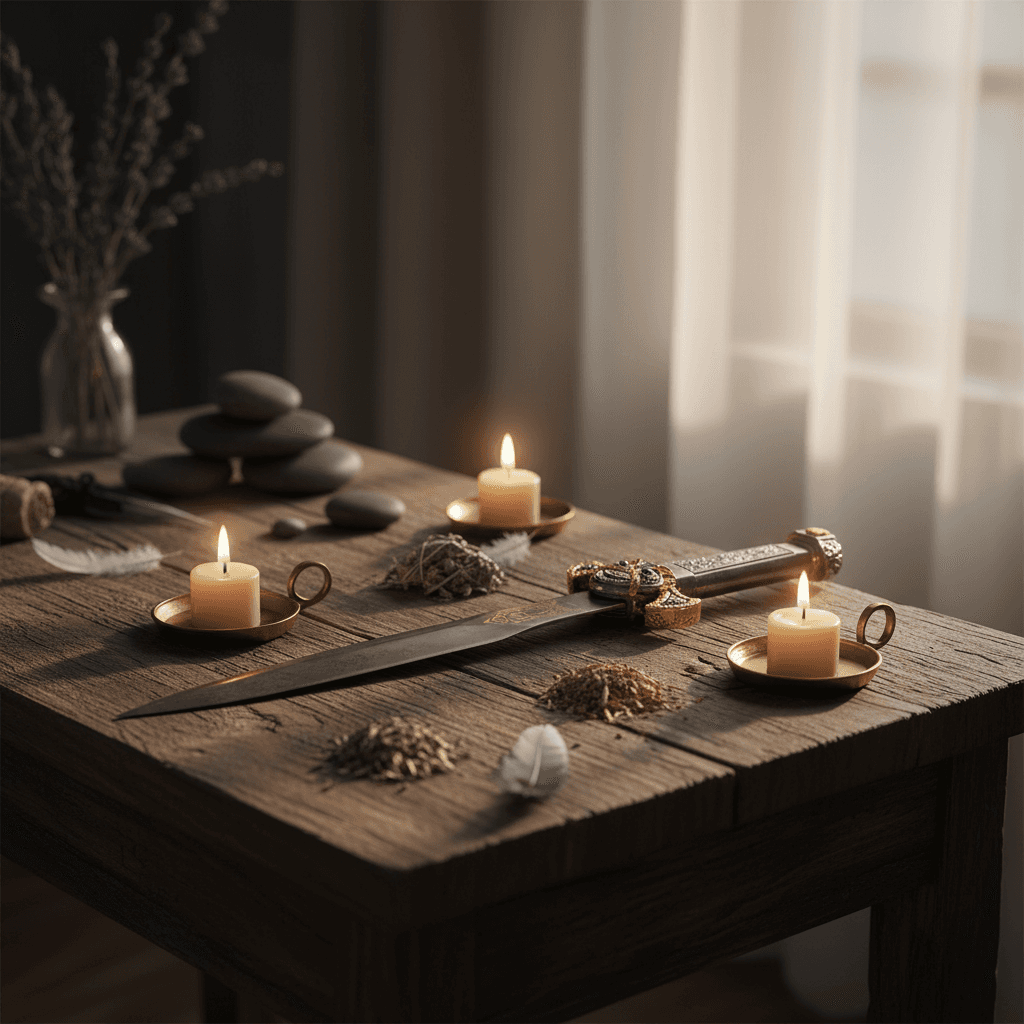
Ritual Nile Dagger, Egyptian-Style Blade with Scabbard
Ritual Nile Dagger, Egyptian-Style Blade with ScabbardOrders over $50 ship free in the U.S.Other rates are calculated at checkout.
Couldn't load pickup availability
- Primary Spiritual Use: Intention
- Secondary Spiritual Use: Transformation
- Element: Fire
- Planet: Mars
- Zodiac: Aries, Scorpio
- Chakra: Solar Plexus
- Ruling Day: Tuesday
- Tradition: Wiccan
- Intent: Intention, Transformation
The sword and dagger have belonged to ceremonial magic and ritual practice for as long as either has existed. In the Western tradition, the sword is one of the four classical ritual implements alongside the wand, the cup, and the pentacle; it corresponds to the element of Air, to the directed will, to clarity of thought and decisive intention. In Egyptian magic and its modern derivatives, the blade is an instrument of spiritual authority: it cuts, it separates, it draws a boundary between what is invited in and what is not.
This Ritual Nile Sword Dagger is styled after Egyptian design motifs: a stainless steel blade, an aluminum scabbard for safe storage, and a handle and guard with the elegance of historical Egyptian-inspired metalwork. It is a ritual tool for practitioners who want the presence and weight of an actual blade in their ceremonial work, rather than a symbolic substitute. The combination of dagger length and sword proportions makes it versatile across altar use, circle work, and dedicated Egyptian-style ritual practice.
Key Features
Stainless steel blade for lasting use. Stainless steel holds an edge without the rust vulnerability of plain carbon steel, making this an appropriate material for a ritual dagger that will be handled regularly, stored in a scabbard, and carried in and out of ceremonial contexts. The blade is designed for ceremonial cutting (energy work, circle casting) rather than physical use.
Aluminum scabbard for safe storage and transport. The included scabbard protects the blade and makes storage and altar display safe and clean. Aluminum is lightweight, which means the scabbard does not add significant weight when the piece is displayed.
Egyptian-inspired design with handle and guard detail. The handle and guard design draw from historical Egyptian motifs: the aesthetic language of ancient Egyptian ceremonial weapons and ritual objects that appear in hieroglyphic imagery and archaeological finds. This makes the piece specifically appropriate for practitioners working within or inspired by Kemetic, Egyptian Wicca, or Thelemic magical traditions.
Product Details
- Blade material: Stainless steel
- Scabbard material: Aluminum
- Design: Egyptian motif handle, guard, and blade detailing
- Includes: Scabbard
- Intended use: Ritual and ceremonial; not for physical cutting or combat
- Note: Handle with appropriate care; blade is sharp
The Spiritual Significance
In Wiccan practice, the athame (ritual dagger) is the primary directive tool: it represents the element of Air, the masculine principle, and the directing of will. It is used to cast the ritual circle, call the quarters, consecrate the other tools, and define the boundary between sacred space and ordinary space. A full sword carries the same correspondences with greater presence; some traditions use both, reserving the sword for formal circle work and the athame for more intimate personal ritual.
In Egyptian magical tradition, bladed weapons appear in the hands of protective deities and their human representatives. Horus carries a spear; Sekhmet carries a blade; the khepesh (the Egyptian sickle-sword) appears in the imagery of both warfare and divine protection. Ritual weapons in the Egyptian context are not about violence but about the assertion of divine order against chaos: the blade that separates ma'at (truth, balance, cosmic order) from isfet (chaos, disorder, wrongdoing). For practitioners who work with Egyptian deities or within Kemetic traditions, a blade in this aesthetic context carries that symbolic weight.
For practitioners who use the sword in banishing: the classic Qabalistic Cross and Lesser Banishing Ritual of the Pentagram (LBRP) traditions, which use a pointed tool to trace pentagrams in the cardinal directions, a sword or dagger of appropriate weight and presence deepens the engagement with those ritual acts beyond what a finger or wand accomplishes.
How To Use
- Consecrate before first ritual use. Pass the blade through incense smoke (frankincense is traditional for consecration), sprinkle with salt water, hold briefly in both hands and state your intention for this tool. Some practitioners recite a dedicatory prayer; others simply speak directly and clearly.
- Cast and close your ritual circle. Hold the blade extended and walk clockwise from the north, visualizing a line of protective energy tracing from the blade tip as you move. Close the circle by reversing the direction or by drawing the energy back in at the completion point.
- Use for banishing rituals. In banishing work, trace pentagrams in each cardinal direction with the blade, invoking the appropriate elemental or divine force at each point. The blade's physical weight and edge make the gesture more kinetically and energetically present than a purely gestural practice.
- Place on your altar as a directional tool. When not in active use, lay the dagger on the south or east quadrant of your altar (traditions vary on Air's compass attribution) as a permanent representative of its elemental correspondence.
- Handle with awareness. Even ritual daggers are sharp. Draw and sheathe with calm, deliberate attention. Keep the scabbard in place when the blade is not in active ceremonial use.
Pairs Well With
- Goddess Athame: use the goddess athame for intimate personal ritual and the Nile Sword for formal circle castings; the two blades serve complementary ceremonial functions at different scales.
- 5" Cast Iron Cauldron with Lid: the four Wiccan altar tools: athame, wand, cup, and pentacle, with the cauldron as a fifth traditional element; pair the sword with the cauldron on a complete altar arrangement.
- Earth Goddess Silver Altar Bell: open your ritual with the bell, cast your circle with the sword, and close with the bell again: a complete ceremonial opening and closing sequence.
- Solomon's Pentacle Silver-Plated Amulet: the Solomonic and Egyptian traditions share deep roots in the Western ceremonial lineage; wear the pentacle while working with the Nile Sword for a combined protective and directive practice.
- Athames Collection: browse PE's full collection of ritual blades to compare the Nile Sword with other athame formats and find the right combination of tools for your tradition.
History & Occult Background
The ritual sword's place in Western ceremonial magic traces directly to the grimoire tradition: the Greater Key of Solomon specifies an elaborate protocol for constructing and consecrating a magical sword, including precise materials, astrological timing, and specific prayers. The sword in this context is an instrument of authority and compulsion: it commands spirits, defines sacred space, and asserts the magician's will. This is not metaphor; in the logic of the ceremonial tradition, the sword is a genuine instrument of spiritual power that requires appropriate preparation and respect to function as intended.
In Egyptian civilization, bladed weapons carried deep ceremonial significance. The khepesh (a curved sickle-sword derived from the Canaanite weapon) was carried by pharaohs in both military and religious contexts, representing the king's divine authority to maintain order. Protective deities were depicted with blades as extensions of their divine will. In Hermetic and Thelemic practice, which draws heavily from Egyptian imagery and mythology, the blade is an instrument of the True Will: the directed, clarified intention of the fully realized self acting in alignment with its deepest purpose.
For practitioners working in any tradition that uses a directed tool to define sacred space, the principle is the same: the blade's capacity to cut, to separate, to make a definitive line between one thing and another, makes it the natural instrument for the creation of ritual boundary. Casting a circle with a sword is not performance; it is the act of drawing a real boundary in energetic space, with a tool whose weight and sharpness make the gesture impossible to treat as casual.
In contemporary Wicca, Gerald Gardner described both the athame (personal ritual dagger) and the sword (used for formal circle castings in a coven context) as primary ritual tools. The Egyptian aesthetic of this particular piece makes it particularly appropriate for practitioners who blend Wiccan practice with Kemetic or Egyptian-influenced working styles, which is a well-established current in contemporary Paganism.
Frequently Asked Questions
What is the difference between a ritual dagger (athame) and a ritual sword? In Wiccan tradition, the athame is a personal tool used primarily for energy direction, candle inscribing, and intimate ritual work. The sword is used for formal circle castings, particularly in group or coven contexts where its greater reach and presence command the space more effectively. Some solitary practitioners use one or the other; many traditions use both. The Nile Sword's dagger-length proportions make it usable in both contexts.
Is this blade sharp? Yes. Handle with appropriate care. Draw from the scabbard with deliberate attention, keep the blade sheathed when not in active ceremonial use, and store safely away from children.
Can this be used for the LBRP (Lesser Banishing Ritual of the Pentagram)? Yes. The LBRP calls for tracing pentagrams in each cardinal direction with a pointed instrument; the Nile Sword is appropriate for this purpose. Its weight and blade length give the gestures a presence and gravity that enhances the ritual engagement.
What tradition does the Egyptian design align with? The Egyptian motifs are most directly applicable to practitioners working within Kemetic practice, Egyptian Wicca, Thelemic magic (which draws heavily from Egyptian mythology), or any eclectic path that incorporates Egyptian deity work. The blade functions in any tradition that uses a directed ritual tool regardless of aesthetic.
Does this include a sheath or scabbard? Yes, an aluminum scabbard is included for safe storage and display.

Spend $50 & enjoy guilt-free shopping with our free shipping on all orders. Get your favorite items delivered right to your door at no extra cost.