



Plentiful Earth | Spiritual Store
The Goddess Athame, Ritual Dagger for Altar Work
The Goddess Athame, Ritual Dagger for Altar Work- Primary Spiritual Use: Intention
- Secondary Spiritual Use: Energy
- Size: 13 in overall, 8 in blade
- Material: Steel blade, pewter sheath
- Shipping Weight: 2.0 lb
- Element: Fire
- Planet: Mars
- Zodiac: Aries, Scorpio
- Chakra: Solar Plexus
- Ruling Day: Tuesday
- Tradition: Wiccan
- Intent: Intention, Energy, Protection
Couldn't load pickup availability
Works Well With


Of all the tools on a Wiccan altar, the athame is the most charged with intent. It does not cut herbs or carve candles; that work belongs to the boline. The athame cuts energy: it traces the boundary of the ritual circle, directs power toward a working, and severs what needs to be severed in the subtle realm. It is the embodiment of will made physical, the extension of the practitioner's focused intent into a form that can move through space and leave its mark on the unseen. Working with an athame changes how you relate to your own magical practice. It asks for clarity, precision, and the conviction that what you direct the blade toward deserves that specific attention.
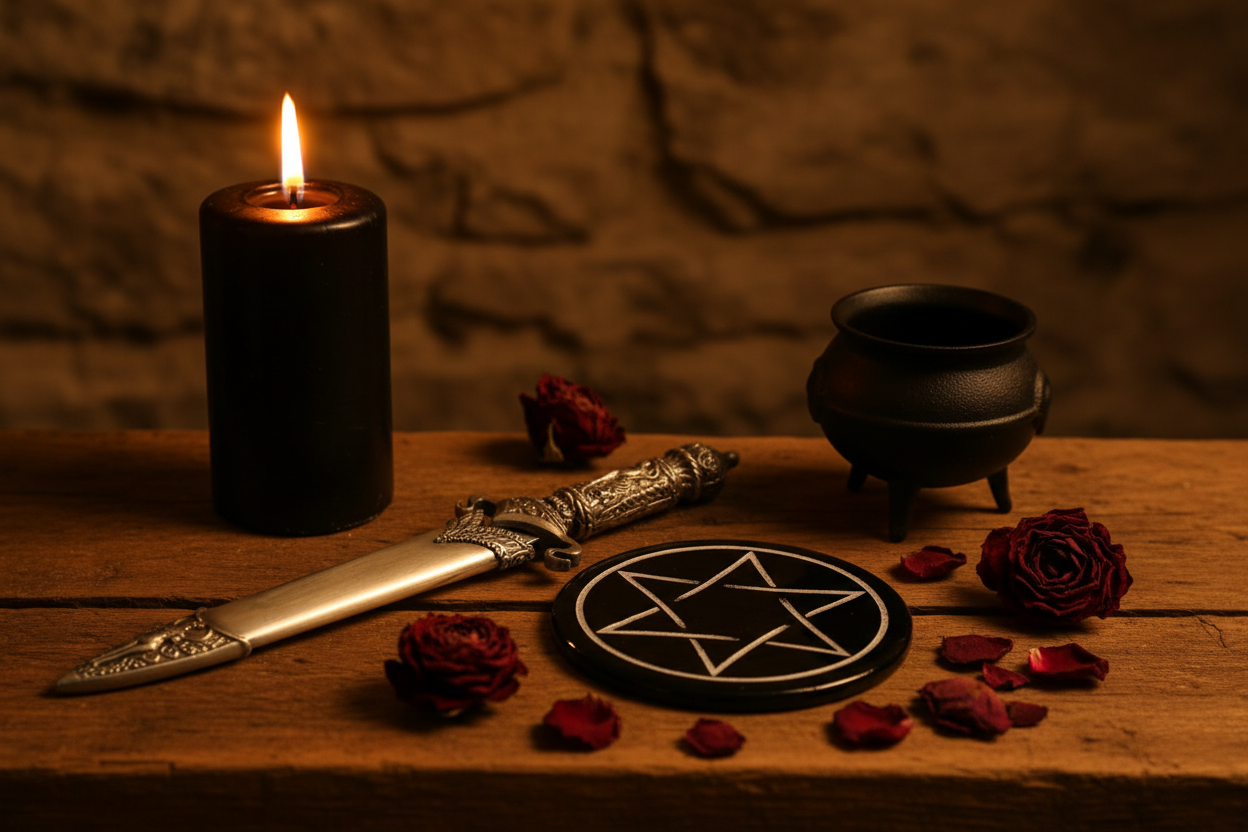
This Goddess Athame is a working ritual blade with a presence worthy of the name. The hilt is ornate with intricate scrollwork winding the length of the handle, and the goddess design at its center grounds the tool in the feminine divine, the Goddess who stands at the heart of Wiccan theology as counterpart and equal to the Horned God. At 13" total length with an 8" blade, it is a full-sized ritual athame that holds real weight in the hand: not a decorative piece, but a tool sized and designed to be used. The pewter sheath carries a winged goddess design that mirrors the hilt, making the pair a coherent devotional object as well as a ritual instrument.
The imagery of the winged goddess resonates across multiple traditions. In Egyptian symbolism, wings represent divine protection; in Greek myth, winged beings carry messages between worlds. In Wicca, the Goddess herself is often depicted with wings in certain forms, particularly in her lunar aspect where she moves freely between realms. Whatever your specific relationship to the divine feminine, this athame holds that symbolism with elegance and weight. It is a blade you might choose at the beginning of your practice and carry through decades of it.
Shipping note: This item cannot be shipped to Massachusetts or California. Please review your state's blade length and knife laws before purchasing.
Key Features
13" overall length with an 8" blade: a true working size. This is a full-sized ritual athame, not a decorative miniature. The 8" blade gives you real reach when casting a circle, allowing you to trace the boundary of your space with sweeping, deliberate strokes. The balance between blade length and handle length matters in use; at 13" total this athame sits comfortably in the hand while the blade extends meaningfully into ritual space.
Ornate goddess hilt with intricate scrollwork: beauty that carries spiritual meaning. In Wiccan practice, the tools on your altar are not merely functional objects. They are expressions of your relationship with the tradition and with the divine forces you work with. An athame whose handle depicts the Goddess keeps that presence active in your hand during every circle casting, every direction call, every cord cut. The scrollwork is not ornament for its own sake; it is the visual language of the sacred feminine.
Pewter sheath with winged goddess design: the blade housed as a sacred object. The sheath completes the athame as an altar object when the blade is at rest. A pewter winged goddess on the sheath means this tool has a coherent visual identity whether drawn and active or sheathed and waiting. On a dedicated altar or displayed in a ritual space, the full set, blade and sheath together, communicates the intention of the practice it belongs to.
Product Details
- Total length: 13"
- Blade length: 8"
- Handle material: Metal with ornate scrollwork and goddess figure
- Sheath: Pewter with winged goddess design
- Shipping restriction: Cannot ship to Massachusetts or California
- California Prop 65: This product contains chemicals known to the State of California to cause cancer or reproductive harm. See www.P65Warnings.ca.gov
The Spiritual Significance
In Gardnerian and Alexandrian Wicca, the athame is associated with the element of Air (in some lineages, Fire) and with the God aspect of the divine polarity, though it is used by practitioners of any gender in service of the balanced working of their tradition. You can use this Goddess Athame specifically for casting a protective ritual circle: stand at the East, blade extended in your dominant hand, and walk clockwise (deosil) around your working space, visualizing brilliant protective light flowing from the tip of the blade as you trace the boundary. Speak your circle-casting words as you move, calling in each direction, and close the circle at the East where you began. The length and weight of this athame make the physical act of circle casting feel genuinely grounded rather than gestural.
You can also use this athame for the specific Wiccan working of cutting cords or energetic ties in release work. When you have identified a connection, pattern, or relationship that no longer serves your highest good and are ready to ceremonially release it, hold the blade before you, visualize the cord clearly in your mind's eye, and cut it with a single deliberate stroke while speaking the release aloud. This is not a working to undertake lightly or casually; cord-cutting with an athame in formal ritual is a genuine act of severance with real energetic consequence. The goddess imagery on this blade makes it particularly appropriate for this work in traditions that associate the Goddess with transformation, death, and rebirth.
How To Use
Consecrating your athame before first ritual use: Before working with a new athame, consecrate it by passing it through the smoke of incense (frankincense, sage, or copal are all traditional), holding it under the light of the full moon, and anointing the blade lightly with consecrated water or oil. Many Wiccan traditions include a consecration ritual that dedicates each of the four elemental tools; if you follow a specific tradition, use its prescribed form. If you practice eclectically, speak your intention aloud and ask the blade to serve your highest working and the good of all.
Casting a ritual circle: Stand at the East, facing outward. Raise the athame, extend it in front of you parallel to the ground, and walk clockwise. Visualize light flowing from the blade's tip as you trace the circle's boundary. When you return to the East, complete the circle verbally and energetically. The athame is the physical anchor for this boundary; let its weight remind you of the gravity of what you are creating.
Calling the quarters: Many practitioners use the athame to call and release the quarters at the four directions during circle work. Point the blade toward each direction as you call its element and guardian, and again as you give thanks and release at the working's close.
Cord-cutting and release work: When working a cord-cutting ritual, be clear and deliberate. Have the cord, thread, or symbolic object in front of you. Hold the athame firmly and make a single, intentional cut. Speak the release aloud. This is most powerful in Wiccan practice when done at the waning moon or dark moon, when the lunar energy supports endings and dissolution.
Care and storage: Wipe the blade clean after each use with a soft cloth. A light coating of oil on the blade prevents rust and preserves the metal. Store the athame in its sheath when not in active use; many practitioners keep it on their altar, in its sheath, between workings. Some traditions hold that the athame should not be drawn casually, only with intention.
Your relationship with this tool will develop through use. The right athame feels right in your hand from the first time you hold it, and grows more familiar with every circle you cast.
Pairs Well With
Medieval Boline: The boline is the athame's functional counterpart in Wiccan tradition: while the athame directs energy, the boline cuts physical materials including herbs, cords, and candle wicks; having both tools completes the working knife toolkit for a fully equipped altar.
Tree of Life Cast Iron Cauldron, 6": Pair the athame with a working cauldron for rituals that combine directed energy work with fire: cast your circle with the blade, then burn your petition or cord-cut materials in the cauldron to complete the working.
New Moon Ritual Spell Kit: Use the Goddess Athame alongside this new moon kit to add formal circle-casting to your lunar intention-setting practice; the kit supplies the working materials while the athame provides the sacred boundary that holds the ritual space.
White Sage Kit Smudge: Smudge the athame and your ritual space before casting a circle; cleansing both the tool and the environment with smoke prepares the space and signals the transition from ordinary to sacred time.
Athames Collection: Explore the full range of ritual blades at Plentiful Earth; whether this Goddess Athame is your first or you are adding to an existing collection, the full range includes styles suited to every tradition and aesthetic.
History & Occult Background
The athame as a distinct ritual tool enters the Western magical tradition through the Key of Solomon (Clavicula Salomonis), a grimoire whose origins are disputed but whose influence on Renaissance ceremonial magic was enormous. The Key of Solomon describes a ritual knife used to direct magical energy and inscribe protective circles and symbols, and this tool appears in various forms across the manuscript tradition. The word "athame" itself may derive from the Latin artavus, a small knife used for cutting quill pens, which appeared in some manuscript versions of the grimoire; the etymology is debated by scholars, but the lineage from the Key of Solomon to modern practice is reasonably well established.
Gerald Gardner, whose development of Wicca in the mid-20th century drew heavily on ceremonial magic sources including the Key of Solomon tradition and the work of Aleister Crowley, incorporated the ritual knife as one of the four primary elemental tools of the Wiccan altar, alongside the chalice, the pentacle, and the wand. In Gardnerian Wicca, the athame is traditionally associated with the element of Air and the eastern quarter. Some other Wiccan lineages, including certain Alexandrian variants and many eclectic practitioners, associate the athame with Fire; this variation has been a genuine point of discussion within the Wiccan community for decades, and both attributions have lineage and logic behind them. There is no single correct answer.
Doreen Valiente, Gardner's collaborator and one of the most significant figures in modern Wicca's development, worked with the athame extensively and wrote about its use in circle casting and ritual direction. Her writings, alongside Gardner's Witchcraft Today (1954) and The Meaning of Witchcraft (1959), established the athame as a central symbol of the Wiccan practice that spread through Britain and eventually worldwide. The athame's function in Wicca, directing energy rather than cutting physical matter, distinguishes it from the boline, which is the working blade for physical tasks. This distinction is specific to Wicca and its derivatives; in other traditions, a single knife might serve both functions.
The goddess imagery on this athame places it within the strong current of goddess-centered Wicca that developed particularly through the influence of feminist spirituality in the 1970s and 1980s, drawing on writers like Starhawk (The Spiral Dance, 1979) and Zsuzsanna Budapest, who emphasized the Goddess as the primary or equal divine principle and developed traditions of women-centered Wiccan practice. An athame that carries the Goddess on its hilt rather than a more generic or masculine symbol is a statement within that lineage about where the practitioner locates the divine in their practice.
Frequently Asked Questions
Should I sharpen this athame or leave it dull? In Wiccan tradition, the athame is classically kept dull because it is a tool for directing energy rather than cutting physical matter. Physical cutting on the altar (herbs, cords, candle wicks) is traditionally the role of the boline. That said, practices vary widely, and some traditions and individual practitioners do keep a working edge on their athame. This is ultimately a question for your own tradition and your own comfort. If you are uncertain, the traditional dull blade is the safe starting point.
How do I consecrate this athame before first use? Common approaches in eclectic Wiccan and Pagan practice include: passing it through the smoke of incense to cleanse and bless with the element of Air; touching the blade briefly to salt or earth to connect it with the physical world; anointing the hilt with consecrated oil; and holding it under the light of the full moon to charge it. Many practitioners also formally declare the blade's purpose aloud during this process. If you follow a specific Wiccan lineage, use the consecration rite specific to your tradition.
Is the athame associated with Air or Fire? This depends on your tradition. In Gardnerian Wicca, the athame is traditionally associated with Air and the East. In some other Wiccan lineages and eclectic practice, it is associated with Fire and the South. Both attributions have genuine lineage and reasoning behind them, and the disagreement has been ongoing in the Wiccan community since at least the mid-20th century. Choose the attribution that fits your tradition, and be consistent within your own practice.
Can I buy this athame if I live in Massachusetts or California? No. This item cannot be shipped to Massachusetts or California due to state blade-length laws and chemical disclosure requirements. If you are in either of these states, please explore other options in PE's athame collection that comply with your state's requirements.
How should I store this athame between rituals? Store it in its pewter sheath on your altar, in a dedicated altar box, or wrapped in a cloth (black, red, and white are all traditional in various lineages). Many practitioners treat the athame as a charged ritual object that should be handled with intention rather than casually, kept separate from mundane objects and brought out with purpose. Some traditions also specify that the athame should not be touched by others without the owner's permission, as personal tools accumulate the practitioner's own energy signature over time.
Is this appropriate for a beginner's first athame? Yes, particularly if the goddess imagery resonates with your spiritual orientation. A beautiful tool that feels right to you is always appropriate regardless of experience level. The 13" size is standard for working ritual use rather than decorative display, so it is a genuine ritual instrument rather than an ornamental piece. If you are completely new to athame work, it is worth reading about circle-casting and the role of the athame in Wiccan practice before your first use, so the tool has context when you pick it up.


Spend $50 & enjoy guilt-free shopping with our free shipping on all orders. Get your favorite items delivered right to your door at no extra cost.