



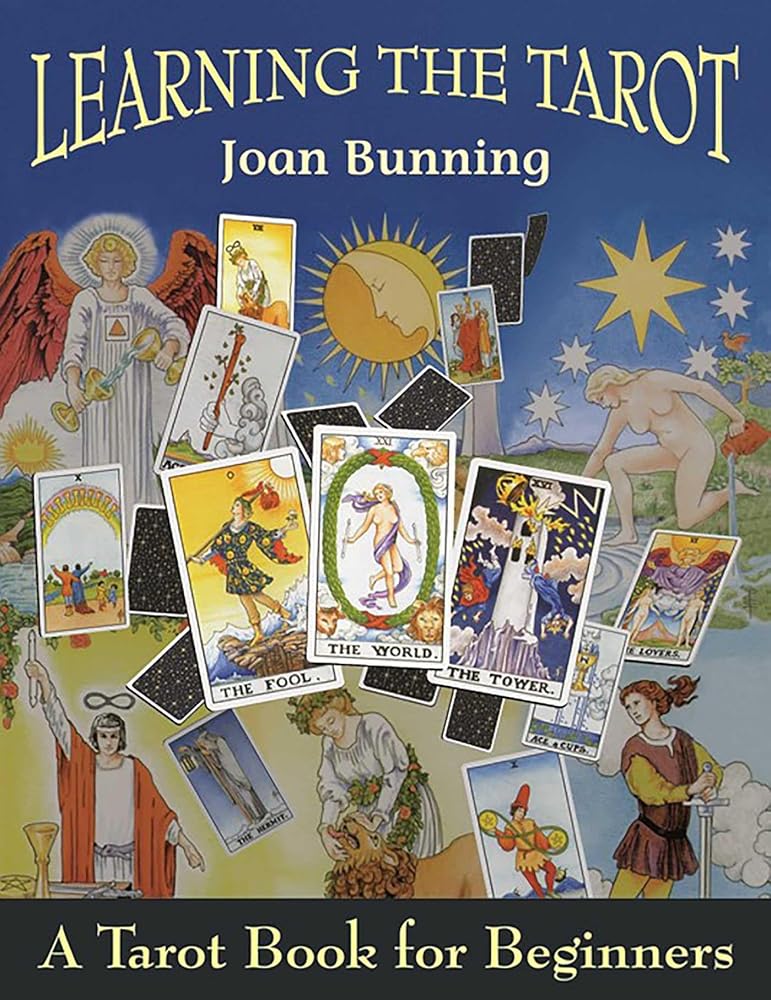
Learning the Tarot: A Tarot Book for Beginners by Joan Bunning
Learning the Tarot: A Tarot Book for Beginners by Joan Bunning- Primary Spiritual Use: Psychic
- Secondary Spiritual Use: Wisdom
- Element: Air
- Planet: Mercury
- Zodiac: Gemini, Virgo
- Chakra: Third Eye
- Ruling Day: Wednesday
- Tradition: Modern eclectic
- Intent: Psychic, Intuition, Wisdom
Couldn't load pickup availability
Joan Bunning's Learning the Tarot is the book most people are handed when they say they want to learn tarot, and it has held that position since 1998 for good reason: it is a complete nineteen-lesson course that takes you from never having held a deck to reading a full spread, without ever getting mystical about it.
It grew out of her free online course at learntarot.com, which still draws a great many readers a month.
Key Features of Learning the Tarot
A nineteen-lesson course. Structured, sequential, and paced so a beginner is never lost.
A full reference section. Two pages per card: a Waite-Smith image, description, keywords, action phrases, and cards with similar and opposite meanings.
Teaches reading, not memorizing. The core of the book is how to find meaning in a card, read pairs, and build the story of a spread.
Product Details
- Author: Joan Bunning
- Publisher: Weiser Books
- First published 1998; a modern standard for beginners
- Uses the Waite-Smith deck for its illustrations
- SKU: BLEATAR
The Spiritual Significance
Tarot's history is worth knowing and often gets embroidered. The cards began as a fifteenth-century Italian card game, tarocchi, and were not used for divination until the eighteenth century, when French occultists took them up and attached Egyptian and kabbalistic frameworks the original decks never carried. That does not make the practice less useful; it makes the ancient-Egypt story false, which is a different thing.
What Bunning does well, and what makes the book last, is treat the cards as a tool for reflection rather than a fortune-telling machine. She writes about psychological projection openly: the cards give you an image, you project meaning onto it, and what you project is information about you. That is an honest account of how a reading actually works, and a practitioner who understands it reads better than one who does not.
How To Use Learning the Tarot
- Work through the lessons in order rather than skipping to the card meanings.
- Do the exercises. The book is a course, and it only works if you treat it as one.
- Use the reference section as you read, not instead of reading.
- Keep a journal of your draws, written before you know how things turn out.
- Take the guidelines as guidelines, which is how she offers them.
Pairs Well With
- Llewellyn's Little Book of Tarot: a pocket companion, for the same subject.
- Aged Leather Journal with Latch: for the daily draw, which is the part that teaches you.
- Llewellyn's Complete Book of Correspondences: the reference behind the symbols.
- Lapis Lazuli Chambered Pendulum: another divination tool for the same table.
- Lemongrass Incense Sticks: the clear-headed register, before a reading.
Frequently Asked Questions
Is it really for total beginners?
Yes. It assumes nothing and builds from the first card to a full reading over nineteen lessons.
Does it include a deck?
No, the book is sold on its own. It uses Waite-Smith images throughout, so a Rider-Waite-Smith deck is the natural companion.
What makes it different from other beginner books?
It is a structured course rather than a dictionary of meanings, and it teaches you how to find meaning rather than look it up.
Are the cards really ancient Egyptian?
No. Tarot began as a fifteenth-century Italian card game and was not used for divination until the eighteenth century, when French occultists attached the Egyptian story to it.
Is the online course the same thing?
The book grew out of learntarot.com and covers the same ground in a more polished, complete form, with the reference section the site does not give you.

Spend $50 & enjoy guilt-free shopping with our free shipping on all orders. Get your favorite items delivered right to your door at no extra cost.