



White Interfaith Minister's Stole by AzureGreen
White Interfaith Minister's Stole by AzureGreen- Primary Spiritual Use: Connection
- Secondary Spiritual Use: Wisdom
- Element: Spirit
- Planet: Sun
- Zodiac: Leo
- Chakra: Crown
- Ruling Day: Sunday
- Tradition: Modern eclectic
- Intent: Connection, Wisdom
Couldn't load pickup availability
Some garments are meant to be worn. Others are meant to be inhabited. This white minister's stole is the latter, a piece of ceremonial cloth that carries the weight of twelve traditions, twelve lineages, twelve ways of meeting the sacred. Whether you are a credentialed interfaith minister, a spiritual director, a ritual leader, or simply a practitioner who walks the threshold between traditions, this stole is designed to be both a tool and a testament.
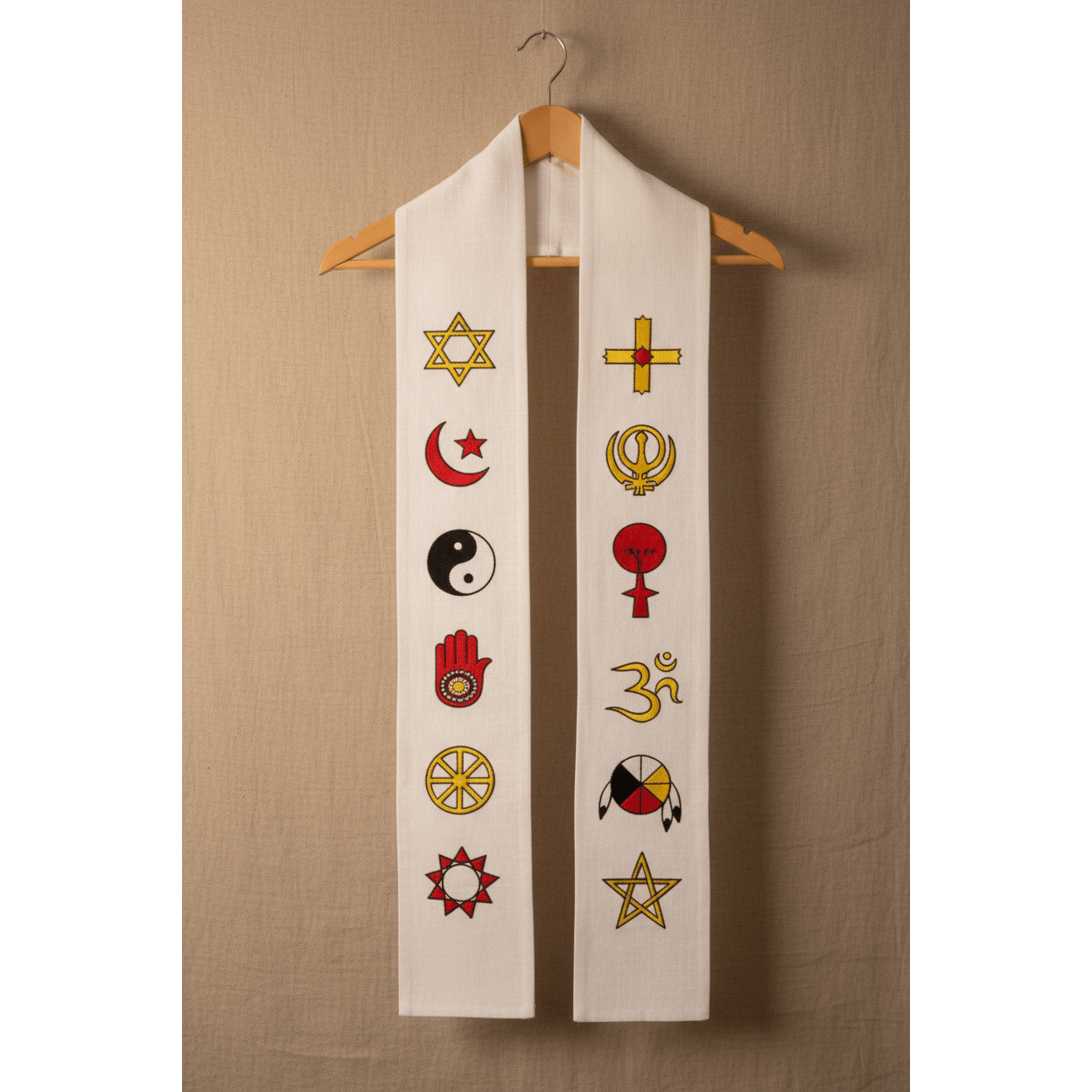
Printed on clean white cotton with a soft liner, the stole displays twelve symbols representing the world's major religions, Christianity, Islam, Judaism, Buddhism, Hinduism, Sikhism, Taoism, and more, arranged in a visual language of shared reverence. White has long signified purity, clarity, and openness in ceremonial contexts across many traditions, making it an ideal canvas for a garment meant to welcome all paths equally. At roughly four inches wide and six feet long, it drapes with intention over robes, vestments, or everyday wear.
Key Features
Twelve sacred symbols, one shared intention. The stole is printed with symbols from twelve of the world's major religious traditions, making it a visual affirmation of interfaith respect and universal spiritual unity. For ministers and facilitators who work across diverse congregations or eclectic communities, this is a statement of practice.
White cotton construction with a soft interior liner. The fabric is clean, breathable, and drapes with the kind of easy elegance a ceremonial garment requires. The liner gives it structure and prevents the lightweight cotton from appearing flimsy during formal or ritual settings.
Includes a symbol description sheet. Each of the twelve religious symbols represented on the stole is explained in the accompanying reference sheet. This is particularly useful for practitioners who lead public ceremonies and want to speak confidently and accurately about the traditions they honor when wearing it.
Product Details
- Dimensions: Approximately 4 inches wide × 6 feet long
- Materials: White cotton with soft interior liner
- Print: 12 symbols of the world's major religions
- Includes: Symbol description sheet
- Color: White
The Spiritual Significance
If you lead ceremonies that draw from multiple traditions, weddings, memorials, naming rituals, healing circles, you can wear this stole as a visible declaration that every person in the room belongs. The twelve symbols carry the energetic weight of inclusion; donning the stole as part of your ritual preparation signals to your community, and to yourself, that you enter the space as a servant of many paths rather than a gatekeeper of one. Many interfaith ministers incorporate a brief moment of silent prayer or centering as they put on the stole, treating the act of vesting as the opening of sacred space.
You can also use this stole as a focal anchor in interfaith meditation or energy work. Laid across an altar or draped over the hands during a healing session, the symbols can serve as visual touchstones for invoking broad spiritual protection, calling upon the collective wisdom of traditions rather than a single deity or lineage. Practitioners working in eclectic or non-denominational spiritual communities have found that the stole helps them move through ritual with more steadiness, particularly in moments when they might otherwise feel uncertain about which tradition to draw from.
How To Use
Before its first use, you might choose to cleanse the stole using sacred smoke, palo santo or frankincense work beautifully here, as both have interfaith ceremonial roots. Avoid salt on fabric; smoke, moonlight, or sound (a singing bowl held near the garment) are gentler options.
To consecrate the stole for your work, hold it in both hands and speak your intention aloud, something as simple as, "I dedicate this garment to the service of all paths and all people." This kind of spoken consecration is a practice found in many traditions from Catholic priestly vesting prayers to Wiccan tool blessing rites, and you're invited to adapt the language to your own path.
When putting on the stole before ceremony, take a moment to breathe. Let the act of draping it over your shoulders become a threshold crossing, a signal to your body and spirit that you are moving from ordinary time into sacred time.
During a ceremony, the symbols on the stole may serve as quiet reference points. Some ministers find it grounding to briefly touch or acknowledge the stole when transitioning between portions of a multi-faith service.
After any ceremony, fold the stole with care and store it separately from everyday clothing if possible, a simple cloth pouch or dedicated drawer keeps its ceremonial energy distinct from the mundane. Trust your own practice to tell you how much formality feels right. There is no wrong way to honor a tool that is already rooted in respect.
Pairs Well With
- White Sage Kit Smudge — Everything you need to cleanse and open sacred space before donning the stole: abalone shell, feather, cobra stand, and a 3" white sage stick. A natural pre-ceremony pairing.
- Mala Beads collection — Prayer beads are used across Buddhism, Hinduism, Christianity, and Islam, making them a natural companion to an interfaith vestment. Hold them during opening prayer or meditation to ground your intention before ceremony.
- Palo Santo collection — Sustainably harvested palo santo for smoke cleansing before or after ceremony. Its sweet, resinous scent is broadly welcomed across spiritual traditions and is particularly suited to the inclusive spirit of an interfaith practice.
- Singing Bowls collection — Sound is one of the most cross-traditional cleansing and centering tools available. A singing bowl rung before ceremony can cleanse the stole energetically, settle the room, and signal the opening of sacred space.
- Statues collection — An altar arrangement featuring figures from multiple traditions pairs beautifully with this stole as a visual focal point for interfaith ceremony or meditation.
History & Occult Background
The stole as a liturgical garment has its most documented roots in early Christian tradition, where it developed from the Roman orarium, a cloth worn around the neck as a sign of office. By the early medieval period, it had become a central vestment in Catholic, Orthodox, and later Anglican and Lutheran clergy dress: a long strip of fabric worn over the shoulders to signify ordained ministry and the yoke of sacred service. The color of a stole in these traditions traditionally changed with the liturgical calendar: purple for Advent and Lent, red for Pentecost, green for ordinary time, white for seasons of celebration and purity.
The adoption of the stole into interfaith ministry is a more recent development, emerging most visibly in the late 20th century as interfaith ordination programs, such as those offered by the Interfaith Seminary in New York and similar institutions worldwide, began credentialing ministers whose training drew from multiple religious traditions. These ministers needed vestments that could speak across traditions rather than claim allegiance to one, and the stole, with its universal shape and long history of sacred office, became a natural choice. The addition of multi-faith symbols reflects the same spirit of synthesis that drives interfaith theology itself.
In broader esoteric and Western mystery tradition, the act of vesting, or putting on sacred garments before ritual, is understood as a form of assumption: stepping into a role, an office, or a state of consciousness. Ceremonial magicians, Wiccan high priests and high priestesses, and ritualists across many traditions use robes, sashes, and other vestments to mark the transition between ordinary and sacred states. The white stole functions in this lineage as well, with white being the color most widely associated with clarity, purity of intent, and readiness to receive spiritual influence across Western esoteric, Christian, and many Eastern systems.
Frequently Asked Questions
Who is this stole designed for? It is designed primarily for ordained or practicing interfaith ministers, but it is equally well-suited for spiritual directors, ceremony officiants, energy workers, ritual facilitators, and any practitioner who works within or across multiple spiritual traditions. You do not need a specific ordination to use this garment in your personal practice — intention and respect are the real qualifications.
Does wearing this stole represent any particular religion? No. The stole displays twelve religious symbols together, which is a statement of inclusion rather than allegiance to any single tradition. It is designed specifically for practitioners who honor multiple paths. If you work primarily within a single tradition, you may find a tradition-specific vestment a better fit, but if your practice is eclectic, interfaith, or universal, this stole was made with you in mind.
How do I care for the stole to keep it in good condition? Hand-wash or gentle machine wash in cold water is typically appropriate for cotton vestments. Avoid harsh detergents, which can fade the printed symbols. Air dry flat when possible to preserve the shape and liner. Iron on low heat if needed before ceremony. Store folded, away from direct sunlight, to protect the color and fabric over time.
Can I use this stole even if I'm not an ordained minister? Yes. While it was designed with ordained interfaith ministers in mind, there is no gatekeeping around who may use ceremonial vestments. Many energy workers, spiritual teachers, and eclectic practitioners wear stoles as part of ritual dress. What matters is that you wear it with intention and respect for the traditions the symbols represent.
What are the twelve symbols on the stole? The stole includes a description sheet that identifies and explains each symbol. Typical interfaith stoles of this type represent Christianity (cross), Islam (crescent and star), Judaism (Star of David), Buddhism (dharma wheel), Hinduism (Aum), Sikhism (Khanda), Taoism (yin-yang), and several others. Confirm the exact symbols represented via the included description sheet, as specific symbol selections can vary by manufacturer.
Is this stole appropriate for outdoor or destination ceremonies? Yes. The lightweight cotton construction makes it breathable and practical for outdoor use, garden ceremonies, beach rituals, forest gatherings. White is a strong visual choice in natural settings. You may want to store it protected from the elements before the ceremony begins.
How does this stole differ from a traditional Christian clergy stole? A traditional Christian clergy stole typically features Christian iconography, a cross, Chi Rho, or IHS monogram, and is worn in specific ways depending on whether the wearer is a deacon, priest, or bishop. This interfaith stole carries no tradition-specific iconography and is designed to communicate openness across all faiths rather than ordination within a single one.


Spend $50 & enjoy guilt-free shopping with our free shipping on all orders. Get your favorite items delivered right to your door at no extra cost.