



Plentiful Earth | Spiritual Store
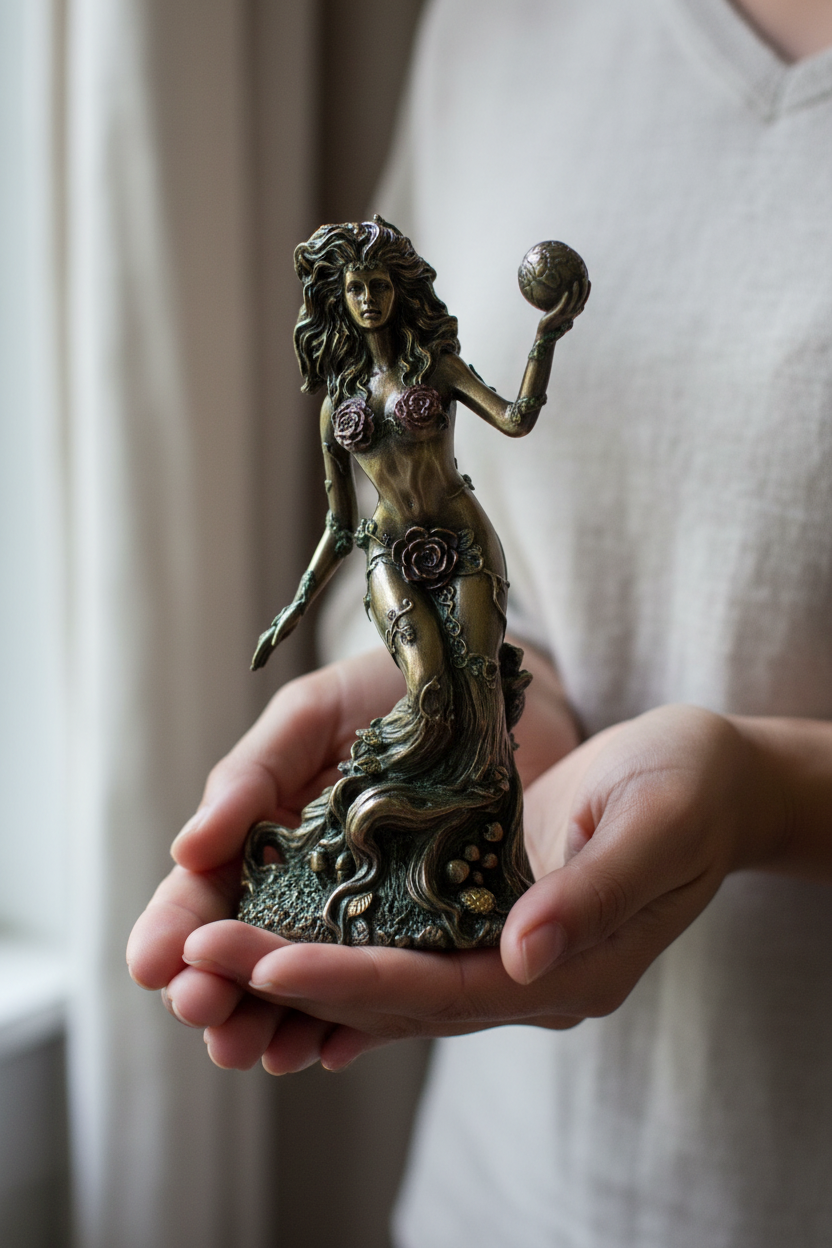
Gaia Statue, 8.5 Inch Cold-Cast Resin, Greek Earth Mother
Gaia Statue, 8.5 Inch Cold-Cast Resin, Greek Earth MotherThis item ships free in the U.S.Other rates are calculated at checkout.
Couldn't load pickup availability
- Primary Spiritual Use: Grounding
- Secondary Spiritual Use: Abundance
- Size: 8.5 x 4 x 2.5 in
- Material: Cold cast resin, antique bronze finish
- Shipping Weight: 2.5 lb
- Element: Earth
- Planet: Venus
- Zodiac: Taurus
- Chakra: Root
- Ruling Day: Friday
- Tradition: Hellenic (Greek)
- Intent: Grounding, Abundance, Devotion
Works Well With


Gaia is the Earth herself, the primordial goddess from whom, in Greek myth, all things came. Before the Olympians, before the Titans, there was Gaia, the deep and steady ground that is the ever-sure foundation of all. She is the Earth Mother in the oldest and most literal sense, the living planet given a face.
This 8 1/2-inch statue, hand-painted in an antique bronze finish, brings her grounding, nurturing presence to an altar or home, a focal point for connection to the Earth and the steady support beneath your feet.
Key Features
The Greek primordial Earth Mother. Gaia, the goddess who is the living Earth itself.
Antique bronze finish. Cold-cast resin, hand-painted in an earthy antique bronze, roughly 8 1/2 x 4 x 2 1/2 inches.
A grounding focal point. A modern devotional sculpture for earth connection and grounding, not an archaeological reproduction.
Product Details
- Dimensions: about 8 1/2 x 4 x 2 1/2 inches
- Material: cold-cast resin
- Finish: hand-painted antique bronze
- Form: Gaia, the Earth Mother
- Use: deity statue, altar focal point, grounding and earth work
- SKU: SG101
- Sold by Plentiful Earth
The Spiritual Significance
In Greek myth Gaia is the first mother, born near the beginning of all things and bringing forth the sky, the mountains, and the sea, then with the sky god Uranus the Titans, from whom the Olympian gods descend. She is the ground of being, the literal Earth and the deep stability beneath everything that lives. The very first oracle at Delphi is said to have been hers before it passed to Apollo.
On a modern altar, Gaia is honored for grounding, stability, fertility, and abundance, and as the focus of earth-based and ecological devotion. Practitioners turn to her to feel rooted and supported, to bless gardens and growing things, to steady scattered energy, and to deepen their care for the living planet. Her presence is a quiet reminder that you are held by the ground itself.
How To Use
- Place her on an altar, near houseplants, or in a spot that connects you to the natural world.
- Welcome her by cleaning the statue, holding it, and speaking your hopes; a first offering of fresh water, flowers, or a little soil is fitting.
- For grounding, sit before her and breathe slowly, imagining roots reaching from you down into the earth she embodies.
- Honor her through care for the living world: tending plants, composting offerings, or returning a gift to the earth.
- Keep offerings fresh and dust the statue gently with a soft cloth.
Pairs Well With
- Millennial Gaia Statue, 6.5 Inches another Gaia statue, showing the Earth Mother with the web of life.
- Hera Statue, 9.5 Inches the queen of the Greek gods for a Greek devotional shelf.
- Aphrodite Statue, 13.25 Inches the goddess of love and beauty.
- Black Tourmaline a grounding, stabilizing stone for earth work.
- White Sage Smudge Sticks to cleanse the space and the statue.
History & Occult Background
Gaia appears at the very start of Hesiod's Theogony, emerging after Chaos as the broad-breasted Earth, the secure seat of the gods. She bears Uranus the sky, the mountains, and the sea, and then with Uranus the Titans, making her the ancestress of nearly the whole Greek pantheon. The Romans honored her as Terra or Tellus. In modern times her name was taken up by the Gaia hypothesis, James Lovelock's scientific proposal that Earth functions as a single self-regulating system, a metaphor that helped renew Gaia as a central figure in earth-based spirituality and ecological awareness.
Frequently Asked Questions
Who is Gaia?
She is the Greek primordial goddess of the Earth, the first mother from whom the sky, sea, mountains, and the Titans came. She is the living Earth given a divine face.
Is she the same as Mother Earth?
In essence, yes. Gaia is the Greek personification of the Earth as a mother goddess, and her name is now widely used for the Earth Mother across modern earth-based spirituality.
What is the Gaia hypothesis?
It is a modern scientific idea, proposed by James Lovelock, that Earth behaves as a single self-regulating system. It is a scientific metaphor rather than a religious claim, but it helped renew interest in Gaia as a spiritual figure.
How do I honor her?
Offer fresh water, flowers, or soil; tend plants and the land; and practice grounding in her presence. Care for the living world is itself a devotion to Gaia.
How do I care for the statue?
Dust it with a soft dry cloth and keep it out of prolonged direct sunlight to protect the finish. Avoid soaking the resin; a barely damp cloth is enough for occasional cleaning.


Spend $50 & enjoy guilt-free shopping with our free shipping on all orders. Get your favorite items delivered right to your door at no extra cost.