



Plentiful Earth | Spiritual Store
Damascus Athame, 13¾", Dirk Wod Ritual Dagger
Damascus Athame, 13¾", Dirk Wod Ritual Dagger- Primary Spiritual Use: Intention
- Secondary Spiritual Use: Energy
- Element: Fire
- Planet: Mars
- Zodiac: Aries, Scorpio
- Chakra: Solar Plexus
- Ruling Day: Tuesday
- Tradition: Wiccan
- Intent: Intention, Energy
Couldn't load pickup availability
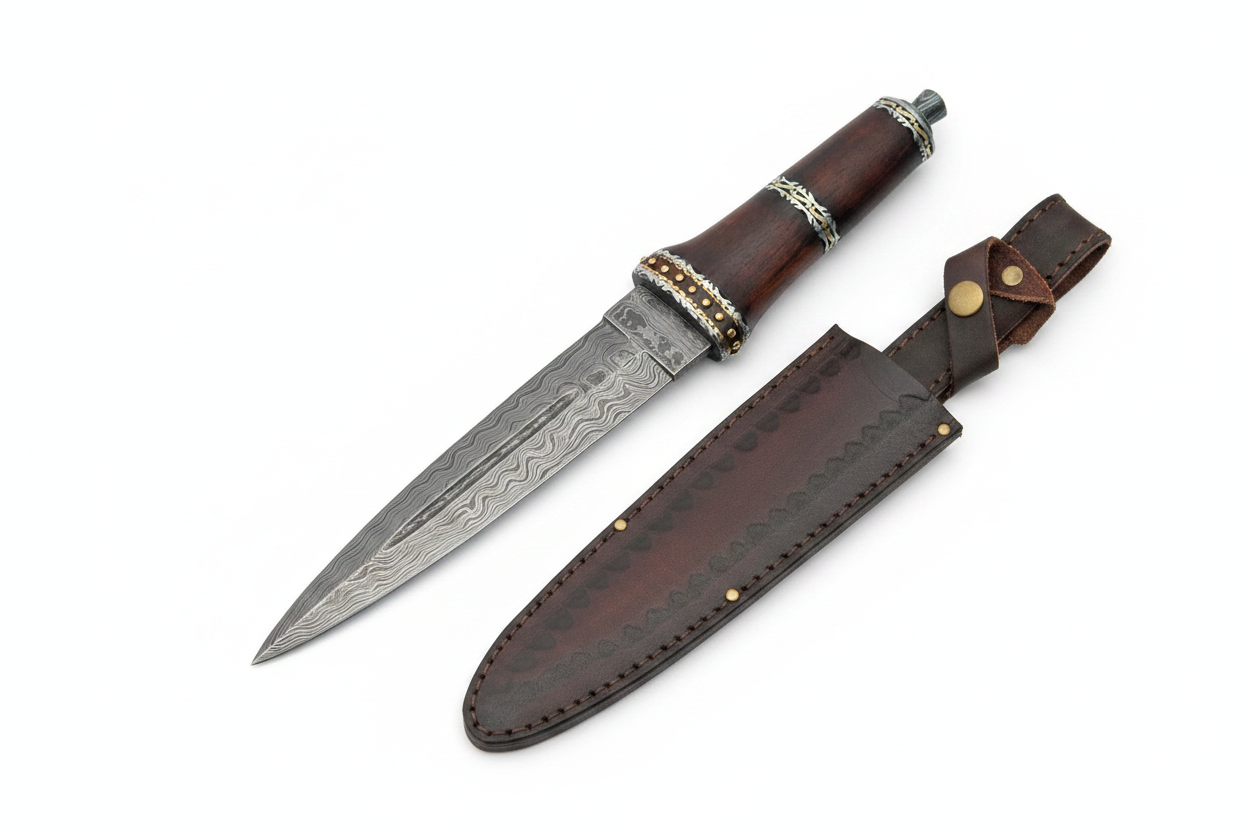
Damascus steel has its own presence before you even pick it up. The rippling, water-patterned surface of this 13 3/4" Dirk Wod athame catches light the way few blades do; it is visually arresting and instantly recognizable as something made with care, through a process that has fascinated smiths and seekers alike for well over a thousand years. For the practitioner who wants a ritual blade that earns its place on the altar through material quality and craftsmanship, not just aesthetics, this athame delivers.
The Dirk-style form is longer and more substantial than a standard athame, and this one wears that presence well. The wooden hilt is fitted with pewter and brass embellishments that give it weight and warmth without tipping into ornate. The pommel is finished with a skull cracker, a detail that resonates deeply with ceremonial and folk magic traditions where the skull serves as a symbol of transformation, the liminal passage between states, and mastery over one's own mortality. The whole blade is housed in a fitted goat leather sheath when not in use.
At $109.95, this is a commitment piece. It is the kind of athame that practitioners save for, choose deliberately, and build a relationship with over years of ritual work. Damascus steel carries with it centuries of association with exceptional craft, with the marriage of opposing forces into something unified and beautiful, and with the idea that the finest tools are made through processes that cannot be rushed. That history does not leave the blade when it comes to your altar.
Key Features
Damascus steel blade with layered patterned finish. Damascus steel is produced by repeatedly folding and welding multiple types of steel together, creating the distinctive flowing, watered pattern visible on the blade's surface. This is not a decorative coating; it is the structure of the steel itself, and it gives the blade both visual distinction and a character that develops with handling and age. For practitioners who attune their tools over time, there is something genuinely fitting about a material that bears the visible record of its own making.
Skull cracker pommel with ceremonial resonance. The integrated skull cracker at the base of the hilt is a functional feature common to Dirk-style blades, but in the context of ritual use it carries additional symbolic weight. The skull is a cross-cultural symbol of transformation, the dissolution of the ego, and passage across thresholds; it appears in Memento Mori traditions, in Day of the Dead veneration, in Hermetic and alchemical iconography, and in the symbolism of numerous initiatory traditions. Having it at the pommel of your athame, where the hand rests, places that symbol in direct contact with your grip during every working.
Goat leather sheath for protection and storage. A well-made athame deserves proper storage, and this one comes with a fitted goat leather sheath to protect both the blade and your altar from contact between workings. Leather is itself a material with deep ritual associations across traditions; keeping your blade sheathed when not in use also signals intentionality, a deliberate distinction between the blade's active and resting states.
Product Details
- Total Length: 13 3/4 inches
- Blade Material: Damascus steel (patterned layered steel)
- Hilt Material: Wood with pewter and brass embellishments
- Pommel: Skull cracker
- Sheath: Goat leather
- Blade motifs: Persian-inspired patterned surface
- Shipping restriction: Cannot ship to Massachusetts or California
- Prop 65 Warning: This product can expose you to chemicals known to the State of California to cause cancer or other reproductive harm. For more information go to www.P65Warnings.ca.gov.
(Please confirm exact blade length, weight, and UPC with your supplier for complete product records.)
The Spiritual Significance
In Wiccan and eclectic ceremonial practice, the athame is the primary tool of directed will, used to cast the ritual circle that separates sacred space from the mundane world. You can use this Damascus athame to cast your circle by holding it in your dominant hand and moving slowly clockwise through your space, visualizing the blade drawing a boundary of light or energy around you as it passes. The heft and presence of a 13 3/4" blade make the physical arc of this motion more deliberate than a smaller tool, which many practitioners find helps them stay focused and grounded throughout the casting.
The skull cracker pommel opens an additional avenue of symbolic use for practitioners working with transformation magic, banishing, or rites of passage. In traditions that draw on Hermetic and alchemical symbolism, the skull represents the dissolution of what no longer serves; it is the image of release rather than death. You can engage this symbolism deliberately by resting your palm on the pommel during banishing or release workings, consciously invoking the idea of transformation as you direct energy with the blade, making this athame a particularly fitting tool for workings centered on endings, transitions, or the clearing of stagnant patterns.
How To Use
A blade of this quality invites a thorough initial relationship-building before you bring it into circle. Here are some approaches to consider:
Cleanse the blade before first use. Damascus steel and leather both call for a little care in cleansing. Avoid submerging either in water or salt. Instead, pass the blade through the smoke of frankincense, copal, or a cleansing herb blend, and leave it on your altar beneath the light of the full moon overnight. For the leather sheath, a light pass of smoke is sufficient.
Consecrate it to your practice. Many practitioners perform a formal dedication ritual when acquiring a new athame of this significance. You might present it to each of the four elemental quarters in turn, breathe your intention onto the blade at each point, and speak aloud what you are calling this tool into being for. This is your mark on the blade and the beginning of your working relationship with it.
Use it for circle casting and energy direction. Hold the athame in your dominant hand with a firm but relaxed grip, extending the blade outward during casting. You might choose to chant, recite a quarter-calling, or work in focused silence; trust what your practice calls for.
Work with the pommel intentionally. When performing banishing or release work, you might choose to ground and close the ritual by resting both hands around the hilt with your palm over the skull cracker pommel, breathing deeply, and consciously sealing or releasing the energy you have raised.
Maintain the blade with care. Wipe down the Damascus steel with a lightly oiled cloth after use to prevent oxidation. Keep the leather sheath dry and condition it periodically with a small amount of leather oil to preserve its suppleness. A well-maintained athame accumulates ritual energy and intention over years of use; the care you put into it is part of the practice.
Your relationship with this blade will develop in ways that are uniquely yours. Let it.
History & Occult Background
Damascus steel, known historically as wootz steel in its original Indian and Persian forms, has been prized since at least the third century CE for its distinctive surface pattern and legendary performance. The visible flowing lines on the blade surface are the result of carbide banding within the steel, a byproduct of the folding and forging process that creates alternating layers of hard and soft steel throughout the material. Swords made from this steel appeared throughout the medieval Islamic world and became famous among Crusader-era European knights for their apparent superiority; by the time Damascus steel had become a byword for exceptional blade quality, the city of Damascus itself had become a major trading hub for these weapons, lending the steel its Western name even though production originated elsewhere.
The Dirk is a Scottish and Irish long-bladed dagger with roots in the early modern period, particularly associated with Highland culture. The term "dirk" appears in written records from the late sixteenth century onward and describes a blade distinct from the shorter sgian-dubh or the larger claymore; it occupied the middle ground of personal sidearms and was carried by soldiers and clan members alike. In the context of modern witchcraft and Pagan practice, the dirk form appeals to practitioners drawn to Celtic and Northern European lineages, as well as those who simply prefer the longer, more substantial presence of this blade style at the ritual altar.
The skull as a sacred symbol has an exceptionally wide distribution across magical and spiritual traditions. In Western occultism and Hermeticism it appears under the Latin phrase Memento Mori, "remember that you will die," as a contemplative prompt for aligning one's actions with what truly matters. In Mexican and Latin American folk Catholic and syncretic practice, the skull is central to Día de los Muertos observance and to the iconography of figures such as Santa Muerte, who is venerated for her associations with protection, healing, and the equitable treatment of all who come before death regardless of station. In Tibetan Buddhist Vajrayana practice, skull imagery (the kapala or skull cup) appears in deity iconography associated with transformation and the transmutation of suffering. The Dirk Wod's skull cracker brings this layered symbolic inheritance to the practitioner's hand.
The athame itself carries the lineage described in Wiccan and ceremonial magical tradition: rooted in Gerald Gardner's mid-twentieth century codification, tracing back through the Key of Solomon's "arthame" to a broader tradition of consecrated blades used for circle casting, energy direction, and the marking of ritual boundaries. For practitioners working with high-quality, long-form blades like this one, the physical weight and presence of the tool becomes part of the practice; there is a reason that serious ceremonial magicians have historically invested significantly in their primary ritual blade.
Pairs Well With
- Cast Iron Cauldron with Lid, 8 Inches — The cauldron is the complementary feminine principle to the athame's masculine directed energy; together they form one of the central symbolic pairings in Wiccan altar work, representing the union of opposites that underlies much of ceremonial practice.
- Altar Tiles & Pentacle Plates — A pentacle tile provides the Earth element on your altar and serves as the ideal resting and charging surface for your athame between workings; consecrating your blade over a pentacle is a traditional step in many dedication rituals.
- Black Tourmaline Crystals — Place black tourmaline at the cardinal points of your ritual circle alongside your athame work to reinforce the protective, warding energy of your circle casting; the two tools are deeply complementary for protection and boundary-setting workings.
- Tumbled Black Obsidian Stones — Obsidian's association with transformation and truth makes it a natural pairing for an athame that carries skull symbolism; use a piece of obsidian on your altar during release or banishing workings performed with this blade.
- Celtic Athame — If you work in multiple traditions or with different ritual intentions, keeping a second athame allows you to dedicate each to a specific type of working; the Celtic pentacle athame is a natural companion piece for practitioners drawn to both Wiccan and Celtic-influenced practice.
Frequently Asked Questions
Is the Damascus steel on this athame real, or is it a pattern? The Damascus patterning on this blade is the actual surface structure of the layered steel, not a printed or applied design. True Damascus (also called pattern-welded) steel is formed by folding and welding multiple steel alloys together, creating the characteristic watered or flowing pattern throughout the blade material. Please confirm technical steel specifications with the supplier if you require precise metallurgical details.
Can this athame ship to my state? This athame cannot ship to Massachusetts or California due to blade regulations in those states. If you are ordering from either state, please contact Plentiful Earth before purchasing.
How do I care for Damascus steel? Damascus steel can be prone to surface oxidation if not maintained. After each use, wipe the blade down with a soft cloth lightly dampened with a neutral oil such as mineral oil or camellia oil. Store the blade in its leather sheath in a dry environment. Avoid leaving the blade in contact with moisture, acidic substances, or salt for extended periods.
How do I care for the goat leather sheath? Keep the sheath dry and away from prolonged moisture. Condition it periodically with a small amount of leather conditioner or beeswax-based leather balm to maintain its suppleness and prevent cracking. Do not submerge in water.
What does the skull cracker pommel mean, and how do I use it in ritual? The skull cracker is a practical feature common to Dirk-style blades, designed as a striking surface at the base of the hilt. In ritual context, the skull carries rich symbolic associations with transformation, liminality, and the dissolution of what no longer serves. Practitioners working with release, banishing, or rites of passage may choose to engage this symbolism deliberately; for example, by resting the palm over the pommel during the closing of a banishing ritual as a conscious gesture of sealing the work.
Is this athame appropriate for initiatory Wiccan traditions? Some initiatory traditions (Gardnerian, Alexandrian) have specific requirements or preferences around the form and sourcing of the athame, including whether it is given by the coven or acquired by the practitioner. If you are working within such a tradition, we recommend consulting your High Priestess or High Priest before purchasing any ritual blade. For eclectic, solitary, and non-initiatory practitioners, this athame is well-suited to Wiccan and ceremonial magical use.
How is this different from the other athames on Plentiful Earth? The Dirk Wod stands apart through its Damascus steel blade, its longer Dirk-style form, its skull cracker pommel, and its goat leather sheath. It is the most premium blade currently offered in the PE athame collection, intended for practitioners who want a long-term ritual tool of exceptional material quality rather than an entry-level or decorative piece.


Spend $50 & enjoy guilt-free shopping with our free shipping on all orders. Get your favorite items delivered right to your door at no extra cost.