



Plentiful Earth | Spiritual Store
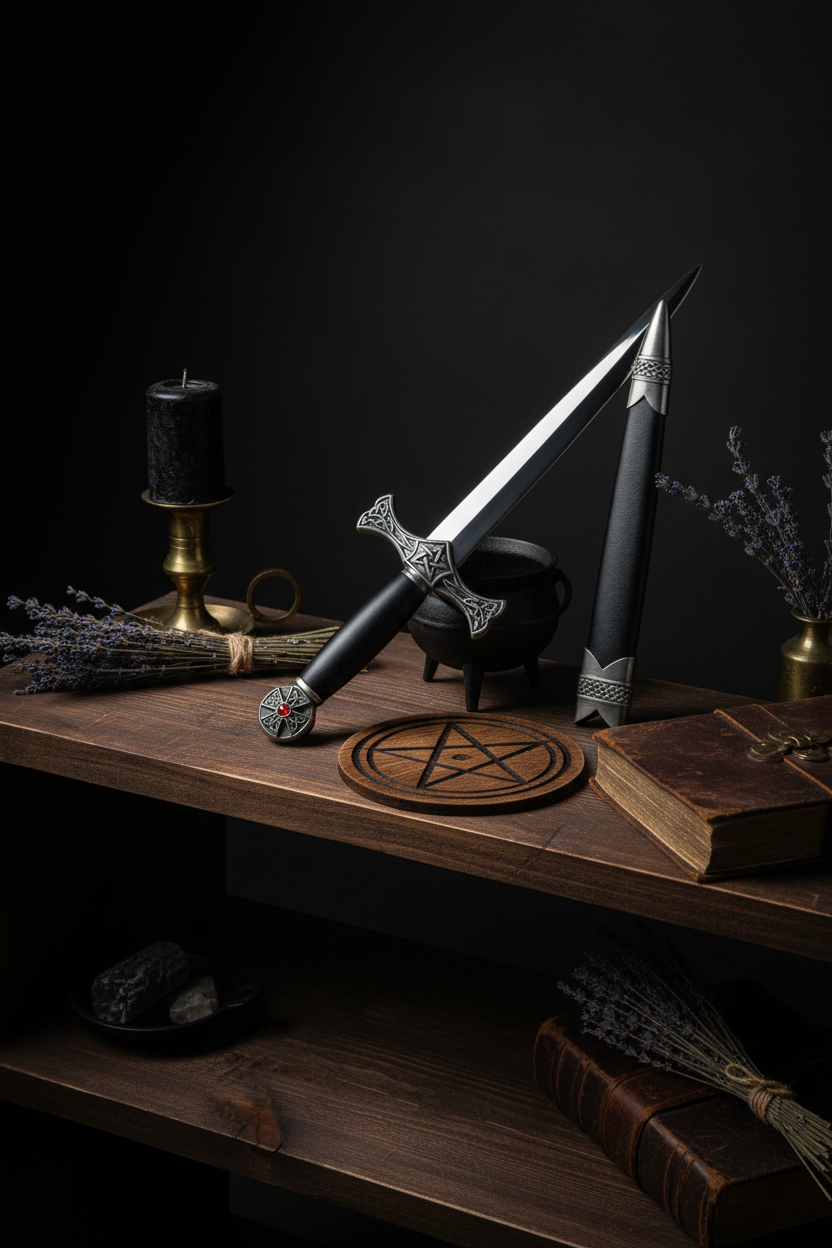
Celtic Athame | Pentacle Cross Guard, 15¼ Inches
Celtic Athame | Pentacle Cross Guard, 15¼ Inches- Primary Spiritual Use: Intention
- Secondary Spiritual Use: Wisdom
- Element: Fire
- Planet: Mars
- Zodiac: Aries, Scorpio
- Chakra: Solar Plexus
- Ruling Day: Tuesday
- Tradition: Wiccan
- Intent: Intention, Wisdom
Couldn't load pickup availability
Celtic knotwork has been one of the most recognizable and widely loved design languages in Western decorative art for centuries: the interlacing, continuous, mathematically precise patterns that appear on the Book of Kells, on Iron Age metalwork, on crosses and illuminated manuscripts from the early medieval period of Ireland and Scotland. On a ritual blade, that visual language carries specific weight: the knotwork suggests the continuous weaving of intention, the interconnection of all things, and the Celtic sensibility that the sacred and the ordinary are not opposed but interwoven.
This Celtic Athame features an interwoven pentacle at the cross guard, pewter-finished handle and scabbard with stainless steel hardware, and a 9-inch blade at 15¼ inches total length — the proportions of a working athame rather than a display piece. It comes with a scabbard. The pentacle at the cross guard sits at the point where the blade and the handle meet, the threshold between directed will (the blade) and the practitioner's grip (the handle): an appropriate location for a symbol of the five elements and spiritual completeness.
⚠️ Shipping restrictions: This item cannot ship to Massachusetts or California. See Prop 65 warning below.
Key Features
Interwoven pentacle at the cross guard. The cross guard sits between handle and blade; placing the pentacle here marks the threshold between intention and action. The interwoven knotwork style connects to the broader Celtic visual tradition of continuous, interlacing pattern: a design language associated with eternity, the weaving of fate, and the interconnection of the visible and invisible worlds.
15¼-inch total length with 9-inch stainless steel blade. These are genuine working proportions: the blade is long enough to use for circle casting, quarter calls, and elemental invocations, and substantial enough to feel present in the hand during ritual. Stainless steel resists rust and holds a clean edge appropriate for a blade that will be handled regularly.
Pewter finish with scabbard included. Pewter's grey-silver tone is in keeping with the Celtic aesthetic tradition and appropriate for a blade that represents the element of Air. The included scabbard provides safe storage and transport between ritual sessions.
Product Details
- Total length: 15¼ inches
- Blade length: 9 inches
- Blade material: Stainless steel
- Handle/scabbard material: Plastic with pewter finish
- Cross guard design: Interwoven pentacle (Celtic knotwork)
- Includes: Scabbard
- Shipping restrictions: Cannot ship to Massachusetts or California
- ⚠️ California Prop 65 Warning: This product can expose you to chemicals which are known to the State of California to cause cancer or other reproductive harm. For more information visit www.P65Warnings.ca.gov.
- Note: The blade is sharp; handle with appropriate care
The Spiritual Significance
The athame in Wiccan tradition is the primary directive tool: it represents the element of Air, the practitioner's directed will, and the masculine principle of active, focused intention. In Gerald Gardner's codification of Wicca, the athame is one of the four cardinal altar tools alongside the wand, the chalice, and the pentacle. It is used to cast the ritual circle (tracing the boundary in the air from north, clockwise, returning to north), to call the four quarters and their elemental guardians, to consecrate other altar tools, and to direct energy in workings.
The Celtic aesthetic adds a specific cultural resonance for practitioners who work within or draw from the Celtic or Neo-Druidic traditions: the knotwork and the pentacle together connect the athame to the specific spiritual vocabulary of the British Isles, Ireland, and Scotland, where the weaving of wyrd (fate), the interconnection of all life, and the dual structure of visible and invisible worlds were fundamental to pre-Christian and folk religious practice.
The pentacle at the cross guard specifically invokes the five elements — earth, air, fire, water, and spirit — at the junction of will and action: a visual reminder that effective magical direction integrates all five dimensions of experience rather than operating from a single register.
How To Use
- Cast the ritual circle. Beginning at the north (or east, depending on your tradition), hold the athame outward and walk clockwise, visualizing a bright line of protective energy tracing from the blade tip as you move. Complete the circle by returning to your starting point.
- Call the quarters. At each cardinal direction, face outward, hold the athame extended, and invoke the element and guardian of that quarter. The blade's directed point focuses the call into the specific direction.
- Consecrate altar tools. Hold the athame over a tool to be consecrated and speak the consecration, directing the blade toward the object as a channel for the intention.
- Direct energy in workings. Use the blade to draw symbols in the air, trace petitions, or direct raised energy toward an intention as the working reaches its peak.
- Store in the scabbard. Between ritual sessions, keep the blade in the scabbard on your altar, pointing east (Air's traditional direction) or in whatever position your tradition designates for the athame's resting place.
Safety: This blade is sharp. Draw and sheathe with deliberate, calm attention. Never rush with a blade in hand. Keep safely stored when not in active ritual use.
Pairs Well With
- Goddess Athame — If your practice calls for both a personal athame (the Celtic, for intimate ritual use) and a ceremonial blade, the goddess athame provides a complementary option for different working contexts.
- Earth Goddess Silver Altar Bell — The athame and bell together provide the opening and closing tools for a complete ritual: ring the bell to open, cast the circle with the athame, ring again to close.
- 5" Cast Iron Cauldron with Lid — Athame and cauldron are the classic Wiccan pairing: the directed masculine will of the blade in symbolic union with the receptive feminine vessel of the cauldron. Together on the altar, they represent the Great Rite in symbolic form.
- Solomon's Pentacle Silver-Plated Amulet — Wear the pentacle amulet while casting circle with this athame: the pentacle on the body, the pentacle at the blade's guard, and the circle itself form a complete protective frame.
- Athames Collection — Browse PE's full collection of ritual blades to find the combination of athames appropriate to your tradition and practice contexts.
History & Occult Background
The athame as a specific ritual tool named and defined in its current form originates primarily with Gerald Gardner, who included it in the ritual system of Wicca he developed and published in the 1950s. Gardner described the athame as a black-handled double-edged knife used for casting circles and directing energy, distinct from the bolline (white-handled knife used for physical cutting). The athame's Air and masculine attributions are Gardner's, drawing on the Western ceremonial magic tradition — particularly the Golden Dawn's attributional system — which associated swords and blades with Air and the element's qualities of mind, direction, and clarity.
Celtic knotwork as a design tradition emerged in the British Isles and Ireland during the early medieval period (roughly 7th to 9th centuries CE), reaching its most elaborate expression in Insular art: the illuminated manuscripts (Book of Kells, Lindisfarne Gospels), carved high crosses, and metalwork of Ireland, Scotland, and Northumbria. The knotwork patterns are not specifically pagan or Christian in origin — they appear in both Christian and non-Christian contexts of the period — but their continuous, interlacing quality has come to represent the Celtic spiritual worldview in modern Neo-Pagan and Neo-Druidic practice: the unbroken interconnection of all things, the flowing of fate, the spiral nature of time.
Placing Celtic knotwork on a Wiccan athame connects the tool's ceremonial magic origins (Gardner's system, drawing on the Western Hermetic tradition) to the British Isles cultural heritage from which much of modern Paganism draws its aesthetic vocabulary. This is a characteristically syncretic move in contemporary Western spiritual practice, and it produces a blade that speaks to practitioners who work within both lineages simultaneously.
Frequently Asked Questions
Why can't this ship to Massachusetts or California? This product carries a California Prop 65 warning (exposure to chemicals known to the state of California to cause cancer or other reproductive harm). Massachusetts has its own separate blade/shipping restrictions. Both states' restrictions apply to this item and Plentiful Earth cannot fulfill orders to these addresses.
Is the blade sharp? Yes. All athames sold as ritual tools have genuine edges; this blade is sharp. Handle with deliberate care, draw and sheathe slowly and attentively, and keep the blade in the scabbard when not in active ritual use.
Is the handle solid metal or plastic with a pewter finish? The handle material is plastic with a pewter finish. This is standard for athames in this price range; it provides the appearance of pewter without the weight and cost of solid metal. The stainless steel blade is genuine metal.
What is the difference between an athame and a bolline? In Wiccan tradition, the athame (typically black-handled, double-edged) is used for ritual work: casting circles, calling quarters, directing energy. It is not used for physical cutting. The bolline (typically white-handled, single-edged) is used for physical tasks: harvesting herbs, carving candles, cutting cord. Some practitioners own both; some use only an athame for both purposes. This Celtic Athame is designed for ritual use.
Can I use this in the Lesser Banishing Ritual of the Pentagram? Yes. The LBRP calls for tracing pentagrams in each cardinal direction with a pointed instrument; this blade is appropriate for that purpose. Its 15¼-inch total length gives the gesture sufficient visual presence.

Spend $50 & enjoy guilt-free shopping with our free shipping on all orders. Get your favorite items delivered right to your door at no extra cost.