



Cosmic Tarot Deck by Norbert Lösche
Cosmic Tarot Deck by Norbert Lösche- Primary Spiritual Use: Psychic
- Secondary Spiritual Use: Intuition
- Material: 78 cards and 40-page booklet
- Shipping Weight: 0.6 lb
- Element: Water
- Planet: Moon
- Zodiac: Cancer, Pisces
- Chakra: Third Eye
- Ruling Day: Monday
- Tradition: Modern independent tarot
- Intent: Intuition, Divination, Wisdom
Couldn't load pickup availability
Works Well With


The pen and ink artwork, colored with muted pastel create a deck full of imagery that is both appealing and accessible to all tarot readers. For each of the 78 cards, the booklet by Norbert Lösche, provides interpretations on the individual level, the community, and the cosmos. Several sample card layouts are also described.About Norbert LöscheThe creator and artistic designer of the Cosmic Tarot was born in 1951 and currently lives in Aachen, Germany. He is a self-taught artist. He originally began his professional life as a surveyor, then studied the history of art before taking up painting. It was an interest in the esoteric that led him to the tarot -- an interest which found the perfect means of expression in the creation of the Cosmic Tarot.
Some tarot decks age into obscurity. The Cosmic Tarot has done the opposite. First published in 1986 by German self-taught artist Norbert Lösche, it has quietly become one of the most beloved decks in print — not because it chased trends, but because it didn't have to. The pen and ink artwork, colored in muted pastels with a warmth and intimacy that scanned images consistently fail to capture, draws you in card by card. This is a deck that rewards time spent with it.
The Cosmic Tarot follows the Golden Dawn system, drawing on astrological, Qabalistic, and Hermetic symbolism throughout all 78 cards. The Minors are fully illustrated and closer in meaning to the Thoth tradition than to the Rider-Waite-Smith, though the overall framework will feel familiar to readers of any school. What makes this deck distinctive is Lösche's intention: to make esoteric knowledge accessible without stripping out its depth. Every card holds layers — interpretable at the level of the individual, the community, and the cosmos — and you can work with it as a total beginner or a seasoned student of the occult and find something real.
The included booklet offers Lösche's own card interpretations at those three levels, along with sample spreads to get you started.
Key Features
Fully illustrated Golden Dawn-influenced deck. All 78 cards carry original artwork, including the Minor Arcana — no pip-only suit cards here. The symbolism draws on Golden Dawn correspondences, Qabalistic numerology, and astrological attributions woven into every card, making this a rich deck for students of Western esoteric tradition as well as intuitive readers.
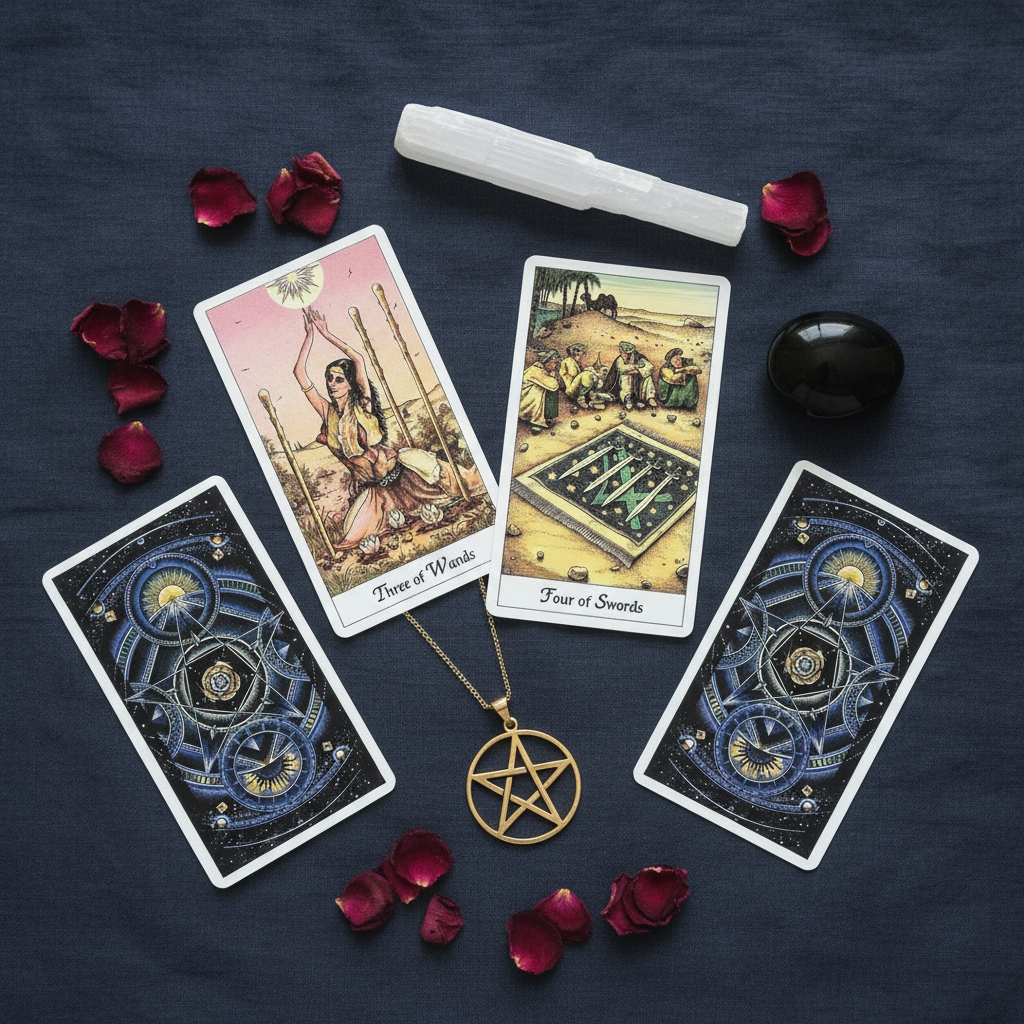
Pen and ink art with muted pastel coloring. Lösche's technique creates imagery that is simultaneously detailed and soft — the suits each have their own dominant palette, the figure work is precise, and the whole deck has a quiet 1980s European aesthetic that feels genuinely unlike anything else in print. The card backs feature a star field with a central pentagram, rising sun, and white rose: arguably one of the most striking back designs in the tarot canon.
Accessible to all readers, esoteric for those who want it. The Cosmic Tarot was designed to be understood without requiring prior knowledge of astrology, Kabbalah, or the Golden Dawn's secret doctrines — but that depth is there for readers who want to go further. The booklet provides interpretations at the individual, community, and cosmic levels, making it a working tool at every stage of a practice.
Product Details
- Cards: 78 (22 Major Arcana, 56 Minor Arcana)
- Card size: approximately 2.75 x 4.72 inches (7 x 12 cm)
- Suits: Wands, Cups, Swords, Pentacles
- Court cards: King, Queen, Prince, Princess
- Back design: Non-reversible (star field with pentagram, white rose, sun and moon)
- Includes: 40-page booklet by Norbert Lösche
- Publisher: AGM-Urania, distributed by U.S. Games Systems
- Originally published: 1986 (FX Schmidt); current edition AGM-Urania / U.S. Games
- ISBN: 9780880793957
- Tradition: Golden Dawn / Thoth-influenced Minor Arcana
The Spiritual Significance
The Golden Dawn system at the heart of the Cosmic Tarot is one of the most complete frameworks for working with tarot as a genuine tool of esoteric practice. Each card is assigned an astrological correspondence, a Kabbalistic sephira or path on the Tree of Life, and an elemental attribution — and Lösche has embedded all of this into the imagery in ways that become more legible the longer you work with the deck. If you're drawn to Western ceremonial magic, Hermeticism, or astrology, this deck becomes a study tool as much as a reading deck. You can use the astrological glyphs visible in the Minor Arcana to deepen your understanding of both systems simultaneously.
For intuitive and spiritual reading practice, the Cosmic Tarot's distinctive quality is its scale: the three levels of interpretation Lösche built into each card (individual, community, cosmos) give readings an unusual range of focus. A card can speak to what is happening inside you right now, to how that situation connects to the people around you, or to a larger pattern of meaning beyond the personal. Sitting with this framework as you read teaches you to think about the cards in motion rather than as fixed signposts — a valuable shift for any reader.
How To Use
If you're new to this deck, spend a few days with just the Major Arcana before moving to the full 78. The Majors in the Cosmic Tarot are rich enough to repay sustained attention, and getting a feel for Lösche's visual language will make the Minors much more legible when you add them.
The booklet's three-level interpretation framework is worth using deliberately rather than skimming. When you draw a card, try reading its individual-level meaning first, then the community level, then the cosmic. Notice whether your reading situation resonates most strongly at one level — this itself tells you something about where the energy is moving.
Because the backs are non-reversible, decide before a reading whether you'll work with reversals. If you do, you'll need to shuffle with that intention rather than relying on the back design to tip you off. Many readers find this deck reads clearly without reversals, given how fully the artwork and meanings cover the range of expression in each card.
For cleansing, a selenite slab under the deck overnight or a smoke cleanse before significant readings will keep the deck's energy clear between sessions. Store it somewhere meaningful — a dedicated bag, box, or altar space — and it will hold its charge between uses.
Pairs Well With
- Tarot Cards Collection — Explore other decks to build a reading practice or to keep alongside the Cosmic Tarot for comparative readings; Golden Dawn-adjacent decks like the Thoth pair especially well for students of the tradition.
- Journals — Keeping a tarot journal with the Cosmic Tarot pays dividends quickly, given the depth of symbolism in each card; recording daily pulls and noting which of the three interpretive levels resonates builds a genuinely personal relationship with the deck.
- Divination & Psychic Abilities Collection — Pendulums, crystal balls, rune stones, and other divination tools to complement a tarot practice and deepen your intuitive development.
- Oracle Cards Collection — Oracle decks pair naturally alongside tarot for layered readings; pulling an oracle card alongside a Cosmic Tarot spread can clarify or expand the message.
- Spiritual Growth Collection — Tools for ongoing esoteric study and practice development; the Cosmic Tarot rewards long-term engagement, and this collection supports the broader inner work that grows alongside it.
History & Occult Background
Norbert Lösche was born in 1951 near Aachen, Germany. He trained originally as a surveyor, then studied art history, and came to painting through a deepening interest in esotericism. His spiritual journey included an extended study of Hinduism and time spent in the community of Indian guru Bhagwan Shree Rajneesh (later known as Osho). It was this convergence of Western occult study and Eastern spiritual practice that shaped the Cosmic Tarot — a deck that carries the rigor of the Golden Dawn tradition while retaining something warmer and more humanistic in its imagery.
The deck was first published in 1986 by FX Schmidt, a Bavarian publishing house, and quickly found a devoted following. When FX Schmidt was sold in the 1990s, the deck moved to AGM-Urania (also known as AGMüller) in Switzerland, where it has been published continuously since. U.S. Games Systems distributes it in North America. Two English-language companion books have been published separately: one by Jean Huets, who also co-authored The Encyclopedia of Tarot with tarot authority Stuart R. Kaplan, and one by Laura Clarson.
The Cosmic Tarot belongs firmly to the Golden Dawn lineage, which runs from the Hermetic Order of the Golden Dawn's late 19th-century codification of tarot through the Rider-Waite-Smith (1909) and Crowley-Harris Thoth (1943) decks. Lösche's Minor Arcana are closer in meaning to the Thoth than to the Rider-Waite-Smith, though his visual presentation is original. One of the deck's charming and well-documented features is that the court cards' faces were based on — though not identical to — Golden Age Hollywood stars, giving the figures an expressiveness and immediacy that sets them apart from more symbolic or archetypal court card portraits.
Frequently Asked Questions
Is the Cosmic Tarot a good deck for beginners? Yes, with some nuance. The imagery is intuitive and the booklet's three-level interpretations make the cards approachable without prior esoteric knowledge. That said, the Minors are closer to Thoth in meaning than to the more widely known Rider-Waite-Smith, so if you're learning from a Rider-Waite based guidebook, some meanings will diverge. Beginners who engage with the booklet directly will find it fully accessible.
How does this deck differ from the Rider-Waite-Smith? The Major Arcana follow familiar RWS titles and sequence, with the exception of Justice at VIII and Strength at XI (as in the Thoth). The Minor Arcana are fully illustrated but draw on Golden Dawn correspondences rather than the Waite-Smith's more narrative imagery. Court cards are titled King, Queen, Prince, and Princess rather than King, Queen, Knight, and Page.
Are the card backs reversible? No. The backs feature an intricate asymmetrical design — a star field with a central pentagram, white rose, rising sun, and moon — that reveals card orientation. Decide before shuffling whether you'll work with reversals, as you'll need to manage orientation intentionally.
Who is Norbert Lösche? Norbert Lösche is a German self-taught artist born in 1951 who created the Cosmic Tarot as his primary tarot work. He studied art history and was drawn to the esoteric through his spiritual practice, which included both Western occult study and time with the Osho community. The Cosmic Tarot remains the defining work of his artistic career.
Does this deck come with a companion book? It includes a 40-page booklet by Lösche with card interpretations at three levels and sample spreads. Two full companion books are also available separately: one by Jean Huets and one by Laura Clarson, both published in English.
What tradition is this deck based on? The Cosmic Tarot is grounded in the Golden Dawn system, drawing on Hermetic Kabbalah, astrological correspondences, and the elemental associations codified by the Golden Dawn in the late 19th century. The Minor Arcana are closer in meaning to the Thoth tradition than to the Rider-Waite-Smith, though the overall framework will feel familiar to students of either.
What makes the court cards distinctive? The court cards feature portrait-style figure drawings whose faces were modeled loosely on Golden Age Hollywood film stars — not so literally as to be distracting, but expressively enough that they carry a distinctive warmth and presence. This is one of the most discussed and beloved features of the deck among its long-term readers.


Spend $50 & enjoy guilt-free shopping with our free shipping on all orders. Get your favorite items delivered right to your door at no extra cost.