



Plentiful Earth | Spiritual Store
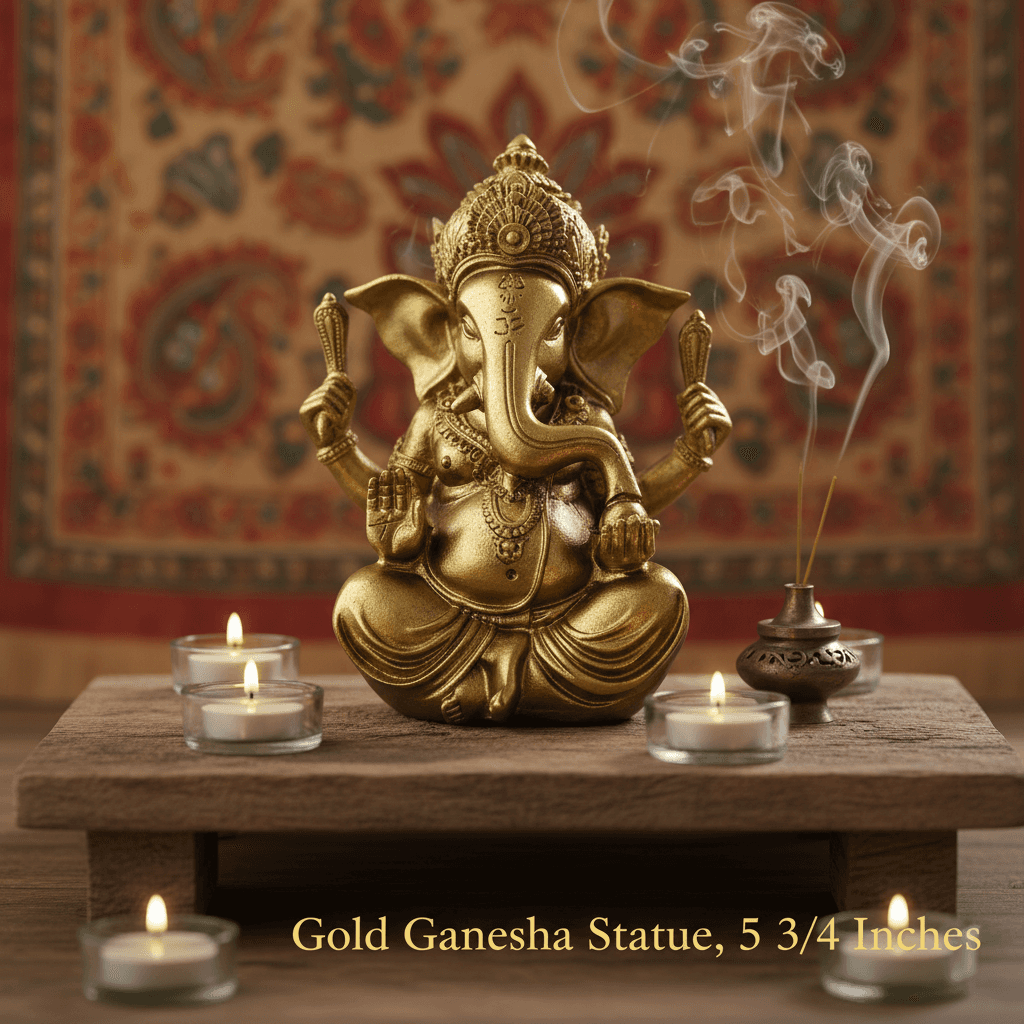
Gold Ganesha Statue, 5.75 Inches
Gold Ganesha Statue, 5.75 Inches- Primary Spiritual Use: Unblocking
- Secondary Spiritual Use: Wisdom
- Element: Earth
- Planet: Mercury
- Zodiac: Gemini, Virgo
- Chakra: Root
- Ruling Day: Wednesday
- Tradition: Hindu
- Intent: Unblocking, Wisdom
Couldn't load pickup availability
Ganesha is among the most beloved and widely worshipped deities in the world, the elephant-headed Hindu god revered as the remover of obstacles and the lord of beginnings. Before any new venture, journey, or undertaking, it is Ganesha who is honored first, the one who clears the way and blesses the start. He is also the patron of wisdom, learning, and the arts, gentle and approachable, wise and famously fond of sweets.
This 5 3/4-inch statue, in a warm gold-tone finish, brings his auspicious presence to an altar or sacred space, a focal point for clearing obstacles, prosperity, and beginning well.
Key Features
The Hindu remover of obstacles. Ganesha, lord of beginnings, in his elephant-headed form.
Gold-tone finish, 5 3/4 inches. Cold-cast resin with a luxurious gold-tone finish and detailed craftsmanship.
A devotional focal point. A modern devotional sculpture, not an archaeological reproduction.
Product Details
- Height: about 5 3/4 inches
- Material: cold-cast resin
- Finish: gold tone
- Form: seated elephant-headed Ganesha
- Use: deity statue, altar focal point, new beginnings, obstacles, and prosperity work
- SKU: SG102
- Sold by Plentiful Earth
The Spiritual Significance
Ganesha, also called Ganapati, is the son of Shiva and Parvati and the leader of Shiva's ganas, his divine attendants. He is Vighnaharta, the remover of obstacles, the one who clears the path before any undertaking, which is why he is invoked first in nearly every Hindu ritual, prayer, and new beginning. He is equally the god of wisdom, intellect, and the arts, and his image is rich with meaning: the broken tusk, the great listening ears, the small mouse that carries him, and the sweet modak he loves. His gold-bright form especially evokes the auspicious prosperity that follows when the way is cleared.
For more than a billion Hindus he is a living, daily presence, honored at thresholds, on home altars, and at the start of weddings, journeys, and ventures. On a modern altar he is worked with for new starts, for clearing what blocks the way, for wisdom in study and creative work, and for success and prosperity in endeavors. Honor him as the specific deity he is, with respect for the living tradition he comes from.
How To Use
- Place him on an altar or a sacred space, ideally near an entrance or where new ventures begin.
- Welcome him by cleaning the statue, then offer fresh flowers, incense, and a sweet such as a modak or laddu, which are traditional favorites.
- Invoke him before a new venture, journey, or piece of work, asking him to clear the obstacles in your path; the mantra Om Gam Ganapataye Namaha is traditionally used.
- Keep a small regular practice rather than calling on him only in need, a little incense or a fresh flower as an ongoing devotion.
- Keep the space clean, refresh offerings, and dust the statue gently with a soft cloth.
Pairs Well With
- Bronze Ganesha Statue, 3.5 Inches a smaller Ganesha for a layered altar or travel.
- Lakshmi Statue, 10 Inches the goddess of prosperity, often honored alongside Ganesha.
- Ganesh Supari Brass Statue, Set of 3 tiny brass Ganesha figures for puja.
- Shiva Nataraja Statue, 9 Inches Ganesha's father, the cosmic dancer.
History & Occult Background
Ganesha rose to prominence in the Hindu tradition by the Gupta period, becoming one of the principal deities worshipped across all of Hinduism's major branches. The best-known story of his elephant head tells how Parvati created him as her own and set him to guard her door; Shiva, not knowing the boy, struck off his head, and to console Parvati restored him to life with the head of an elephant. His great festival, Ganesh Chaturthi, fills streets and homes across India and the diaspora. His image traveled with Indian culture across Asia and appears in Jain and Buddhist contexts as well, a measure of how widely loved he is.
Frequently Asked Questions
Who is Ganesha?
He is the elephant-headed Hindu god, son of Shiva and Parvati, revered as the remover of obstacles and the lord of beginnings, and honored as a god of wisdom and the arts. He is invoked first in most Hindu worship.
Why does he have an elephant head?
In the best-known myth, Shiva beheaded the boy Ganesha without recognizing him as his son, then restored him to life with an elephant's head to console Parvati. The elephant head carries meanings of wisdom, memory, and strength.
What offerings are traditional?
Sweets, especially modak and laddu, along with fresh flowers, fruit, and incense. The mantra Om Gam Ganapataye Namaha is traditionally chanted in his honor.
Can I honor Ganesha outside Hinduism?
Ganesha is welcoming and widely honored beyond his home tradition, but he is a specific deity of a living religion. Approach him with respect and accuracy rather than as a generic luck charm, and learn a little of his tradition as you work with him.
How do I care for the statue?
Dust it with a soft dry cloth and keep it out of prolonged direct sunlight to protect the gold-tone finish. Avoid soaking the resin; a barely damp cloth is enough for occasional cleaning.


Spend $50 & enjoy guilt-free shopping with our free shipping on all orders. Get your favorite items delivered right to your door at no extra cost.