



Plentiful Earth | Spiritual Store
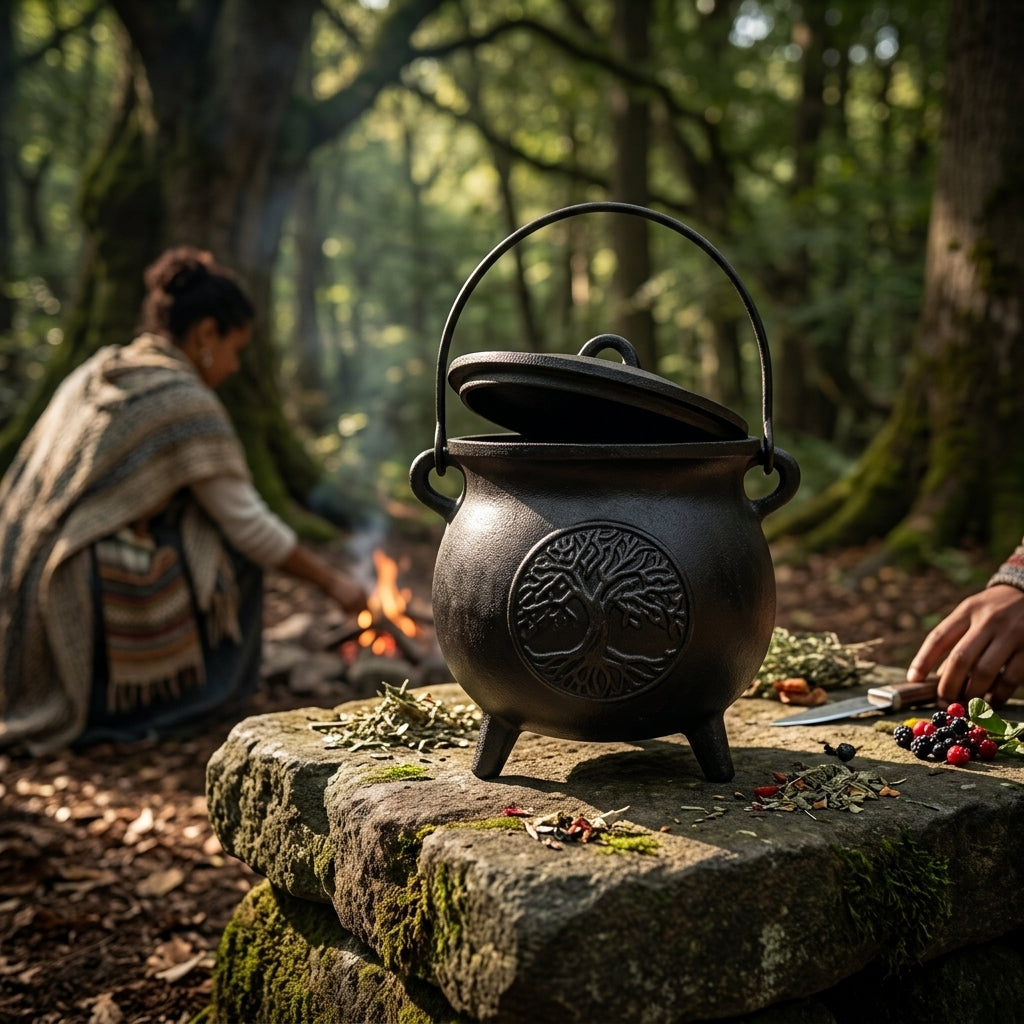
Medium Tree of Life Cast Iron Cauldron, 6"
Medium Tree of Life Cast Iron Cauldron, 6"- Primary Spiritual Use: Rebirth
- Secondary Spiritual Use: Creativity
- Element: Water
- Planet: Moon
- Zodiac: Cancer, Scorpio
- Chakra: Sacral
- Ruling Day: Monday
- Tradition: Wiccan/eclectic
- Intent: Rebirth, Creativity, Transformation
Couldn't load pickup availability
The cauldron is one of the oldest magical objects in the Western imagination. Long before it became a symbol of the witch's craft, it was a practical tool of transformation: the vessel in which raw things became something new, in which the act of cooking crossed the line into the sacred. In Celtic mythology, cauldrons held particular power, the Cauldron of Dagda that fed the hungry and the Cauldron of Cerridwen from which the bard Taliesin drank and received his gifts. The tradition of the ritual cauldron in modern Wiccan and Pagan practice descends from that lineage, and the cauldron on a working altar carries that weight of meaning in every working it joins.
This 6" Tree of Life cast iron cauldron brings that tradition together with one of the most enduring symbols in Western spiritual iconography. The Tree of Life, embossed on the body of the cauldron, depicts the world tree: roots reaching into the earth, branches extending toward the sky, the whole structure a map of the relationship between the seen and unseen worlds. On a cast iron cauldron, that symbol is not decorative in the passive sense. Every working that happens inside this vessel takes place within the frame of that imagery: transformation happening at the axis between worlds.
Cast iron is the traditional and most practical material for a working cauldron. It is fireproof, extraordinarily durable, and develops a natural seasoning over years of use that bonds it to your practice in a specific, embodied way. This cauldron has a removable lid, a swing bail handle for stability and heat management, and three sturdy legs that raise it safely off any surface. At 6" across, it is a true working size: large enough to burn spell papers and charcoal incense tablets comfortably, small enough to anchor any altar without dominating it.
Key Features
6" working diameter: genuinely functional, not decorative. Many cauldrons sold in the spiritual supply market are too small for practical ritual use. At 6" across, with a 5" mouth and 5" bowl depth, this cauldron is sized for real work: burning petitions, holding charcoal tablets for loose incense and resin blends, containing smudge bundles, or serving as a fire-safe vessel for small candle workings. It is both a tool and a symbol, and it performs well as both.
Tree of Life embossed body: sacred geometry in cast iron. The Tree of Life appears in Celtic mythology, Hermetic and Kabbalistic traditions, Norse cosmology (as Yggdrasil), and across many other spiritual lineages. Its presence on this cauldron is not brand-specific; it invokes a symbol that has carried meaning across thousands of years and dozens of traditions. Whatever your path, the tree stands at the center of the world and holds the working that happens within its frame.
Removable lid, swing handle, three legs: a complete working vessel. The lid allows you to contain smoke and heat, to smother a working when you are ready to close it, and to preserve whatever is burning inside without extinguishing it entirely. The swing handle allows safe movement even when the cauldron is hot. The three legs protect every surface beneath it from heat, and in Wiccan symbolism, three is the number of the Goddess's three faces: Maiden, Mother, and Crone.
Product Details
- Cauldron height: Just under 6" tall
- Mouth diameter: 5"
- Bowl depth: 5"
- Width handle to handle: 6½"
- Lid diameter: Approximately 5⅛"
- Lid height: Approximately 2"
- Legs: 3 raised sturdy legs
- Handle: Metal swing bail handle
- Material: 100% cast iron
- Finish: Black
- Motif: Tree of Life embossed on body
- AzureGreen SKU: ICBR89
The Spiritual Significance
In Wiccan practice, the cauldron represents the womb of the Goddess and the element of Water, making it the appropriate vessel for workings focused on transformation, rebirth, manifestation, and the deep inner processes of change. You can use this cauldron as the central altar vessel for a full moon or new moon ritual, placing it at the center of your working space and burning your intention written on petition paper inside it. The act of writing your intention, placing it in the cauldron, and watching it transform to ash is one of the most direct forms of spell-casting in eclectic Wiccan and folk magic practice: the paper is the desire in its fixed form, and the fire is the act of releasing it to manifest in the world.
You can also use this cauldron for incense and resin burning as a sustained sacred smoke practice rooted in the long tradition of fumigation as spiritual purification. Place a lit charcoal tablet in the cauldron's bowl on a bed of sand, and add loose resin incense such as frankincense, copal, or dragon's blood as your working calls for. The cauldron's iron body holds and radiates heat safely while the lid allows you to control the intensity of the smoke. This is the practical foundation of countless Wiccan, ceremonial, and eclectic rituals, and the Tree of Life cauldron gives that work both physical safety and symbolic resonance.
How To Use
Seasoning your cauldron before first use: New cast iron cauldrons benefit from a light coat of cooking oil wiped over the interior and exterior, then heated briefly, to begin building a protective seasoning layer. This prevents rust and creates the patina that deepens with every use. If you are using this cauldron exclusively for ritual burning rather than cooking, simply wiping it clean after each use and occasionally treating with oil is sufficient to maintain it.
Burning charcoal for loose incense and resin: Place a thin layer of sand or salt in the bottom of the cauldron to insulate the metal from direct charcoal heat. Set a self-lighting charcoal tablet on the sand, light it according to the tablet instructions, and allow it to fully ash over (about 5 minutes) before adding resin or loose incense. The lid can be used to control smoke output: tilt it slightly open for a steady stream, close it fully to reduce smoke.
Burning spell papers and petitions: Write your intention clearly on a small piece of paper. Hold it between your hands and breathe your focus into it before lighting it. Place it in the cauldron and allow it to burn completely. Some practitioners prefer to do this under the open sky where the smoke can rise freely; the swing handle makes the cauldron portable for outdoor ritual.
As an offering vessel: Place offerings of herbs, flowers, or food inside the cauldron on your ancestor altar or deity shrine. The cauldron's symbolism as a vessel of transformation and nourishment makes it one of the most appropriate containers for offerings across Celtic-influenced and Wiccan practice.
As an elemental Water representation: In Wiccan elemental altar arrangements, the cauldron is often placed in the West, the direction of Water, as one of the four elemental tools. The cauldron here represents the receptive, transformative aspect of Water: the womb, the vessel, the potential for change. Even when not in active use, it holds that meaning on your altar.
Cast iron develops its character over years of use. The cauldron you have in ten years will be different from the one you receive today, seasoned by every working it has held. Let that relationship unfold at its own pace.
Pairs Well With
White Sage Kit Smudge — Use the cauldron as a safe, heat-resistant smudge vessel: light your sage bundle, let it catch, then rest it in the cauldron while it releases smoke, keeping ash and embers safely contained throughout your space-cleansing ritual.
Prosperity Incense Sticks by Escential Essences — Burn prosperity incense alongside the cauldron during abundance workings; the incense fills the space with intention while the cauldron holds the central working, creating a layered sensory ritual environment.
Prosperity Magic Dust — Add a pinch of prosperity dust to a petition paper before folding it and placing it in the cauldron to burn; combining the dust's symbolic energy with the fire of transformation amplifies the working from two directions at once.
3¾" Cast Iron Ritual Cauldron — Keep the smaller cauldron on your altar for everyday offerings and incense cone burning while the 6" Tree of Life cauldron serves larger workings; having two sizes allows you to match the vessel to the scale of the ritual.
Cleansing & Home Blessing Collection — Explore the full range of cleansing and blessing tools at Plentiful Earth; the cauldron works in concert with sage, Florida Water, incense, and protective herbs from this collection to build a complete space-cleansing and blessing practice.
History & Occult Background
The cauldron's place in Celtic mythology is both deep and specific. The most prominent mythological cauldrons include the Cauldron of Dagda, one of the four treasures of the Tuatha Dé Danann in Irish mythology, which was said to be inexhaustible; the Cauldron of Cerridwen from Welsh mythology, from which the poet-bard Taliesin received his gift of inspiration after accidentally drinking three drops intended for her son; and the Pair Dadeni, the Cauldron of Rebirth from the Mabinogion, which could restore the slain to life. These mythological cauldrons share a common theme: the vessel as a site of transformation, abundance, and the crossing of the boundary between life and death. This symbolic weight is what the cauldron carries into modern Wiccan and Pagan practice.
The cauldron as a ritual altar tool in modern Wicca was established through Gerald Gardner's development of Wiccan practice in the mid-20th century. Gardner drew on Celtic mythological imagery, including the cauldron as a symbol of the Goddess's transformative womb, to develop the symbolic vocabulary of Wiccan altar tools. In the elemental system Gardner formalized, the cauldron is associated with Water and the West, and it serves as one of the primary representational objects for the feminine principle in the ritual circle. Doreen Valiente, Gardner's collaborator and one of Wicca's most influential figures, emphasized the cauldron's role in the cycle of birth, death, and rebirth that lies at the heart of Wiccan theology.
Cast iron's history as the material of choice for magical cauldrons is rooted in both its practical properties and its symbolic associations. Iron was understood across many European and other traditions as a powerful protective and transformative metal: it was used for amulets and protective charms, hung above doorways and buried at thresholds to ward off malevolent spirits, and worked by blacksmiths who occupied a liminal, quasi-magical role in many cultures. Its association with the forge — with heat, transformation, and the mastery of natural forces — made it the natural material for a vessel whose purpose is fundamentally transformative. A cast iron cauldron brings the element of Fire (through its forge-born nature) to a vessel that represents Water, making it a meeting point of two primary elemental forces.
The Tree of Life symbol embossed on this cauldron has a presence across multiple traditions. In Celtic cosmology, the World Tree (often an oak or ash) connected the three realms: the underworld, the middle world of human experience, and the upper world of the gods. In Norse cosmology, this role is filled by Yggdrasil, the great ash that holds the nine worlds in its roots and branches. In the Hermetic and Kabbalistic tradition, the Tree of Life (Etz Chayyim) is a fundamental diagram of the structure of existence, mapping the ten sephirot and the pathways between them. All of these lineages are present in the symbol, and a practitioner can engage with whatever resonates most deeply with their own path.
Frequently Asked Questions
How do I season and care for this cast iron cauldron? Before first use, wipe the interior with a light coat of vegetable or coconut oil, then heat it gently for a few minutes to allow the oil to bond with the metal. Wipe away any excess. After each ritual use involving burning or charcoal, allow the cauldron to cool completely before cleaning. Brush out ash and debris, wipe with a dry cloth or lightly oiled cloth, and store in a dry place. Avoid leaving standing water in the cauldron, which will cause rust. If rust appears, scrub with a coarse cloth and re-oil.
Can I burn loose resin incense directly in this cauldron? Yes, with a precaution: place a bed of sand or salt in the bottom of the bowl before placing your lit charcoal tablet. The sand acts as insulation, protecting the cauldron's legs and the surface beneath it from the intense heat of charcoal. Without sand, the heat can discolor or damage surfaces the cauldron rests on, and over time can stress the iron itself. Once your sand bed is in place, this cauldron is well-suited for resin, loose herb, and powder incense burned on charcoal.
Is this cauldron food-safe for kitchen witchcraft? Cast iron can be used for cooking, and a well-seasoned cast iron vessel is food-safe. However, this cauldron is sold as a ritual tool and may be treated or finished in ways that are not food-safe. If you intend to use it for actual cooking, confirm the finish with Plentiful Earth before doing so. For ritual burning only, this question is not relevant.
What does the Tree of Life symbol mean in the context of witchcraft practice? The Tree of Life in Wiccan and eclectic Pagan practice generally represents the interconnection of all life, the axis between the earthly and spiritual realms, and the cycle of growth, decay, and rebirth. It is associated with balance, wholeness, and the understanding that every living thing participates in a web of relationships that extends beyond the visible world. Working with this symbol on your cauldron places every transformation that happens within it in that larger context of connection and continuity.
Is this cauldron appropriate for a beginner's practice? Yes, and it may be one of the most practical first ritual tools you acquire. A cast iron cauldron with a lid is functionally useful from the first day you own it: for burning sage, holding charcoal and loose incense, or burning a petition paper. You do not need extensive experience to use it safely and meaningfully. Over time it will become one of the most familiar and well-used objects in your practice.
How do I cleanse this cauldron spiritually before its first ritual use? Pass it through incense smoke, set it under moonlight overnight, or wipe its interior and exterior with a cloth lightly dampened with Florida Water or diluted salt water, then dry thoroughly to prevent rust. Many practitioners also speak a simple consecration aloud, dedicating the cauldron to their practice and the intentions they will work with it. Cast iron is already charged with the energy of fire from its making; your intention adds the personal layer that makes it yours.


Spend $50 & enjoy guilt-free shopping with our free shipping on all orders. Get your favorite items delivered right to your door at no extra cost.