



Third Eye Chakra Pillar Candle, 3 x 6 Inch | Ajna Intuition & Inner Sight
Third Eye Chakra Pillar Candle, 3 x 6 Inch | Ajna Intuition & Inner Sight- Primary Spiritual Use: Intuition
- Secondary Spiritual Use: Psychic
- Element: Spirit
- Planet: Jupiter
- Zodiac: Pisces
- Chakra: Third Eye
- Ruling Day: Thursday
- Tradition: Wiccan/eclectic
- Intent: Psychic, Spirituality, Power, Intuition
Couldn't load pickup availability
The Third Eye Chakra is the chakra people meet when they have started to suspect that knowing has more channels than thinking. After years of being told to be reasonable, after the dream that turned out to be true, after the gut feeling you ignored and later regretted, after the meditation that opened a window you did not know was there. When you start trusting what you sense without proof, when your dreams get vivid, when patterns connect that you could not have analyzed your way to, this is the chakra asking for attention. Ajna, the Sanskrit name, translates to "command" or "perceiving," the inner sight that does not depend on the eyes.
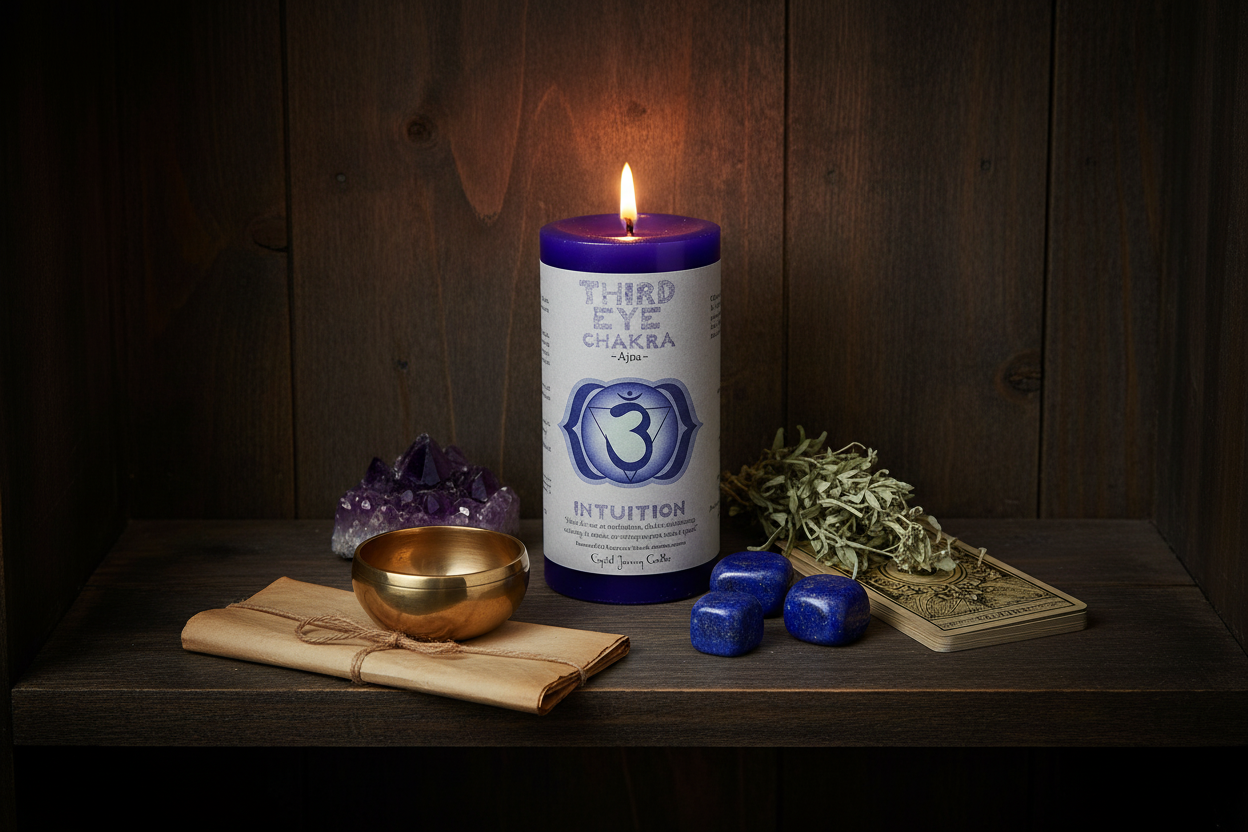
This Crystal Journey pillar carries deep indigo for Ajna energy: intuition, inner sight, the slow practice of trusting what you cannot prove. The 3 x 6 inch format gives you roughly 70 hours of burn time, the right scale for sustained Third Eye work, week-long containers around opening intuition, season-long practice for dream work or divination, or extended rituals around significant questions where one shorter sit isn't enough. Light it during meditation, dreamwork, divination practice, journaling that wants to surface deeper material, or any practice that asks you to listen to subtler channels. The flame gives you a focal point; the color and intention do the rest.
Ajna is the witness consciousness, the part of you that can observe without judging, that sees what is rather than what you wish were so. This is not the same as imagination, which is closely related Sacral and Solar Plexus territory; Ajna's work is to receive what is true, even when it is uncomfortable, even when it disagrees with what you want. The candle isn't the seeing. The candle is the quiet long enough for the seeing to come.
Key Features
Indigo wax for Ajna energy. The Third Eye Chakra's traditional color across both Vedic and modern Western chakra systems is deep indigo, the wavelength between blue and violet, the color of night sky just before full dark. The wax color is the working, not decoration.
Pillar size for sustained ritual practice. A 3 x 6 inch pillar burns for around 70 hours total, the right scale for week-long dream-work containers, season-long intuition-development rounds, or extended ritual circles where Third Eye Chakra needs continuous attention. Long enough to hold a sustained working; substantial enough to anchor an altar.
Crystal Journey ritual candle with informational paper label. Every Crystal Journey chakra candle ships with a paper label wrapped around it that carries detailed Third Eye Chakra information, useful as a reference card and as a small ritual study tool before you light. Remove the label fully before lighting.
Product Details
- Format: pillar candle
- Dimensions: 3 x 6 inches
- Color: indigo (Ajna/Third Eye Chakra correspondence)
- Maker: Crystal Journey Candles
- Includes: removable paper label with Third Eye Chakra information
- Burn time: approximately 70 hours
- Total weight: 1.7 lb (about 27 oz)
The Spiritual Significance
The Third Eye Chakra (Sanskrit: Ajna, आज्ञा, "command" or "perceiving") is the sixth of the seven main chakras, located at the center of the forehead, between and slightly above the eyebrows. Its element is light, the inner light of perception that does not require external eyes. Its bija (seed) mantra is OM (sometimes written AUM), and its lotus is depicted with only two large white petals around an indigo center, a striking departure from the multi-petaled lotuses of the lower chakras. Functionally, it governs intuition, inner sight, perception beyond the ordinary senses, dreams, visualization, and the witness consciousness that observes experience without being lost in it.
When Ajna is balanced, you tend to trust your intuition without needing to defend it, hold paradox without needing to resolve it prematurely, see patterns and meaning without forcing them, and remember and work with your dreams. Reality and imagination are clearly distinguishable. When the chakra is constricted, through rationalist conditioning that dismisses inner knowing, religious or family environments hostile to intuition, overwhelming experiences that shut down receptivity, or simply too much screen time and not enough quiet, the felt sense tends to be familiar: chronic doubt of your own perceptions, mental fogginess, an inability to visualize or remember dreams, tension around the brow, denial of intuitive hits that turn out to be right. The opposite imbalance also exists: an overactive Third Eye that floats untethered from the body, mistakes imagination for intuition, sees patterns where there are none, and uses spiritual experience as escape from material life.
Lighting a Third Eye Chakra candle is one small, repeatable way to bring intentional attention to this layer. The candle is not magic that makes you psychic; it is a tool that focuses your own perceptive work. Pair it with grounding practice (Root Chakra work, embodied movement, eating real food, sleep), with the willingness to let intuition include uncomfortable knowing, and with the patience to let inner sight develop slowly. Third Eye work without grounding can drift into spiritual bypass; the steady chakra system is what keeps it useful.
How To Use
- Remove the paper label from the candle completely before lighting. Do not skip this step; the label is paper and will catch fire.
- Cleanse the candle in your usual way: pass it through smoke from a smudge stick or palo santo, leave it in moonlight overnight, or sprinkle a light pass of salt around the base.
- Sit quietly. Place a finger lightly at the center of your forehead, between and slightly above the eyebrows, where the third eye center sits. Notice any sensation there. Place the candle in front of you on a heatproof surface.
- Light the wick and set your intention. For Third Eye work, intentions tend to be questions rather than statements: "Show me what I have not been able to see," "What is true about [situation] beyond what I want it to be?", "Let me trust what I sense." Or any specific question you have been carrying without an answer.
- Sit with the flame. Practices that pair particularly well with this chakra: dream journaling (have paper nearby), divination with tarot, pendulum, or runes, soft-focus meditation gazing at the candle flame, or simply quiet listening for what wants to be known. Many practitioners chant OM, the Third Eye Chakra's seed mantra, on a slow exhale.
- When you are finished or the candle has burned to its base, snuff it out (don't blow it out, traditionally) and offer thanks. Drink water afterwards. Write down any insight before it slips. Do not argue with what came up; let it sit for a few days before deciding what it means.
Pairs Well With
- Third Eye Chakra Votive Candle: same Ajna energy in a votive form, for single-session meditation or daily intuition practice where 70 hours of burn isn't needed.
- Throat Chakra Pillar Candle, 3 x 6 Inch: the chakra below Third Eye in the pillar line, governing communication and authentic expression. Vishuddha gives Ajna's insights words; without it, intuition stays stuck as private knowing that never reaches the world.
- Crown Chakra Pillar Candle, 3 x 6 Inch: the next and final chakra up the pillar line, governing connection to source and spiritual unity. Once Ajna's inner sight is steady, Sahasrara opens onto the dimension that inner sight is always perceiving.
- 7 Chakra Tumbled Stones, Set of 7: a set of seven traditionally chakra-aligned tumbled stones, including the amethyst, lapis lazuli, sodalite, or fluorite that pair specifically with Ajna intuition and inner-sight work.
- Astral Journey Reiki-Charged Pillar Candle: a Reiki-infused pillar specifically charged for astral work, dream travel, and psychic exploration, the most thematically aligned non-chakra candle for sustained Third Eye rituals or extended intuitive practice.
- Healing Reiki-Charged Pillar Candle: a Reiki-infused pillar that anchors longer chakra-balancing or full-body healing rituals, while the Third Eye pillar handles the specific Ajna focus within them.
History & Occult Background
The chakra system as we know it in modern Western spiritual practice traces back to Hindu tantric texts, particularly the Sat-Cakra-Nirupana, a sixteenth-century Sanskrit work that codified the seven-chakra model along the central channel of the subtle body. Earlier mentions of energy centers appear in the Upanishads and in tantric Buddhist sources, but the seven-chakra model that became dominant in Western contexts is largely the one this text codified.
Ajna, the Third Eye Chakra, is the sixth of those seven, sitting at the brow between the eyebrows. Traditional iconography depicts it as a two-petaled white lotus around an indigo center, a striking visual difference from the multi-petaled lotuses of the lower chakras. The two petals are often understood as representing the union of opposites that resolves at Ajna: solar and lunar, masculine and feminine, knower and known. The seed mantra OM at the center is the primordial sound of the universe, the most universal mantra in Vedic tradition. The deity Ardhanarishvara, the half-Shiva-half-Shakti form representing non-duality, presides over this center in many tantric texts; in others, it is the goddess Hakini Devi.
The "third eye" in Western esoteric practice is sometimes mapped to the pineal gland, a small endocrine gland at the geometric center of the brain that some traditions consider the physical seat of inner perception. Whether the chakra and the gland are literally connected or metaphorically connected has been debated since at least Descartes, who famously called the pineal "the seat of the soul." For practical chakra work, the question matters less than the practice. The system was carried into Western esoteric thought through nineteenth-century Theosophy and twentieth-century New Age writing, and was popularized in modern English-language spiritual practice through writers like Anodea Judith, Caroline Myss, and Caroline Shola Arewa. As with any tradition adopted across cultures, respect for the source matters: the chakra system is a Hindu tantric inheritance, and using it well includes acknowledging where it comes from.
Frequently Asked Questions
What's the difference between the Third Eye Chakra and Throat Chakra candles?
The Throat Chakra (light blue) governs communication, truth-telling, and authentic expression, work it when you feel silenced or unable to say what you mean. The Third Eye Chakra (indigo) governs intuition, inner sight, dreams, and the witness consciousness, work it when you feel cut off from inner knowing, when intuition feels muffled, when you want to deepen meditation or dream practice, or when you are trying to learn to trust what you sense. Vishuddha speaks; Ajna sees.
What's the difference between the Third Eye Chakra Pillar and the Third Eye Chakra Votive?
Both candles work the same Third Eye Chakra correspondences (indigo wax, Ajna, OM mantra, intuition and inner-sight focus), so the chakra material is identical. The format choice depends on practice scale: the votive (about 15 hours of burn time) is sized for a single meditation, a focused divination session, or a quiet sit with one question; the pillar (about 70 hours of burn time) is sized for week-long dream-work containers, season-long intuition-development practice, or sustained rituals around significant questions that need extended quiet to surface their answers. Both can be used for the same intentions; the pillar suits sustained practice.
How do I know if my Third Eye Chakra needs work?
Common signs of an unbalanced Third Eye Chakra include chronic doubt of your own perceptions, mental fog, inability to visualize or remember dreams, a persistent tightness around the brow, denial of intuitive hits that turn out to be right, or, on the overactive end, mistaking imagination for intuition, seeing meaningful patterns where there are none, or using spiritual experience to escape material life. If two or three of those describe your current state, this is the candle to start with.
Can this candle help me develop psychic or intuitive abilities?
Ajna work is traditionally connected to the development of intuition and what some traditions call the subtle senses (clairvoyance, clairsentience, and so on). The candle is not magic that gives you psychic abilities; it is a tool that focuses repeated quiet practice. Real intuitive development happens through sustained attention over months or years, paired with grounding so the receptivity stays useful. The candle is a ritual companion to that practice, not a shortcut around it.
What's the difference between intuition and imagination?
This is one of the most useful questions in Third Eye work. Imagination is a Sacral and Solar Plexus territory, the creative faculty that generates possibility. Intuition is a Third Eye territory, the receptive faculty that perceives what is. They feel different in the body: imagination has a quality of effort and creation, intuition has a quality of arrival and recognition. Practiced Third Eye work develops the discernment to tell them apart. When you are starting, write down both, and let time test which kind of knowing each was.
What's the OM mantra and do I have to chant it?
OM (also written AUM, pronounced "ohm" or as three sounds A-U-M blended) is the bija (seed) mantra traditionally associated with Ajna in Vedic tantric practice, and is also considered the primordial sound of the universe in broader Hindu and yogic tradition. Chanting it on a slow exhale, especially with attention at the brow, is a particularly direct technique for activating Third Eye Chakra energy. Optional, but if you are going to chant any chakra mantra, OM is the most familiar and most universally used.
Can I use this candle for spell work as well as chakra meditation?
Yes. Indigo and dark blue candles are traditional in many folk magic practices for psychic work, divination, dream magic, banishing illusion, mental clarity, and revealing hidden truth, all of which overlap with Third Eye Chakra themes. The candle's chakra dedication does not preclude spell-craft use; if anything, the focused Ajna energy reinforces intuition-aligned and divination-aligned spell work.
How long does a Third Eye Chakra pillar candle burn?
Crystal Journey 3 x 6 inch pillars typically burn for around 70 hours, depending on draft and burn conditions. That's enough for week-long sustained Ajna work, multiple divination rituals across a season, or substantial altar-burning containers anchored in Third Eye Chakra focus.
Is it safe to leave the candle burning unattended?
No. As with any open flame, never leave a burning candle unattended. Keep it on a heatproof surface, away from drafts, fabric, and flammable materials. Snuff it out before sleep or leaving the room.


Spend $50 & enjoy guilt-free shopping with our free shipping on all orders. Get your favorite items delivered right to your door at no extra cost.