Purification
Skip to product information
1 of 5

Plentiful Earth | Spiritual Store

PurificationCleansing

Yellow Sandalwood Powder, 1oz (Santalum album)

Yellow Sandalwood Powder, 1oz (Santalum album)
Regular price $6.95 USD
Regular price Sale price $6.95 USD
Sale Sold out
Shipping calculated at checkout.
Primary Spiritual Use: Purification
Secondary Spiritual Use: Cleansing
<p>Earn%20[points_amount]%20when%20you%20buy%20this%20item.</p>
Quantity
Save up to 15% off!
  • Ships In 1-2 Days

  • 180 Day Returns

  • Trusted By 1,000+ Spiritualists

PayPalAmazon American Express Apple Pay Diners ClubDiscoverGoogle Pay JCBMaestroMastercardShop Pay Union PayVisa
Spiritualist-Approved Instructions & Product Info ✅

This is the sandalwood you know. Santalum album, white or yellow sandalwood, the fragrant heartwood that has been burning in temples, ground into devotional pastes, and prized in perfumery for at least four thousand years. Unlike red sandalwood (Pterocarpus santalinus), which shares the name but not the species and carries almost no scent, Santalum album is the deeply aromatic, creamy-woody, slightly sweet heartwood that defines what sandalwood smells like in every cultural context that uses the word.

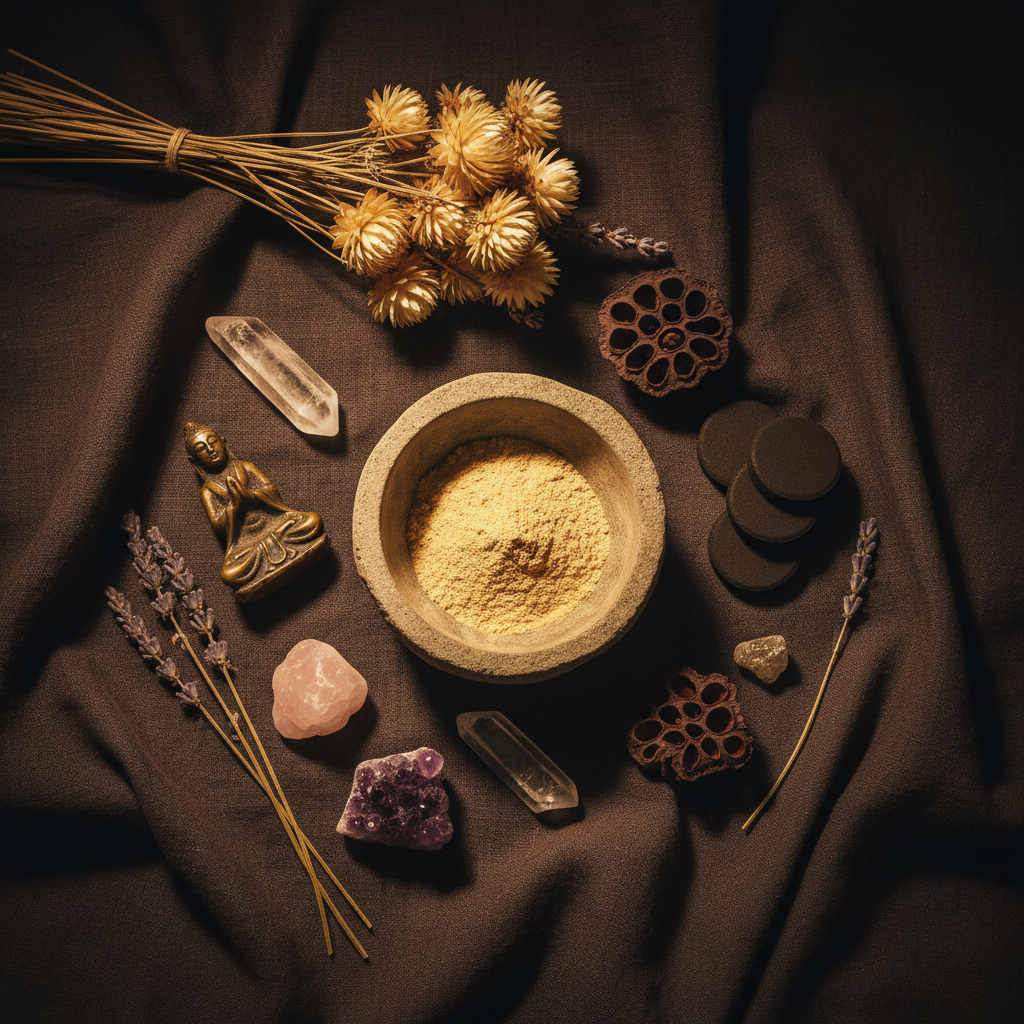
This 1oz packet is the powdered heartwood: ready for blending into loose incense, incorporating into ritual preparations, using as a tilak base in devotional practice, or adding to any working where the spiritual properties of true sandalwood are called for. At 1oz it is a genuine working supply rather than a token quantity.

A note for practitioners who have also seen red sandalwood on the PE shelf: these are entirely different materials. Red sandalwood has minimal scent and is used primarily for its color and its grounding protective energy. Yellow sandalwood has the famous fragrance and the purification, elevation, and devotional associations that have made sandalwood one of the most sacred aromatics in recorded human history.

Key Features

True Santalum album: the fragrant sandalwood of devotional and ritual tradition. This is the species whose heartwood produces the distinctive sandalwood fragrance: warm, woody, creamy, slightly sweet, with a depth that does not fade quickly. It is this fragrance that fills Indian temples, that perfumers use as a base note, and that every spiritual tradition associated with sandalwood actually refers to.

Powdered for versatile use in incense blending and ritual preparation. Powder form is ready for immediate use in loose incense blends (burned on charcoal), ritual powders, and devotional paste preparations. It blends smoothly with resins, other wood powders, and dried herbs.

Genuine working supply at 1oz. A meaningful quantity for practitioners who use sandalwood regularly in incense work, offerings, or devotional practice. Not a token amount.

Product Details

  • Common name: Yellow sandalwood; White sandalwood; East Indian Sandalwood
  • Scientific name: Santalum album
  • Form: Powder
  • Weight: 1 oz
  • Scent: Warm, woody, creamy, sweet; the classic sandalwood fragrance
  • Origin: Southern India (primary wild and plantation sources)
  • Note: Distinct from red sandalwood (Pterocarpus santalinus) in species, appearance, scent, and spiritual applications
  • Conservation note: Santalum album is a protected species in India; ethically sourced powder comes from plantation-grown or legally harvested stock

The Spiritual Significance

In Hinduism, sandalwood paste (chandan) is one of the most sacred devotional materials: applied as tilak marks to devotees, offered to deities on altars, used to anoint sacred images, and burned as incense in temple ritual. The fragrance is considered particularly pleasing to Vishnu, Shiva, and Lakshmi, and its coolness (sandalwood powder applied to skin creates a mild cooling sensation) is associated with divine purity and the calming of heat in all its forms: physical, emotional, and spiritual. In Buddhist tradition, sandalwood is one of the six perfumes of the Buddha and appears in offering practices across Theravada, Mahayana, and Vajrayana lineages.

In Western magical and Hermetic practice, sandalwood carries associations with purification, spiritual elevation, protection, meditation, and the enhancement of psychic perception. Scott Cunningham's Encyclopedia of Magical Herbs lists sandalwood (with Santalum album specifically in mind) as corresponding to the Moon and to spiritual elevation, healing, and protection. It is used to dress candles for purification and protection workings, added to mojo bags for cleansing crossed conditions, and burned as a general-purpose sacred fragrance that lifts the vibration of any space.

In Ayurvedic practice, sandalwood is used in formulas for cooling pitta, calming inflammation, and supporting mental clarity: a convergence of material and spiritual application that mirrors the pattern seen in many sacred aromatics across cultures.

How To Use

  1. Loose incense blending. Add a small amount to a loose incense blend of resins, gums, and wood powders burned on a charcoal disc. Sandalwood powder serves as both a fragrance component and a base note that slows the burn and smooths the overall fragrance profile of the blend. A typical proportion is 20 to 30% sandalwood in a blend.
  2. Tilak preparation. Mix a small amount of sandalwood powder with a few drops of water or rosewater to form a smooth paste. Apply as a devotional mark to the forehead or the image of a deity during puja or personal ritual.
  3. Candle dressing. Mix with a few drops of sandalwood essential oil or another carrier oil to create a paste for dressing candles: apply to the candle body from base to wick (for drawing workings) or wick to base (for releasing workings).
  4. Ritual powder or sachet. Blend with other protection or purification herbs (frankincense powder, myrrh powder, angelica, or any combination appropriate to your intention) to create a ritual dusting powder for thresholds, altar cloths, or mojo bags.
  5. Offering. In Hindu and Buddhist-influenced ritual, a small amount of sandalwood powder can be offered directly to the flame of a devotional candle or oil lamp, releasing the fragrance as an immediate offering to the divine.

Storage: Keep in a sealed container away from moisture, direct light, and heat. Sandalwood powder retains its fragrance for a year or more when stored properly.

Pairs Well With

  • Sonavi 7 Chakra Incense Sticks, 25g — Many quality incense stick blends include sandalwood as a base note; burning chakra sticks alongside a charcoal burn with your custom sandalwood blend creates layered aromatic depth.
  • Red Sandalwood Powder, 1oz (Pterocarpus santalinus) — The two sandalwoods are complementary rather than interchangeable: yellow sandalwood provides the fragrance and spiritual elevation; red sandalwood provides deep crimson color and grounding protection energy. Blend them for a richer incense preparation with both qualities.
  • Plain Cast Iron Cauldron with Lid, 2¾" — A small cauldron with a charcoal disc is the right vessel for burning loose sandalwood powder or a custom sandalwood-based incense blend.
  • Lotus Om Mani Padme Hum Pendant, 1¼" — Burning sandalwood during mantra recitation and wearing a Buddhist mantra pendant creates a complete devotional environment that draws on the aromatic and symbolic traditions of South Asian practice.
  • Incense & Aromatherapy Collection — Browse PE's full incense selection for other resins, wood powders, and loose incense materials to blend with sandalwood in your own custom formulas.

History & Occult Background

Santalum album is native to South India and the Malay Archipelago, with the most prized material historically coming from Mysore (Karnataka), where state-controlled sandalwood cultivation has been in place since the 17th century. The Mysore sandalwood is considered the finest in the world: older heartwood, higher oil content, richer and more complex fragrance. The tree takes 30 to 60 years to develop heartwood of sufficient quality for oil distillation, which has contributed to its scarcity and the severe overharvesting that has depleted wild populations.

Sandalwood has been traded across the ancient world for over four thousand years: Vedic texts document its use, Egyptian papyri record its importation, and Greek and Roman authors mention it. The Silk Road carried sandalwood eastward into China, where it became central to Chinese Buddhist ritual incense. Its distribution through the ancient world means that virtually every spiritual tradition that used incense at all encountered sandalwood and incorporated it.

The fragrance's unique quality — its unusual persistence on skin (up to eight hours), its complex molecular profile that resists synthetic replication for much of its depth, its ability to act as a fixative that slows the volatilization of other fragrance compounds in a blend — explains both its dominance in perfumery and its dominance in sacred fragrance. It makes everything it is combined with last longer and smell richer.

In the Western Hermetic tradition, sandalwood's association with the Moon, with the water element, and with the third eye chakra positions it as a stone of inner perception: appropriate for divination, psychic development, dreamwork, and all practices that involve turning perception inward. This complements its Eastern associations with purification and devotion, making sandalwood one of the most cross-culturally consistent sacred aromatics in existence.

Frequently Asked Questions

Is this the same sandalwood used in Nag Champa incense? Yes. Sandalwood (Santalum album) is one of the primary ingredients in traditional Nag Champa and in most quality masala incense. The warm, creamy woody note that anchors the Nag Champa fragrance is sandalwood.

How do I use sandalwood powder on a charcoal disc? Light a charcoal disc (the quick-lighting kind made for incense, available in most spiritual supply shops) and allow it to fully ash over before adding incense — this takes 3 to 5 minutes. Then sprinkle a small pinch of sandalwood powder directly onto the hot charcoal. Start with less than you think you need; sandalwood produces substantial fragrance from a small quantity.

What is the difference between sandalwood powder and sandalwood essential oil? The powder is ground heartwood: it contains the full aromatic profile of the wood, including some compounds that are not fully captured in steam distillation. The essential oil is more concentrated and more immediately intense but lacks some of the depth and complexity of the whole powder. Both are legitimate; their uses overlap but differ. The powder is better for loose incense, ritual preparations, and anything that benefits from the physical presence of the wood. The oil is better for candle dressing, personal anointing, and applications where concentrated fragrance is needed without bulk.

Is this sandalwood ethically sourced? Santalum album is protected in India, where export of raw wood is tightly controlled; most commercial sandalwood powder comes from plantation-grown sources or legally harvested material. Contact Plentiful Earth to confirm sourcing specifics for this product if ethical sourcing is important to your practice.

Can I use this in skincare or personal care products? Sandalwood powder has a long history in Ayurvedic skincare; it is used in face pastes for its cooling and clarifying properties. This product is sold as a ritual herb and is not evaluated for cosmetic use by the FDA. If you use it topically, perform a patch test and use in small quantities.

View full details
Free Shipping On U.S. Orders Over $100!

Spend $100 & enjoy guilt-free shopping with our free shipping on all orders. Get your favorite items delivered right to your door at no extra cost.