



Plentiful Earth | Spiritual Store
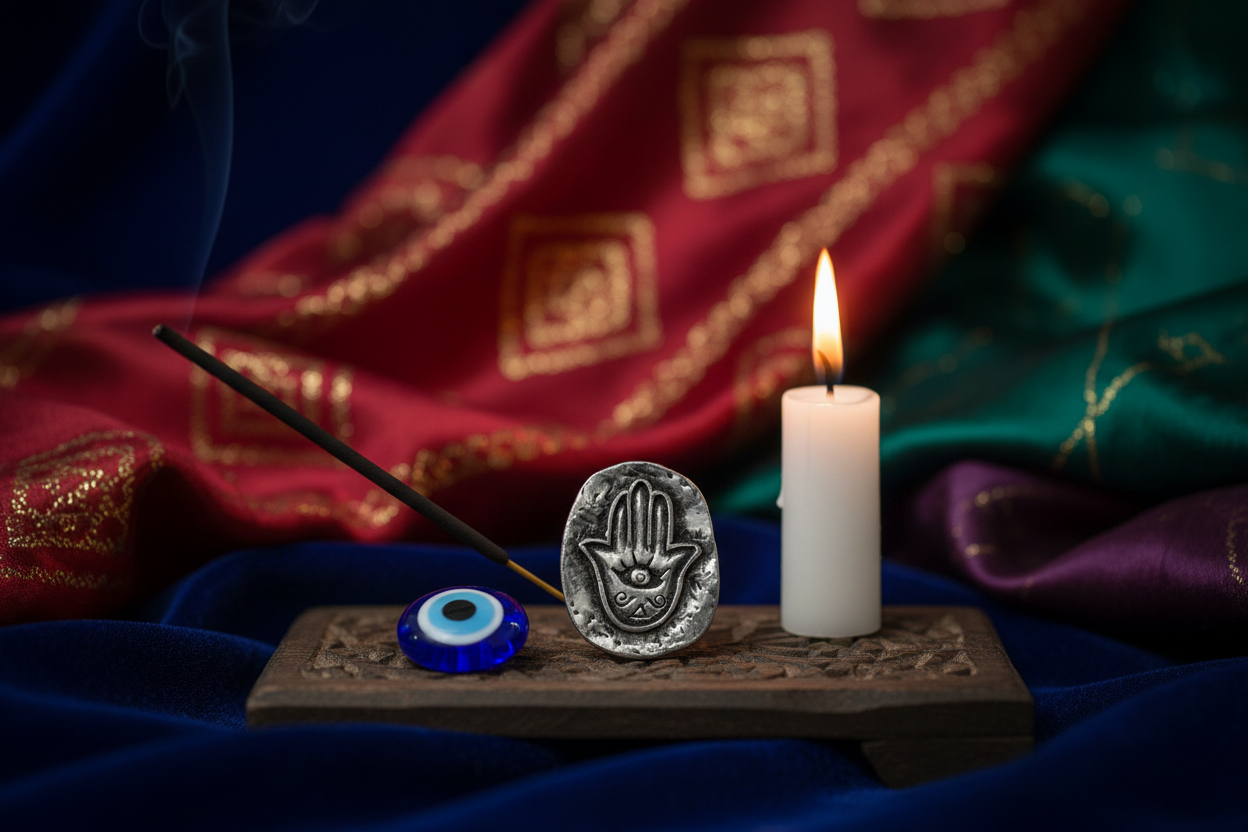
Hamsa Pewter Pocket Stone, 1" x 5/8"
Hamsa Pewter Pocket Stone, 1" x 5/8"- Primary Spiritual Use: Protection
- Secondary Spiritual Use: Banishing
- Element: Water
- Planet: Jupiter
- Zodiac: Sagittarius, Pisces
- Chakra: Third Eye
- Ruling Day: Thursday
- Tradition: Mediterranean folk
- Intent: Protection, Banishing
Couldn't load pickup availability
The hamsa is one of the few symbols that genuinely belongs to several religions at once. Jewish tradition calls it the Hand of Miriam, after the sister of Moses and Aaron. Islamic tradition calls it the Hand of Fatima, after the daughter of the Prophet Muhammad. Levantine Christians have called it the Hand of Mary. Older still, the symbol traces back through Berber and Amazigh North African tradition and Phoenician Carthage, where it appeared as the Hand of Tanit. The same five-fingered hand, often with an eye in the center, has been read as protection against the evil eye across every culture along the Mediterranean and into Western Asia for at least three thousand years. This pewter pocket stone gives you that symbol in a form sized for daily carry: one inch by 5/8 inch, smooth on every edge, ready for a pocket, a palm, or a corner of the altar.
Key Features
- Pewter cast with the hamsa hand at the face, smooth on every edge for daily handling
- 1" x 5/8", the working size for pocket, palm, or altar carry
- Lead-free pewter, made in the USA
- Tactile anchor for evil-eye work, protection rituals, and grounding moments through the day
- Sits comfortably alongside Sephardi and Mizrahi Jewish tradition, Sunni Muslim folk practice in North Africa and the Levant, Berber Amazigh tradition, and the broader Mediterranean evil-eye complex
Product Details
This pocket stone is cast from lead-free pewter in the United States. The face shows a hamsa hand cut into the metal, with the five fingers and central palm shaped so the symbol reads by touch as well as by sight. The reverse is plain. Dimensions are 1 inch tall by 5/8 inch wide, and the weight is enough that you will feel it in a shirt pocket without it being heavy enough to drag. Like all pewter, it develops a soft patina over years of handling, which most carriers consider part of its character.
Spiritual Significance
The hamsa, also written as khamsa or chamsa, takes its name from the Arabic and Hebrew word for "five," referring to the five fingers of the hand. Both languages share the root, and both traditions claim deep connection to the symbol.
In Sephardi and Mizrahi Jewish tradition, the hamsa is most often called the Hand of Miriam, after the prophetess and sister of Moses. It is widely used as a protective amulet in homes, on jewelry, and in synagogues across the Jewish Mediterranean diaspora. In Ashkenazi tradition the symbol appears less, though it has become more common in Israel where Sephardi and Mizrahi traditions are dominant.
In Sunni Muslim folk practice across Morocco, Tunisia, Algeria, Egypt, and the Levant, the same symbol is called the Hand of Fatima, after the daughter of the Prophet Muhammad. It is a standard apotropaic against al-ayn al-hāsida, the envious or covetous eye that traditional belief holds can cause harm when directed at a person, a child, or a possession.
The hamsa's roots run deeper than either Abrahamic religion. In pre-Islamic Berber and Amazigh tradition across North Africa, hand symbols appear in henna designs, textile patterns, and architectural motifs, often associated with the goddess Tanit and her older Phoenician form in Carthage. The Phoenician Hand of Tanit is one of the oldest documented uses of the hand as a protective symbol.
The eye in the center of many hamsas is its own ancient layer. The eye stares back at the envious gaze, deflecting it. The Greek mati, the Turkish and Persian nazar, the Italian malocchio, and the Arabic al-ayn all describe the same belief: that envy carries a real force, and that the right symbol can turn it aside.
Whichever lineage you carry this hamsa into, the pocket-stone form is a modern continuation of a very old practice: small, smooth, concealable, reachable, passable from hand to hand.
How To Use
There is no single right way to carry a hamsa. A few practices that map to real traditions:
In Sephardi and Mizrahi Jewish practice, the hamsa may be kept in a pocket alongside a Star of David or other protective objects, especially on a child's behalf or during travel. Some families bless the object at a home Shabbat table before it is carried.
In Muslim folk practice, the Hand of Fatima is often slipped into a child's belongings, a car visor, or a pocket before leaving the home, particularly when one is going somewhere with large crowds or where the envious gaze might find one. Some carriers say māshāʾ Allāh (an acknowledgment that all good comes from God) when admiring something beautiful, as the verbal counterpart of the symbol.
For modern Pagan, Wiccan, and eclectic practitioners, the hamsa is often used in protection workings alongside other amulets, dressed with protective oils, and carried as part of a daily warding practice. Many witches keep it in a pocket on days they anticipate dealing with envious or hostile energy.
For daily devotional carry, slip it in your pocket on the way out the door and find it again at a stoplight, in line at the grocery, in the long minutes before a difficult conversation. The thumb finds the fingers of the hand, you remember the lineage you are carrying, and you continue.
Pairs Well With
- Angel Worry Stone, Pewter Pocket Stone, a sibling pewter pocket stone for guardian-angel devotional carry
- Against Evil Eye Pocket Spellbottle, a complementary pocket-sized protection working in a different form factor
- Evil Eye: History, Mystery, & Magic by Antonio Pagliarulo, for readers who want to go deeper into the tradition behind the symbol
Frequently Asked Questions
Is this a Jewish symbol or a Muslim symbol?
Both, and neither exclusively. The same five-fingered hand symbol exists in Sephardi and Mizrahi Jewish tradition as the Hand of Miriam, in Sunni Muslim tradition as the Hand of Fatima, in Levantine Christian use as the Hand of Mary, and in pre-Abrahamic Berber and Phoenician tradition as a goddess-hand symbol. It belongs to a region (the wider Mediterranean and Middle East) more than to any single faith.
What is the difference between this and the Angel, Buddha, Cross, and Goddess pewter pocket stones?
They are all the same form factor, 1" x 5/8" lead-free pewter, with different symbols cut into the face. The Angel reads as guardian-angel devotional carry. The Buddha Coin reads as Buddhist mindfulness. The Cross reads as Catholic folk devotion and Hoodoo protection work. The Goddess reads as Wiccan and Pagan divine-feminine devotion. The Hamsa is the one that anchors to the Mediterranean and Middle Eastern evil-eye protection complex, with strong roots in Jewish, Muslim, and Berber traditions.
Should I carry a hamsa if it isn't from my culture?
Cultural sensitivity around the hamsa is a real and ongoing conversation. The symbol has spread widely as a general protection symbol in Western spiritual and fashion contexts, and some practitioners from Jewish, Muslim, and Berber communities have voiced reasonable concerns about that spread. A common middle path is to carry the hamsa with knowledge of its source traditions, to support businesses and artisans from those communities when possible, and to be honest about your own relationship to the symbol.
Will it tarnish?
Pewter develops a soft gray patina over years of handling, which most carriers consider part of its character. If you want to keep the surface bright, an occasional polish with a soft cloth is enough. Do not use silver polish, which is too harsh for pewter.
Is the pewter safe to handle?
Yes. The stone is cast in lead-free pewter, so daily skin contact is fine.


Spend $50 & enjoy guilt-free shopping with our free shipping on all orders. Get your favorite items delivered right to your door at no extra cost.