



Plentiful Earth | Spiritual Store
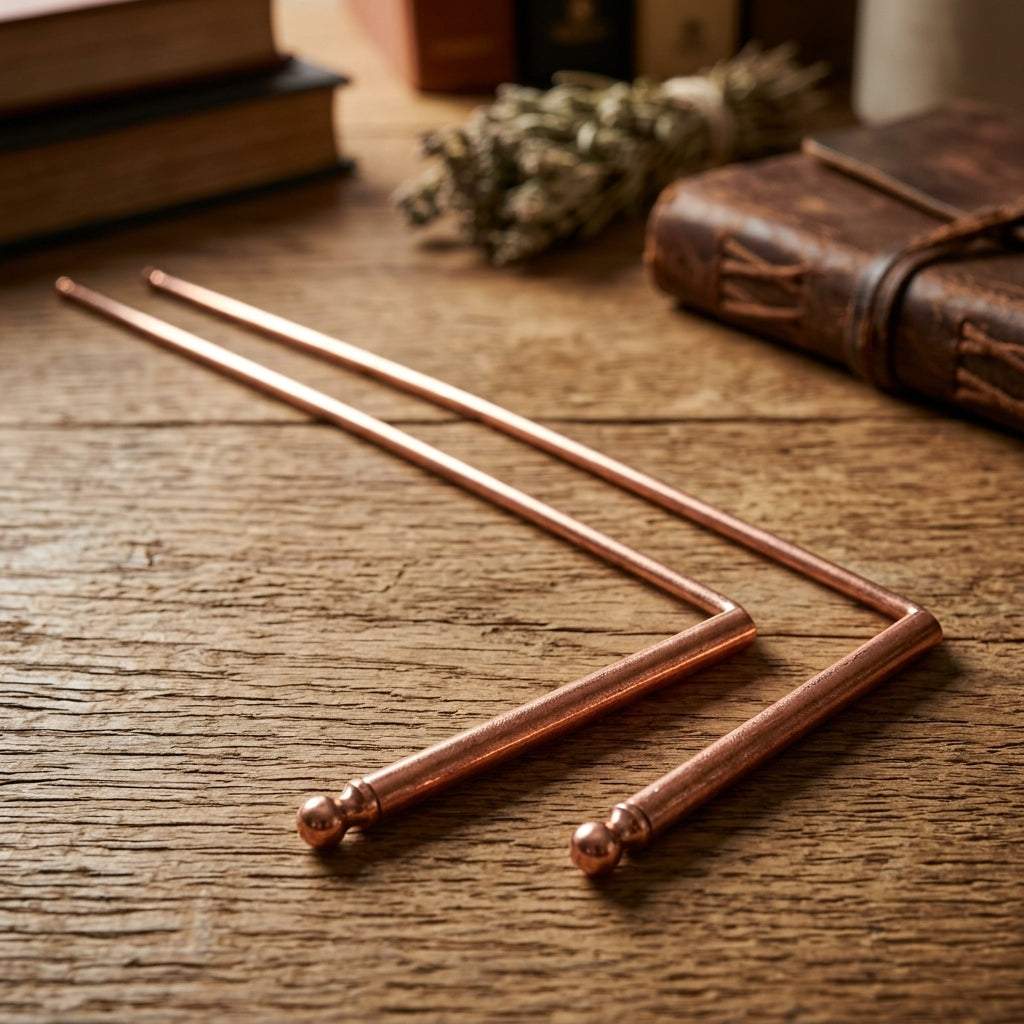
Copper Dowsing Rods Set, 9¼" × 4½"
Copper Dowsing Rods Set, 9¼" × 4½"- Primary Spiritual Use: Psychic
- Secondary Spiritual Use: Intuition
- Element: Water
- Planet: Venus
- Zodiac: Taurus, Libra
- Chakra: Third Eye
- Ruling Day: Friday
- Tradition: European folk magic
- Intent: Divination, Intuition, Psychic
Couldn't load pickup availability
Works Well With


Every tradition that has worked seriously with energy has needed ways to make the invisible visible. The pendulum speaks through rotation and stillness. The tarot speaks through pattern and symbol. Dowsing rods speak through movement, a language that bypasses the analytical mind entirely and communicates through the body's own sensitivity to subtle fields. In the hands of a relaxed, receptive practitioner, a pair of copper L-rods becomes one of the most immediate and readable divination instruments available.
This set of two copper dowsing rods, each measuring 9¼" with a 4½" handle, is the classic L-rod format that has been in use for centuries. Each handle is a copper sleeve that the rod turns inside, so you hold the sleeve and the long arm swings freely. When you walk over or move toward a target, or when you ask a question and the appropriate condition is met, the rods respond: they may cross, open apart, spin, or point. What exactly they indicate is something you calibrate through practice and a clear protocol, but the physical feedback they give is immediate and unmistakable.
Copper is the traditional material for dowsing rods in the modern divination and energy-work community, prized for its reputation as a conductor of subtle energy and its long magical association with the planet Venus, with receptivity, and with amplification. These rods are not just practical tools; they are objects of genuine tradition, and working with them will connect you to a practice with documented roots going back at least to the 16th century and arguably much further.
Dowsing rods have enjoyed a surge of mainstream interest recently, appearing as divination tools in Netflix's Battle of Fates, a fate-reading competition, and paranormal investigation shows alike, a reminder that the impulse to read subtle energy through a physical instrument is genuinely universal.
Key Features
L-rod format: the most versatile and body-responsive dowsing configuration. The L-shaped divining rod is distinct from the Y-rod used in traditional water-witching: both hands hold separate rods, each free to swing independently on its vertical axis. This allows them to cross toward each other, open away from each other, or swing in the same direction, giving you a full range of responsive movement. Beginners consistently find L-rods more legible than Y-rods because the movement is larger and easier to read.
Copper construction: the practitioner's traditional choice for energy sensitivity. Copper's conductivity is cited consistently across the modern dowsing and energy work community as the reason for its popularity in divining rods. Its Venus and Water correspondences in the Western magical tradition add an additional layer of appropriateness for intuitive and receptive work. This is a natural conductor for both electrical current and the subtle field awareness that dowsing appears to tap.
Set of two at the correct working dimensions. Dowsing with L-rods always requires a matched pair; the interaction between both rods, held at the same angle and at the same height, is what produces the crossing and opening responses. At 9¼" × 4½", these rods are sized for responsive, sensitive movement, long enough to swing clearly and short enough to carry easily and control confidently.
Product Details
- Set includes: 2 copper L-shaped dowsing rods
- Total rod length: 9¼" (approximately 23.5cm)
- Handle length: 4½" (approximately 11.4cm); the short arm of the L, held in the fist
- Material: Copper
- Style: Free-swing L-rod with bearing sleeves
The Spiritual Significance
In the New Age and eclectic spiritual traditions that use dowsing as an energy detection tool, practitioners walk these rods around a person or a room and watch where they respond, cross, or open. Many energy workers and eclectic witches make one pass before a session and another afterward to see whether the response has shifted.
You can also use these rods for traditional dowsing and investigative divination: walking a physical space with a clear question in mind, whether about energy lines, lost objects, geopathic stress zones in a home, or a yes/no question whose answer lies in the landscape. In the geomantic practice of earth energy work and ley line detection, which has been part of British Pagan and New Age practice since the mid-20th century, pairs of L-rods are moved along paths or through properties to locate areas of heightened earth energy. Practitioners in this tradition have used copper rods specifically for this work for decades.
How To Use
Establishing baseline responses: Before asking meaningful questions, you need to know what "yes" and "no" look like with your particular rods and your particular hands. Hold one rod loosely in each fist with the long arm pointing forward, parallel to the ground. Relax your shoulders, soften your grip, and ask aloud: "Show me yes." Observe how the rods move. Then ask "Show me no." The responses will be consistent for you; they may differ from another practitioner's. Do not grip the rods tightly, and do not try to hold them still; your relaxed hands allow the micro-movements that translate to visible rod swings.
Walking a space for energy detection: Move slowly and deliberately through a room, a garden, or across land with a clear intention: you are looking for a specific thing (an underground water line, a zone of high earth energy, a spot where the energy feels heavy or stuck). State your target aloud or hold it clearly in mind. Walk in systematic passes rather than wandering. Note where the rods respond and whether the response is consistent across multiple passes.
Yes/no divination: Stand still, establish your baseline, and ask clear yes/no questions. Hold the target question steady in your mind without trying to influence the outcome; the receptive, open mental state is the one that produces reliable readings. Many practitioners find it helpful to ground themselves before each session by breathing slowly and feeling their feet on the floor.
Aura and energy field scanning: Move the rods around a person or object at a distance of one to two feet, observing where the rods pull inward toward the body or open outward, and noting any places where the response is unusually strong or absent. Treat what you see as an observation to record in your journal.
Locating lost objects or underground features: Walk a grid pattern over the area with a clear mental image of what you are seeking. When the rods respond, mark the location and cross-check by approaching from a different angle. Confirmation requires the rods to respond at the same point from multiple directions.
Your dowsing practice will develop its own language and consistency over time. Keep a record of your sessions and what you find; calibration is built through accumulated experience, not intuition alone.
Pairs Well With
Rainbow Moonstone Pendulum: Keep a pendulum alongside your dowsing rods as a complementary divination tool; while the rods are excellent for walking a space or scanning an energy field, the pendulum is more suited for static yes/no questions and confirmation at a fixed point.
Divination & Psychic Abilities Collection: Explore the full range of divination tools at Plentiful Earth, including tarot cards, rune sets, pendulums, and scrying tools, any of which can be used alongside your dowsing practice as part of a complete intuitive toolkit.
Crystal Balls Collection: Use a crystal ball for scrying before a dowsing session to orient your intentions and clarify what you are seeking; crystal ball work and dowsing engage different modes of receptive perception and can reinforce each other.
Copper Heavy Necklace: Wear this copper necklace during dowsing sessions to extend copper's energetic conductivity to your body as well as your hands, creating a more complete copper energy circuit throughout your practice.
History & Occult Background
Dowsing, also called divining, water-witching, or radiesthesia, is among the most widely documented and geographically widespread practical folk traditions in human history. Its use for locating underground water is attested across Europe, the Middle East, Asia, and the Americas. The earliest clearly dated European reference comes from the 1550 edition of Sebastian Münster's Cosmographia, which shows a woodcut of a dowser with a forked rod walking over a mining operation. By 1556, Georgius Agricola's De Re Metallica, a landmark work on mining and metallurgy, included a detailed discussion of dowsing for metal ore and noted that the practice was already sufficiently established to be the subject of serious debate among miners.
The L-rod format used in these dowsing rods represents one of three classical dowsing tool configurations, alongside the Y-shaped forked rod (most associated with water-witching in European folk tradition) and the pendulum. The L-rod, held in both hands with the long arm free to swing horizontally, became particularly popular in the 20th century because it is easier to read than the subtle flexion of the Y-rod and more physically active than the pendulum's smaller movements. Each rod responds independently, allowing the practitioner to read crossing (when both rods swing inward toward each other), opening (when they swing apart), and directional pointing as distinct responses.
Copper has been the preferred metal for dowsing rods in the modern divination and New Age community since at least the mid-20th century. Practitioners cite copper's electrical conductivity and its traditional magical associations: copper corresponds to Venus and the element of Water, both associated with receptivity, intuition, and the subtle flow of energy. While the scientific mechanism of dowsing remains unexplained and its efficacy for locating physical objects is not supported by controlled scientific studies, the subjective experience of practitioners across centuries has consistently described the rods as responding to intention and subtle sensitivity in ways that feel genuine and useful. The ideomotor effect, a well-documented psychological phenomenon in which unconscious micro-movements produce observable physical action, is the most commonly offered scientific explanation.
In 20th-century British and Western European earth energy traditions, including the practices of ley line hunters and geomancers working in the lineage of Alfred Watkins's 1921 The Old Straight Track and the subsequent earth mysteries movement, copper L-rods became a standard tool for walking landscapes to detect zones of heightened earth energy, crossing underground water lines, and mapping the energy geography of sacred sites. This tradition, while relatively recent, drew on the much older folk practice of dowsing and gave it a specifically spiritual and ecological framing that remains active in modern Pagan and New Age practice.
Frequently Asked Questions
How do I hold these rods correctly? Hold the short arm (4½" handle) loosely inside your closed fist, with the long arm pointing forward, parallel to the ground. Your grip should be relaxed enough that the rod can swing freely on the axis of the handle. Imagine your fist is a loose tube rather than a clamp. Many beginners grip too tightly; if the rods are not moving at all, loosen your hands. These rods have sleeve handles: hold the sleeve, and the rod turns freely inside it.
Are dowsing rods scientifically proven to work? Controlled scientific studies, including those conducted under blinded conditions, have not demonstrated that dowsing rods reliably locate water or other targets at better than chance rates. The prevailing scientific explanation for rod movement is the ideomotor effect: unconscious micro-movements of the hands, driven by expectation or subtle sensory input, produce the visible swinging response. Many practitioners work with this understanding rather than against it, finding that the rods' movements are a useful way of making subconscious knowledge visible, regardless of whether the rods themselves are detecting anything independently.
What is the difference between L-rods and a Y-rod for dowsing? The Y-rod, or forked rod, is the tool most associated with traditional water-witching in European folk tradition. It is held with both hands gripping the two arms of the Y, which creates tension, and the stem of the Y dips when the practitioner is over the target. L-rods are more modern in widespread use, each rod held independently, and they provide a wider, more legible range of responses through crossing, opening, and pointing. Most beginners find L-rods easier to read; experienced dowsers often use both depending on the application.
Can I use these rods indoors as well as outdoors? Yes. L-rods are used both indoors for scanning rooms, floors, and energy fields, and outdoors for walking land, detecting water lines, and locating buried features. For indoor use, work in a space where you can walk freely, keeping the rods at a consistent height and angle throughout each pass.
How do I cleanse these rods before first use or between sessions? Pass them through incense smoke, ring a bell over them, or leave them on a dry windowsill in moonlight. Skip salt and water: salt pits copper and water speeds tarnish. Many practitioners also hold the rods between their palms and state what they are for before each session. Our guide to cleaning and caring for copper covers polishing and storage.
Can beginners use these effectively? Yes, though it requires patience in the early stages. The key is developing a consistent, calibrated personal protocol: knowing what your "yes" and "no" look like with these specific rods in your specific hands. That calibration is built through practice sessions with questions whose answers you already know, so you can confirm your rod responses before working on genuinely unknown questions.


Spend $50 & enjoy guilt-free shopping with our free shipping on all orders. Get your favorite items delivered right to your door at no extra cost.