



Celtic Spirit Oracle: Ancient wisdom from the Elementals by Nicola McIntosh
Celtic Spirit Oracle: Ancient wisdom from the Elementals by Nicola McIntoshCouldn't load pickup availability
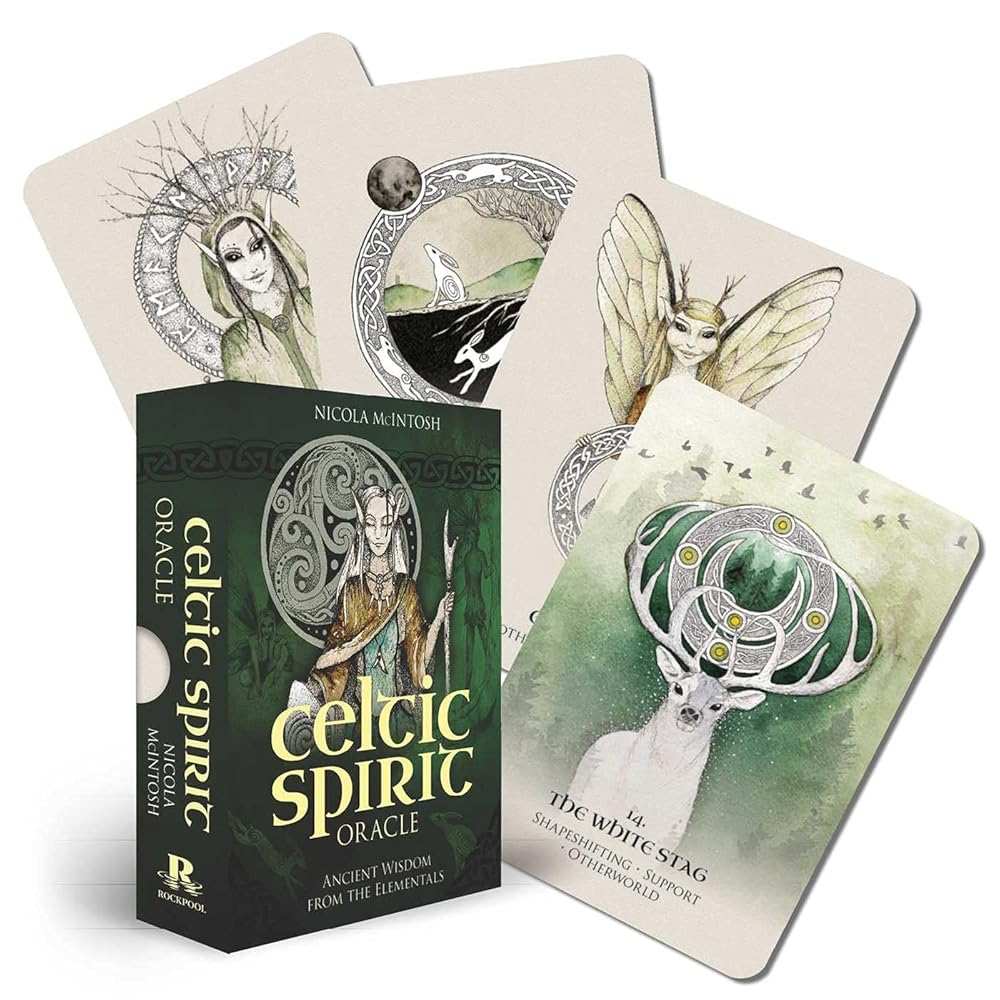
The Elemental beings, Celtic gods and goddesses represent the energies that work through this deck, and their messages at times are so subtle - like a whisper that gets lost in our noisy way of life. Some people are able to hear their messages if they slow down enough to listen.
This oracle is born from artist/author Nicola McIntosh's Celtic shamanic work and her Celtic lineage. The Celts had a deep understanding of nature's cycles and the importance of working with nature and its Elemental beings, which is evident in their artwork, myths and legends.
Are you ready to hear the ancient wisdom from the Otherworlds? The Elemental's remind you that everything you need is inside you, you only need to be still and listen.
Magick awaits you within!
Key Features
Rooted in the author's own Celtic lineage and shamanic practice. This is not a deck assembled from secondary research. Nicola McIntosh is a Celtic shamanic practitioner with family lineage from Scotland, England, and Ireland who has traveled to those lands and worked with their energies directly. The deck's imagery and guidance come from that living relationship, which gives it a quality of authenticity and personal transmission that is harder to find in more commercially assembled decks.
Full-color art with gilded card edges. The 36 cards are fully illustrated in rich, nature-saturated color, and the gold gilt edges give the physical deck a beautiful, ceremonial quality that honors the sacred nature of the work. The smaller 36-card count means each card can carry real weight and specificity rather than spreading meanings thin across a larger set.
112-page guidebook with three Celtic spreads. Beyond individual card meanings, the guidebook includes three spreads designed specifically for this deck's Celtic framework, making it genuinely useful for structured readings rather than just single-card pulls. The spreads support seasonal practice, deeper self-inquiry, and connection with the Elemental realms the deck is built around.
Product Details
- Cards: 36 (full-color, gilded edges)
- Companion guidebook: 112 pages, softcover, full color
- Box dimensions: 4" x 5.5" x 1" (approximately 10 x 14 x 2.5 cm)
- Card size: approximately 5" x 3.5"
- Publisher: Rockpool Publishing
- Author and artist: Nicola McIntosh
- ISBN-13: 978-1-925946-45-1
- Language: English
- Author based in: Tamborine Mountain, Queensland, Australia
The Spiritual Significance
The Celtic shamanic tradition from which this deck emerges holds that the world is animated by living intelligence: that the land, the waters, the trees, the animals, and the atmospheric forces are not simply matter but presences with whom human beings can enter into relationship. The Otherworld of Celtic myth, the realm from which the Tuatha Dé Danann and the Sidhe are said to operate, is not understood as a distant heaven but as a dimension interpenetrating this one, accessible through stillness, ritual, and attunement. You can use this oracle as a tool for that attunement, drawing a card before entering a natural space, beginning a meditation, or opening a seasonal celebration to ask which Elemental or divine energy is present and wishes to communicate.
The deck also carries the four elements explicitly: earth, air, fire, and water as the cornerstones of Celtic magical cosmology, each associated with specific beings, deities, and directions. Working with this deck in relationship to the four cardinal directions on your altar, placing cards at each quarter to represent the Elemental energies present in a working, is one way to extend its use from personal divination into full ritual practice. The guidelines for which cards carry which elemental association are in the companion guidebook, making this accessible even without prior knowledge of the system.
How To Use
Before drawing, take time to genuinely settle. McIntosh's guidance in the booklet emphasizes that the messages of the Elementals are subtle and can only be received in stillness. A few minutes of conscious breathing, placing your hands on the earth (or imagining it beneath you), or sitting in silence outside before beginning a reading all create the right quality of receptivity.
Draw a single card for daily reflection or morning orientation, asking which energy or being wants to be with you today. Sit with the image before reading the guidebook entry; let what arises from the art itself be your first data point. Then read the meaning and allow the two to inform each other.
For deeper readings, the three Celtic spreads in the guidebook give you structured frameworks. One approach McIntosh describes aligns the spread positions with the three realms of Celtic cosmology: the Underworld, the Middle World, and the Upper World. The positions ask about what is beneath the surface, what is present in waking life, and what guidance comes from the higher Elemental or divine dimensions.
The deck is especially powerful when used in relationship with the Celtic seasonal calendar. Pulling cards at each of the eight Sabbaths, particularly Samhain, Imbolc, Beltane, and Lughnasadh, and journaling on what each card reveals about the themes of that turning, builds a rich layered relationship with the deck across the year.
After your reading, close intentionally: a brief acknowledgment to the beings that came forward, a moment of gratitude, and a return to ordinary consciousness. Treat the cards with care. Many practitioners keep their deck wrapped in natural cloth, near a plant or stone, honoring the living nature of the energies it carries.
History & Occult Background
Celtic shamanism as a recognized practice emerged in part from a revival and reconstruction of pre-Christian Celtic spiritual practices beginning in the 20th century, drawing on archaeology, mythology, medieval Irish and Welsh manuscripts, and the ongoing living traditions of Celtic cultures. Figures like the Tuatha Dé Danann appear throughout Irish mythological cycles as divine or semi-divine beings associated with skill, sovereignty, wisdom, and the forces of nature. Cerridwen, one of the figures appearing in this deck, is a Welsh goddess associated with transformation, inspiration, and the cauldron of rebirth from the Mabinogi tradition. Cernunnos, the antlered figure of Gaulish iconography, is associated with wild animals, fertility, and the liminal boundary between worlds.
The Otherworld as a spiritual destination or source of wisdom appears across Irish, Welsh, and broader Celtic mythological literature: Tír na nÓg, Mag Mell, Annwn. These are not identical concepts but share the quality of being realms contiguous with this one, accessible through certain practices, locations, or states of consciousness. The oracle deck as a format is relatively modern, but McIntosh has used it as a vehicle for bringing these ancient voices into a form accessible to contemporary practitioners.
Celtic herbalism is also present in this deck's background: McIntosh is a credentialed Western and Chinese herbalist whose relationship with plant spirits and the living intelligence of the natural world is inseparable from her spiritual practice. That integration of plant knowledge and shamanic work gives the deck a quality of earthy, grounded spiritual relationship rather than the purely abstract or intellectual engagement with Celtic mythology that some decks carry.
Pairs Well With
- Sacred Circle Celtic Pagan Journey Tarot by Franklin & Mason — The Sacred Circle Tarot draws on the sacred sites and Pagan heritage of Britain and Ireland for its imagery and structure. Using it alongside the Celtic Spirit Oracle gives you two complementary Celtic-rooted tools: the oracle for Elemental and divine guidance, the tarot for narrative depth and the full range of human experience through a Celtic lens.
- Hedgewitch Botanical Oracle by Siolo Thompson — McIntosh's deep herbalism background and her view of the natural world as a living teacher makes this plant-based oracle a natural companion. When the Celtic Spirit Oracle speaks to you of an Elemental energy, drawing a botanical oracle card to ask what plant ally supports that energy can add a practical, embodied dimension to the reading.
- White Sage Kit — Opening a reading space with smoke cleansing is a natural precursor to this kind of work. The kit includes an abalone shell, cobra stand, feather, and sage bundle: everything you need to mark the ritual opening of a session with the Celtic Spirit Oracle and signal to yourself and the Elementals that you are genuinely entering sacred time.
- Malachite Pendulum — Malachite is associated with heart-centered transformation, truth-seeing, and connection to the green world of nature, all qualities that resonate directly with the earthy, plant-woven dimension of this deck. A pendulum is a useful complement when a card raises a direct yes-or-no question, allowing the inquiry to deepen without breaking the contemplative quality of the session.
- Amethyst Pendulum — Amethyst is the stone of psychic awareness, spiritual connection, and the thinning of the veil: qualities directly relevant to working with Otherworld beings and Celtic Elemental intelligences. Holding an amethyst during meditation with a card, or placing one nearby during your reading, supports the receptive, intuitive state this deck asks of you.
Frequently Asked Questions
Do I need to know Celtic mythology to use this deck? No, the 112-page guidebook provides all the context you need for each card, including who the beings are and what their messages mean. That said, deeper engagement with Celtic mythology will enrich your experience over time, and the guidebook may itself inspire that further exploration.
Is this deck appropriate for complete beginners to oracle work? Yes. The 36-card count makes it more approachable than larger decks, and the guidebook is written to be genuinely helpful rather than assumed knowledge. McIntosh emphasizes intuition and stillness over technical skill, which makes the deck accessible from the very first draw.
What tradition does this deck represent? The deck comes from Celtic shamanism as practiced by Nicola McIntosh, drawing on Irish, Welsh, and broadly Celtic mythological and spiritual traditions. It is not Wiccan, though it would integrate naturally into a Wiccan or Pagan practice. It is most accurately described as a Celtic shamanic oracle with a nature-based, Elemental focus.
Who are the main figures in the deck? The cards feature Elemental beings and Celtic deities including Cerridwen, Brigid, Cernunnos, and figures from the Otherworld traditions of the Tuatha Dé Danann, alongside other nature spirits, Elemental energies, and sacred forces from McIntosh's personal shamanic practice.
Can this deck be used for everyday questions, or is it primarily spiritual? It can be used for both, though its messages tend toward wisdom, guidance, and spiritual orientation rather than practical life prediction. It asks you to look at the energetic and inner dimension of what you're experiencing. For very practical matters, pairing it with a tarot deck may give you better traction.
How many cards are in the deck? 36 cards, all full-color with gilded edges. The smaller card count is intentional: each card carries real depth and specificity rather than spreading meaning thin.
Is the guidebook included? Yes. Every set includes the 112-page full-color companion guidebook with individual card meanings and three Celtic reading spreads.
Spend $50 & enjoy guilt-free shopping with our free shipping on all orders. Get your favorite items delivered right to your door at no extra cost.