



Plentiful Earth | Spiritual Store
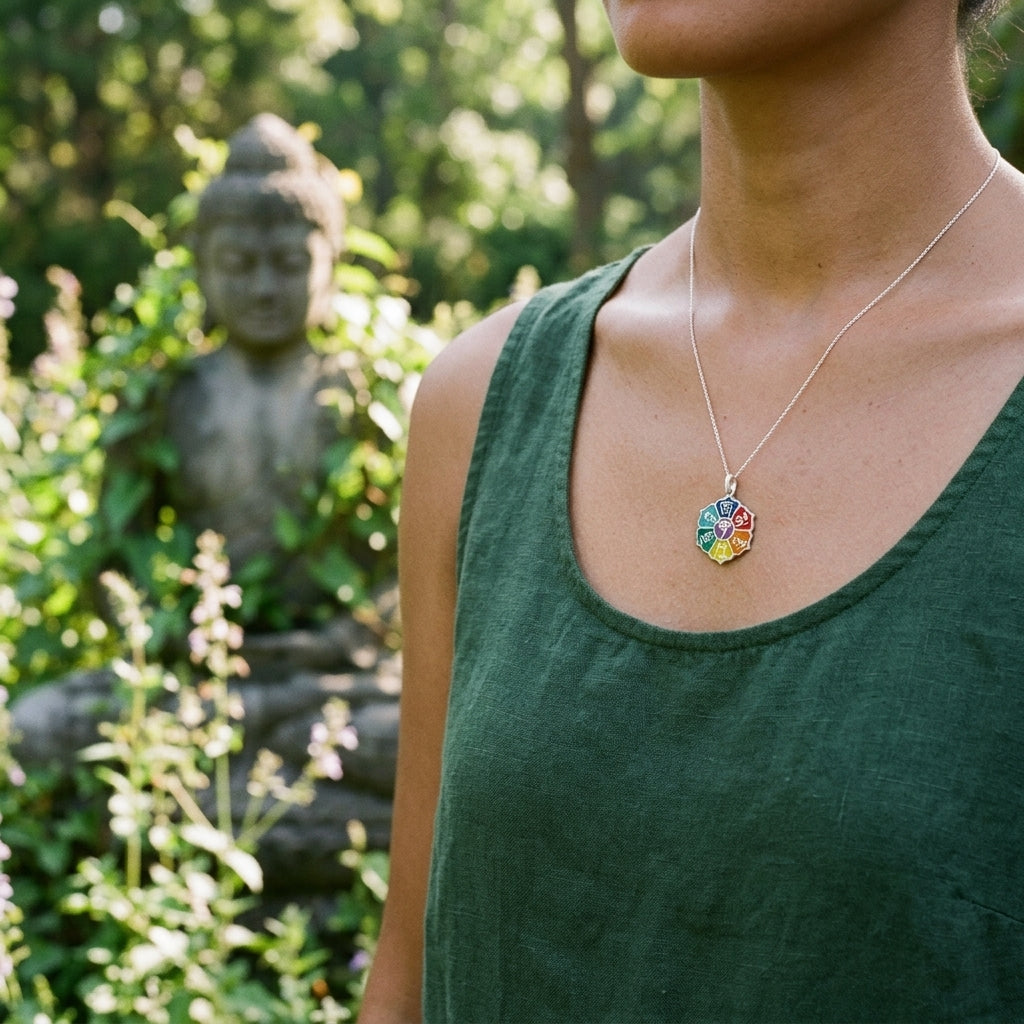
Om Mani Padme Hum Lotus Pendant, 1¼ Inches
Om Mani Padme Hum Lotus Pendant, 1¼ InchesCouldn't load pickup availability
-
Ships In 1-2 Days
-
180 Day Returns
-
Trusted By 1,000+ Spiritualists
Om Mani Padme Hum is the most widely recited mantra in Tibetan Buddhism. It is the mantra of Avalokiteshvara (Chenrezig in Tibetan), the bodhisattva of compassion: the being who hears the cries of the world and responds with limitless care. The six syllables are understood to contain the entirety of the Dharma: OM purifies pride and bliss; MA purifies jealousy; NI purifies desire and passion; PAD purifies ignorance; ME purifies greed; HUM purifies hatred and anger. In the Tibetan tradition, carving or inscribing the mantra on stones, wheels, flags, and jewelry ensures that it radiates its blessing continuously, in every direction, to all beings.
The lotus, paired with this mantra on this 1¼-inch silver-toned pendant, carries its own rich symbolic weight. The lotus rises from muddy water to bloom pure and unblemished at the surface: the classic Buddhist image of the soul's potential to attain enlightenment despite arising from suffering and confusion. Together, the lotus and the mantra of compassion form a pendant that is simultaneously a symbol, a prayer, a reminder, and a small radiating beacon of intention wherever it is worn.
Key Features
A mantra of compassion combined with the lotus of enlightenment. These two symbols reinforce each other: the mantra works moment by moment through recitation and presence; the lotus holds the larger arc of spiritual development over a lifetime. Wearing them together orients both the immediate moment (return to compassion, return to presence) and the longer journey (growth through difficulty toward awakening).
1¼-inch pendant for daily wear. At 1¼ inches, this pendant is present without being heavy: visible, tactile, appropriate for daily wear in most settings. The silver-toned hardware is clean and compatible with other jewelry and everyday clothing.
Appropriate for practitioners across multiple paths. While the mantra and lotus are rooted in Buddhist tradition (particularly Tibetan and Mahayana Buddhism), they are used respectfully by practitioners across spiritual paths as symbols of compassion and awakening. Many Wiccan, Hindu, and eclectic practitioners work with Buddhist mantra symbols as part of a broad contemplative practice.
Product Details
- Pendant size: 1¼ inches
- Design: Lotus wheel with Om Mani Padme Hum mantra inscription
- Finish: Silver-toned
- Wear: Daily pendant
The Spiritual Significance
In Tibetan Buddhist practice, Om Mani Padme Hum is not simply a prayer but an active practice: reciting it continuously, even silently, is understood to purify negative karma, cultivate compassion, and contribute to the liberation of all beings. Prayer wheels, mani walls (lines of stones inscribed with the mantra), and prayer flags inscribed with it are understood to broadcast the mantra's blessing with every revolution of the wheel, every reading of the stone, every flutter of the flag. Wearing the mantra on a pendant extends this principle to the body: the inscription radiates its intention continuously, throughout the day.
The lotus (Nelumbo nucifera) is one of the most pervasive sacred symbols in South and East Asian spiritual traditions. In Buddhism, it is the throne of Buddhas and bodhisattvas, representing the capacity for purity to arise from confused and suffering origins. In Hinduism, it is associated with Lakshmi, Brahma, and Vishnu, symbolizing divine beauty and spiritual power emerging from the primordial waters. The lotus wheel design on this pendant combines the lotus's central flower form with a wheel (dharmachakra) structure, which in Buddhist iconography represents the Buddha's teaching set in motion.
For practitioners who work with mantra as a contemplative technique, wearing this pendant creates a physical anchor for the practice: touching or seeing it during the day returns attention to the mantra and its intention, making the formal recitation practice continuous rather than confined to meditation sessions.
How To Use
- Wear with intention. Before putting on the pendant for the first time, hold it in both hands, take three slow breaths, and state your intention for wearing it. You might recite Om Mani Padme Hum aloud three or more times as you hold the pendant, infusing it with that resonance before it touches your body.
- Use as a mantra anchor throughout the day. When you notice the pendant during the day, let it return your attention to the mantra. You do not need to recite aloud; a mental acknowledgment of the sound and the compassion it carries is sufficient. Over time this builds a contemplative awareness that accompanies ordinary activity.
- Include in meditation. Hold the pendant during seated meditation or place it on your meditation cushion or altar as a focal object. If you work with mantra recitation, let the pendant be physically present during that practice to build its energetic association with the mantra.
- Cleanse periodically. Moonlight overnight, frankincense or sandalwood smoke, or gentle prayer and intention are all appropriate. Silver-toned metals respond well to soft cloth polishing for physical maintenance.
- Gift with intention. This pendant is a meaningful gift for practitioners who work with Buddhist symbolism, compassion practice, or any path that includes mantra or meditation. The universal aspiration it carries, compassion for all beings, makes it appropriate across many spiritual lineages.
Pairs Well With
- Metaphysical Jewelry Collection — Layer with other PE crystal and spiritual jewelry pieces; the lotus and mantra pendant pairs naturally with heart chakra stones like rose quartz.
- Sonavi 7 Chakra Incense Sticks, 25g — Burn during meditation sessions where you work with the mantra; the incense creates an aromatic boundary around the practice time.
- Fairy Dreams Stick Incense, 20 Pack — Jasmine's heart-opening, receptive quality supports compassion-oriented meditation; burn alongside mantra practice for a softened, open atmosphere.
- Tarot Cards Collection — For practitioners who use tarot as a contemplative tool, this pendant worn during reading sessions anchors the practice in compassionate awareness.
- Books & Media Collection — Deepen your engagement with the mantra and its tradition through PE's selection of meditation and Buddhist-influenced spiritual titles.
History & Occult Background
Om Mani Padme Hum (Tibetan: ཨོཾ་མ་ཎི་པདྨེ་ཧཱུྃ) appears first in Sanskrit texts associated with the Karandavyuha Sutra, an early Mahayana text, where it is attributed to Avalokiteshvara and said to contain the essence of all teachings. The Dalai Lamas have long held special association with Avalokiteshvara; the current 14th Dalai Lama, Tenzin Gyatso, has described his own practice as centered on this mantra.
In Tibetan Buddhist practice, Om Mani Padme Hum entered the culture so thoroughly that it became inseparable from the fabric of everyday life: mani stones (flat rocks inscribed with the mantra) are piled in walls along pilgrimage paths; prayer wheels packed with thousands of copies of the mantra are spun by devotees as they walk; prayer flags printed with the mantra flutter on mountain passes, spreading the mantra's blessing with every movement of the wind. This continuous broadcasting of the mantra reflects the Mahayana understanding that compassion is not a private achievement but a force that benefits all sentient beings when it is cultivated and expressed.
The lotus's presence in spiritual iconography across South and Southeast Asia predates Buddhism: lotus imagery appears in ancient Hindu texts (the Rigveda references it), in Egyptian sacred art (the blue lotus), and throughout Buddhist iconography as the throne and emblem of awakened beings. Its meaning, purity arising from the muddy water of suffering and confusion, makes it an almost universally intelligible symbol of spiritual potential.
Jewelry combining the lotus and Om Mani Padme Hum has been produced in Tibetan, Nepali, and Chinese Buddhist craft traditions for centuries, typically in silver, copper, or bronze. The contemporary silver-toned version makes this tradition accessible in a durable, everyday-wear format.
Frequently Asked Questions
Is it appropriate for non-Buddhists to wear Om Mani Padme Hum? The mantra is associated with a specific Buddhist tradition and deity, and wearing it carries a responsibility of respect for that tradition. Many practitioners from diverse spiritual paths wear it with genuine reverence and intention; others prefer to wear symbols from their own tradition. Wearing it as a fashion accessory without awareness of its meaning and context is generally considered inappropriate. With knowledge and respect, its aspiration for compassion is broadly human.
What is the meaning of "Om Mani Padme Hum"? The literal translation is debated among scholars, but a common rendering is "Hail to the jewel in the lotus." Esoterically, the six syllables are understood to contain the entire path to enlightenment and to purify the six realms of suffering. The Dalai Lama has written that the mantra cannot be translated into a simple phrase because its meaning is multidimensional: it is the compassion of Avalokiteshvara made audible.
What is the lotus wheel design on this pendant? The design combines the lotus flower with a wheel-like or circular structure that evokes the dharmachakra (Wheel of Dharma): the Buddhist symbol of the teaching set in motion. Together they represent the blossoming of wisdom and compassion within the path of the Dharma.
Can I use this pendant as a focal object during mantra recitation? Yes. Holding or wearing a physical inscription of a mantra during recitation creates a tangible anchor for the practice. Many practitioners find that having a physical form of the mantra present deepens their engagement with it, turning the pendant into a conduit between the spoken or mental recitation and the body's sensory experience of the practice.
Does this pendant come with a cord or chain? Please confirm with Plentiful Earth, as this may vary by shipment. If a cord is not included, any simple cord or chain appropriate for a 1¼-inch pendant works well.


Spend $100 & enjoy guilt-free shopping with our free shipping on all orders. Get your favorite items delivered right to your door at no extra cost.